Act I
The envelope burst open before anyone realized what had happened.
Cream-colored savings certificates, faded deposit slips, and handwritten notes fluttered across the gleaming marble floor of the private banking lobby like autumn leaves caught in a sudden gust. A pair of old glasses slid several feet away, spinning until they stopped beside a leather chair reserved for VIP clients.
Then came the sound that silenced the room.
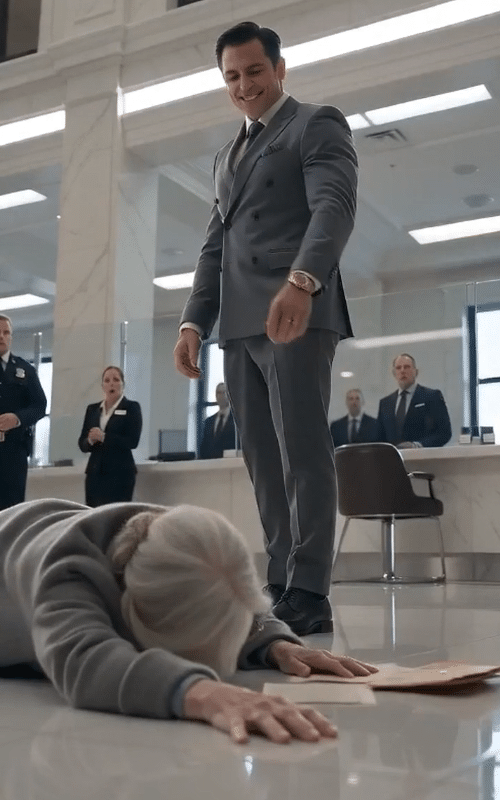
An elderly woman’s body striking polished marble.
A collective gasp rippled through the bank.
Seventy-two-year-old Evelyn Carter struggled to breathe as she lay face-down on the floor, one trembling hand pressed against her chest while the other reached desperately toward the scattered papers that represented nearly fifty years of careful saving.
She had not tripped.
She had been kicked.
Standing behind her, adjusting the cuff of his tailored gray suit as though nothing unusual had happened, was Richard Hawthorne.
Everyone in the bank knew his name.
A successful real estate developer.
One of the bank’s largest private clients.
A man whose investments stretched into the tens of millions.
A man accustomed to getting whatever he wanted.
He looked down at Evelyn with open contempt.
His gold watch glinted beneath the crystal lights.
His polished shoes remained perfectly spotless despite the violence they had just delivered.
He didn’t appear embarrassed.
He appeared annoyed.
“Move, trash,” he said loudly enough for everyone in the lobby to hear.
His voice echoed through the quiet hall.
“People like you don’t belong in a private bank.”
The words hurt more than the fall.
Several customers instinctively looked away.
Others stared without speaking.
A young teller behind the glass counter took half a step forward before her supervisor quietly shook his head.
Don’t.
The silent warning passed without a word.
No one wanted trouble with Richard Hawthorne.
Not here.
Not today.
Evelyn slowly lifted herself onto one elbow.
Pain spread through her ribs.
Her breathing became shallow.
One palm had been scraped against the marble during the fall, leaving tiny red marks that stung with every movement.
Still…
She ignored the pain.
Instead she reached for the envelope.
Not because it contained money.
Because it contained memories.
Letters.
Receipts.
Certificates.
The story of an ordinary life built one careful dollar at a time.
Richard noticed.
He smiled.
Then, with theatrical disgust, he pulled several crisp hundred-dollar bills from his wallet.
He tossed them onto the floor beside her.
The bills floated gently down until they landed across her scattered documents.
“Take this,” he sneered.
“And open a street account.”
Quiet laughter escaped one of the businessmen standing nearby.
Another quickly stopped smiling after noticing everyone else remained silent.
No one defended Evelyn.
No one knelt beside her.
The lobby suddenly felt much larger.
Much colder.
She reached past the cash without touching it.
Instead, she carefully picked up a faded savings book.
Its cover was worn smooth after decades of use.
She brushed a speck of dust from it with surprising tenderness.
Richard frowned.
“You’d rather keep that old junk than real money?”
Evelyn finally looked at him.
There was pain in her eyes.
But there was no hatred.
Only disappointment.
“My father,” she said softly, “worked thirty years in a steel mill to open this account.”
The lobby grew even quieter.
“He told me…”
She paused to steady her breathing.
“…that money should never decide whether someone deserves respect.”
Richard rolled his eyes.
“Then your father clearly never visited a place like this.”
A few uncomfortable coughs echoed across the lobby.
Still…
No one intervened.
Because everyone had already decided who mattered more.
A billionaire investor.
Or an elderly woman wearing an old wool coat.
No one in the room knew who Evelyn Carter really was.
They saw the coat before they saw the woman.
Its sleeves had been repaired twice.
One button no longer matched the others.
Her shoes were practical instead of fashionable.
The leather handbag she carried had faded after years of careful use.
She looked like someone living on a modest pension.
Someone who counted every dollar.
Someone who didn’t belong among marble floors, private advisors, and multimillion-dollar investment portfolios.
Appearances, however, had always been misleading.
Evelyn had never cared about expensive clothes.
She believed quality lasted longer than fashion.
Every coat she owned had a story.
Every dollar she saved had a purpose.
She had raised her son alone after her husband died unexpectedly when the boy was only eleven.
During the day she worked as a school secretary.
At night she balanced bookkeeping for a local hardware store.
On weekends she cleaned offices.
Every paycheck followed the same routine.
Food.
Rent.
Education.
Savings.
She taught her son that wealth meant responsibility, not privilege.
That lesson shaped his entire life.
Years later…
Long after he graduated from college with scholarships she had sacrificed everything to secure…
He would often tell reporters that the smartest financial advisor he had ever known wasn’t an economist.
It was his mother.
But Evelyn never cared about recognition.
She preferred staying invisible.
Even after her son’s career transformed the financial industry.
Even after newspapers began printing his photograph.
Even after television networks requested interviews.
She quietly continued living in the same modest neighborhood where everyone still called her Mrs. Carter.
Very few people connected her to one of the most influential names in American banking.
She preferred it that way.
Today she had come for a simple reason.
Not to ask for money.
Not to complain.
Not to seek special treatment.
Inside the envelope was a handwritten letter she intended to deliver personally.
It marked the fiftieth anniversary of the small savings account her late husband had opened.
She wanted to close it.
Not because she needed the funds.
Because she wanted every dollar transferred into a scholarship for children whose parents could never afford college.
It was meant to be a quiet surprise.
A private act of gratitude.
Instead…
She found herself lying on a marble floor while strangers judged her worth by the fabric of her coat.
Richard crossed his arms impatiently.
“Security,” he called.
“Remove her before real clients start arriving.”
One guard hesitated.
Something about the elderly woman’s calm dignity made the order feel wrong.
Before he could move…
A heavy door at the end of the VIP corridor opened.
Every employee turned instinctively.
Senior executives stepped aside.
Their expressions changed instantly.
Richard’s confident smile began to fade.
Because the man emerging from the private executive suite was not scheduled to appear in the lobby that morning.
He was the president of the bank.
And the first thing he saw…
Was an elderly woman on the floor, gathering scattered savings papers with trembling hands while hundred-dollar bills lay discarded beside them.