Act I
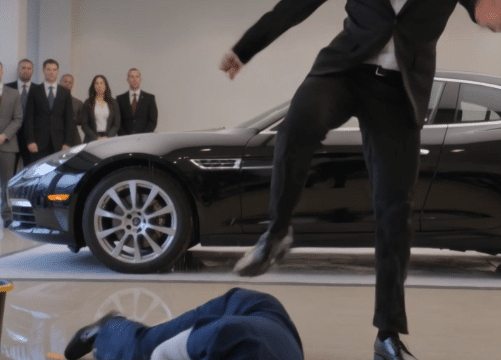
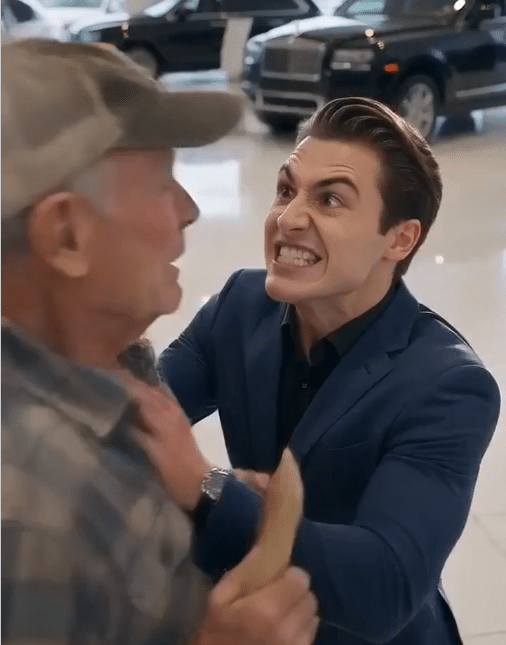
The deposit envelope burst open the moment the old man crashed onto the gleaming showroom floor.
A receipt fluttered beneath the tire of a brand-new luxury SUV. Crisp purchase papers scattered across the white tiles, and his faded cap rolled several feet away before stopping at the polished shoes of a waiting customer.
The salesman never offered a hand.
Instead, he stood over the sixty-seven-year-old farmer with a smug grin that seemed to grow wider as every eye in the dealership turned toward the scene.
“Get out, trash,” he sneered. “People like you can’t even afford the tires.”
The words echoed through the silent showroom.
Finance officers froze behind their glass desks. Receptionists exchanged nervous glances. Even several wealthy buyers stopped discussing six-figure vehicles to watch an elderly man struggle to push himself upright.
His weathered hands shook.
Years of working under the blazing sun had left deep lines across his skin, but there was still strength in those hands. They had built fences, repaired tractors, harvested crops, and raised a family from almost nothing.
Now they trembled simply trying to retrieve a torn envelope.
A faint streak of blood appeared at the corner of his mouth where the punch had landed. His cheek reddened almost immediately, yet he never raised his voice.
He simply reached for the deposit receipt.
The salesman laughed.
“You actually came here to buy something?”
A few uncomfortable chuckles escaped from nearby customers.
To everyone who didn’t know him, the old man looked exactly like someone who had wandered into the wrong place. His faded flannel shirt carried traces of dust from the farm. His boots were scuffed from years of honest labor. His truck, parked outside, was older than some of the employees working inside.
Nothing about him looked wealthy.
And that was enough for the salesman to decide exactly how much respect he deserved.
The old farmer slowly lifted his eyes.
There was hurt in them.
There was disappointment.
But there wasn’t a trace of shame.
As though he had spent an entire lifetime learning that another person’s opinion could never define his worth.
That calm expression irritated the salesman even more.
He stepped closer.
“If you want free coffee, try the gas station across the street.”
No one laughed this time.
Because a heavy office door had just slammed open.
Someone had heard the commotion.
And within seconds, the entire showroom would discover that the oldest man in the room wasn’t there by accident.
The salesman thought he’d just chased away another poor customer.
Act II
Harold Bennett had never cared much about appearances.
He believed a man’s character was measured by how he treated people after the cameras disappeared, not by the truck he drove or the watch on his wrist.
Forty years earlier, he had owned nothing except eighty acres of stubborn farmland that barely produced enough to feed his wife and young son.
Neighbors often wondered why Harold worked so hard when the profits were so small.
He always gave the same answer.
“I’m not building a farm.”
“I’m building a future.”
His son, Ethan, grew up watching those weathered hands fix broken machinery late into the night, then wake before sunrise to start again.
When Ethan announced he wanted to open a small used-car lot instead of taking over the farm, Harold never complained.
Instead, he mortgaged part of the family land.
He sold two tractors.
He even postponed repairing his own farmhouse roof.
Everything he had spent decades building became the seed money for his son’s first dealership.
Harold never asked for ownership.
Never demanded repayment.
Never reminded Ethan what he’d sacrificed.
His only condition was simple.
“If your business ever becomes successful, remember that every customer is someone’s father.”
Ethan never forgot those words.
Twenty years later, Bennett Luxury Motors had grown into one of the most respected dealerships in the region.
The glass showroom, premium vehicles, and exclusive customer lounge impressed nearly everyone who walked through the doors.
But Ethan insisted on preserving one family tradition.
Whenever Harold decided it was finally time to replace his aging pickup truck, he would become the first customer allowed to purchase every flagship model that entered the showroom.
Not because of favoritism.
Because Ethan wanted every employee to remember the man who had made the entire business possible.
The appointment had been scheduled weeks in advance.
Management had received detailed instructions.
The finance department had already prepared the paperwork.
A personalized plaque was waiting inside Ethan’s office.
The elderly farmer arriving in dusty boots wasn’t an inconvenience.
He was the guest of honor.
Unfortunately, one newly hired salesman had ignored every internal memo.
To him, expensive suits mattered more than honest hands.
He judged customers before hearing a single word.
And the greatest sale of his career had just become the biggest mistake of his life.
Still standing over Harold, the salesman nudged the torn deposit envelope with the tip of his polished shoe.
“Come back when you can afford a bicycle.”
No one answered.
Because the owner of the dealership was already running across the showroom toward the injured old man.
And the look on his face made every employee’s stomach drop.