Act I
The bus had barely finished lowering its step when impatience turned into cruelty.
The downtown stop was crowded with commuters eager to get home. The bus doors opened with a familiar hiss, and passengers began filing out one by one.
Near the front stood sixty-six-year-old Robert Hayes.
His movements were slow but deliberate. Wearing a faded veteran’s jacket and leaning carefully on a pair of crutches, he positioned one crutch onto the first step before shifting his weight. Years earlier, injuries sustained during military service had permanently changed the way he walked.
He never asked strangers for help.
He only asked for a few extra seconds.
Behind him, a sharply dressed businessman sighed loudly.
His expensive coat, polished shoes, and impatient expression announced someone accustomed to having the world move at his pace.
Robert had almost reached the sidewalk.
Then everything happened at once.
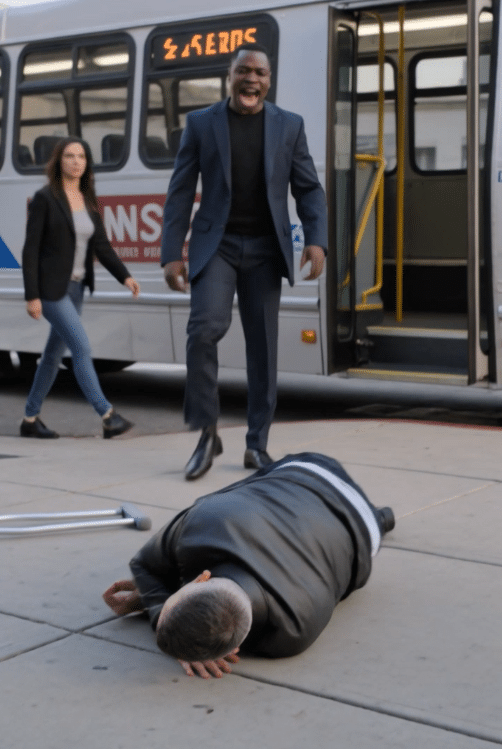
A violent kick slammed into his back.
The force hurled him off the final step. His chest struck the concrete sidewalk with a sickening thud as one crutch skidded across the curb. His elbow scraped against the pavement, leaving only a faint red mark.
The entire bus stop froze.
Passengers gasped.
Traffic seemed to pause.
The businessman stepped onto the sidewalk and glared down at the fallen veteran.
“Trash. Move faster.”
Robert remained silent.
Not because he lacked the strength to answer.
Because he had spent a lifetime refusing to let anger decide his character.
Across the intersection, however, someone had witnessed the entire assault.
Act II
Robert Hayes had once been known as the fastest man in his engineering unit.
During his years in uniform, he carried heavy equipment across impossible terrain without complaint.
Everything changed during a rescue mission that left him with permanent injuries.
The war ended.
The pain never did.
Still, Robert chose gratitude over bitterness.
He volunteered at rehabilitation centers, encouraging newly injured veterans to believe life could still hold purpose.
On this particular afternoon, he had been traveling to visit another former soldier recovering from surgery.
The man standing over him knew none of that.
His name was Charles Bennett.
To Charles, delays represented disrespect.
He believed people who slowed public life should simply stay home.
Watching Robert struggle to recover his fallen crutch irritated him even more.
He stepped forward again.
The first follow-up kick struck Robert’s back.
The veteran instinctively curled forward.
Before anyone could react, a second kick landed against his ribs.
Several passengers shouted.
The bus driver reached for the emergency radio.
Nearby pedestrians stopped in horror.
Charles pointed impatiently toward the bus.
“Don’t make everyone wait for you.”
The words echoed through the intersection.
Robert looked toward his fallen crutch lying several feet away.
Without it, standing again would be almost impossible.
He prepared himself to crawl if necessary.
Then traffic lights changed.
And fate intervened.
Act III
A line of black luxury vehicles had been waiting at the red light.
As soon as the convoy stopped, several bodyguards stepped from the lead vehicles with calm precision.
Pedestrians instinctively moved aside.
Nobody ordered them to.
Authority has a way of announcing itself without words.
From the center vehicle emerged an older man dressed in a tailored charcoal suit.
His expression remained calm.
Almost unreadable.
He crossed the street at an unhurried pace.
Not toward the crowd.
Toward the fallen veteran.
The bodyguards formed a respectful distance rather than surrounding him.
The man bent down first.
Without saying anything, he retrieved Robert’s crutch from the sidewalk and carefully placed it into the veteran’s reach.
Only after ensuring Robert could steady himself did he stand.
His eyes settled on Charles.
The intersection became completely silent.
His voice was low.
Measured.
“If you touch him one more time…”
He stopped speaking.
The unfinished sentence carried more weight than any shouted threat.
Charles forced a nervous laugh.
“You don’t scare me.”
No one else laughed.
The bodyguards remained perfectly still.
Even the police officer directing nearby traffic quietly lowered his radio.
Something about the older man’s presence changed the entire atmosphere.
Charles noticed it too.
Act IV
More than thirty years earlier, the older man had been a frightened young officer leading his first overseas mission.
His name was William Ashcroft.
Today he was one of America’s most respected business leaders, overseeing companies employing tens of thousands of people.
But before wealth…
Before boardrooms…
Before headlines…
There had been one terrifying afternoon on foreign soil.
An explosion trapped William beneath twisted steel.
Smoke filled the air.
Communication failed.
Most believed no one could reach him.
Robert Hayes did.
Ignoring direct orders to retreat, Robert fought through the wreckage and pulled William to safety.
The injuries Robert suffered during that rescue permanently changed his own life.
William never forgot.
He built scholarships for veterans.
Funded rehabilitation hospitals.
Created employment programs for wounded service members.
Yet he never publicly revealed the identity of the soldier who had inspired those efforts.
Until today.
William looked toward the arriving police officers.
“What happened?”
Witnesses answered immediately.
Passengers offered recordings from their phones.
The bus driver’s onboard cameras had captured everything.
There was no dispute.
Only overwhelming evidence.
Charles attempted to justify himself.
“He was blocking everyone.”
William glanced toward Robert.
“He was getting off a bus.”
The simplicity of the response stripped away every excuse.
William turned calmly toward the officers.
“Please preserve all evidence.”
Then toward one of his security directors.
“See that Mr. Hayes gets wherever he was going.”
No raised voice.
No dramatic speech.
Just quiet authority.
The kind earned over decades of keeping promises.
Act V
With William’s help, Robert slowly rose to his feet.
The crowd applauded.
Not because anyone enjoyed confrontation.
But because they had just witnessed respect triumph over arrogance.
William smiled warmly.
“You still refuse to ask for help.”
Robert chuckled.
“And you still arrive exactly when people least expect you.”
The old friends embraced briefly.
Many of the surrounding passengers watched with tears in their eyes.
They had assumed they were witnessing a stranger helping another stranger.
Instead, they had witnessed gratitude carried faithfully across three decades.
William insisted on driving Robert personally to the rehabilitation hospital.
Robert resisted politely.
William smiled.
“You carried me once.”
“This time,” he said quietly, “it’s my turn.”
Across the sidewalk, Charles stood completely alone.
His confidence had vanished.
Even the police officers who had arrived moments earlier now focused entirely on William’s instructions.
Bodyguards waited silently.
Drivers remained by the convoy.
Every person present understood that the older man possessed extraordinary influence.
Charles swallowed hard.
His face turned pale.
His voice barely escaped above a whisper.
“Who are you…?”
William never answered.
He simply walked beside Robert toward the waiting vehicle, matching the veteran’s slow pace without impatience.
Because true greatness is never revealed by how quickly someone reaches their destination.
It is revealed by the willingness to slow down for the person who once sacrificed everything so that others could keep moving forward.