Act I
“Trash. Wipe them with your hands.”
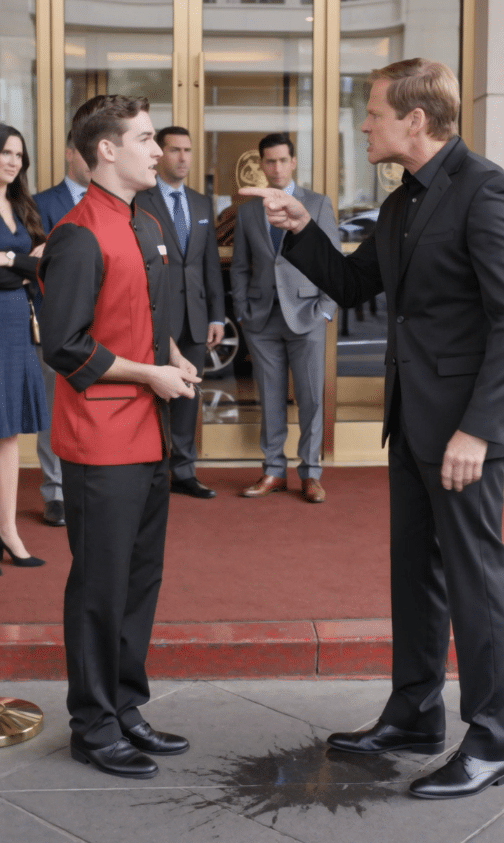
The command rang across the red carpet outside one of Los Angeles’s most exclusive five-star hotels. A young valet stood beside the entrance, clutching a set of car keys, while a wealthy guest in a perfectly tailored black suit pointed angrily at a few drops of water near his polished leather shoes.
The guest, Richard Caldwell, was fifty years old, wore a gold watch that caught the afternoon light, and carried himself like a man who had never waited for anything he wanted. He had been standing outside the glass entrance for less than a minute, but already he had decided that someone needed to pay for the inconvenience of his arrival.
The young valet, twenty-two-year-old Ethan Brooks, glanced at the damp patch on the pavement.
A car had rolled past a small puddle near the curb. A few droplets had splashed onto the ground beside Richard’s shoes. They had barely touched the leather, and a quick wipe with a towel would have taken seconds.
“I can bring a towel for your shoes, sir,” Ethan offered.
Richard looked at him with open contempt.
“Did I ask you to bring me a towel?”
“No, sir. I just thought—”
“You thought?” Richard interrupted. “You’re a valet. Your job is to do what you’re told.”
Ethan felt the familiar pressure in his chest that came whenever a customer decided to turn a minor inconvenience into a test of obedience. He wore the hotel’s red-and-black uniform, his silver name tag fastened neatly above his pocket. He had been working there for eight months, saving as much as he could while helping his mother pay the bills at home.
He had learned to remain polite when guests snapped their fingers, complained about traffic, or demanded their cars before the keys had been retrieved.
But this was different.
Richard pointed directly at his shoes.
“Get down and clean them.”
Ethan blinked.
“Sir, I’ll bring you a cloth. There’s no need to—”
“On your knees.”
The words carried across the entrance, loud enough for the bellmen and arriving guests to hear.
A man stepping out of a black luxury sedan slowed to a stop. Two women near the revolving doors exchanged uncomfortable glances. One of the bellmen looked toward Ethan, then toward Richard, but remained where he was.
Richard noticed the attention and seemed to enjoy it.
He adjusted his gold watch and leaned closer to the young man.
“Do you know how much I’m paying to stay here?”
Ethan did not answer.
“More than you make in a month. Probably more than you make in a year.”
“I’m sorry you’re upset, sir,” Ethan said. “I’ll take care of the shoes if you’ll give me a moment.”
Richard’s face reddened.
“Trash. Wipe them with your hands.”
Ethan tightened his grip on the keys.
He wanted to keep the peace. He wanted to avoid a complaint, a confrontation, and the possibility of losing the job he needed. But he could not bring himself to kneel on the red carpet and rub a stranger’s shoes with his bare hands simply because that stranger had decided humiliation was part of the service.
“I’m happy to help you, sir,” he said quietly. “But I won’t do that.”
For a moment, Richard seemed unable to believe what he had heard.
Then his expression changed.
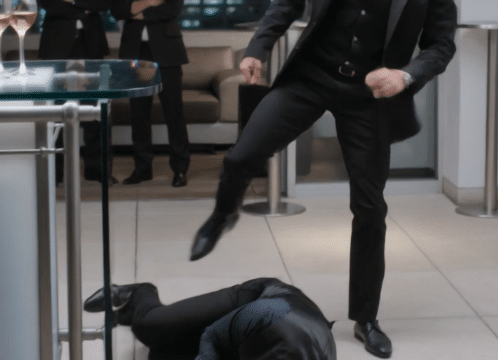
He stepped toward the valet stand, kicked Ethan hard in the chest, and sent the young man crashing to the pavement beside it.
The keys remained clenched in Ethan’s hand.
A sharp gasp swept through the entrance.
Ethan struggled to breathe as he tried to understand what had happened. His elbow scraped the ground, leaving a thin trace of blood on his skin. The red carpet blurred above him, framed by polished stone columns and the towering glass doors of the hotel.
Richard stepped closer.
Then he delivered two more kicks, striking Ethan’s back and side as the young man tried to curl away from him.
The bellmen froze. Guests covered their mouths. One driver took a startled step backward, while another looked around as if waiting for someone else to decide what to do.
Richard straightened his jacket.
“Valets kneel when guests speak.”
Ethan lay on the ground, breathing through the pain, still gripping the keys so they wouldn’t scatter across the pavement.
Then the hotel’s main glass doors swung open with a loud boom.
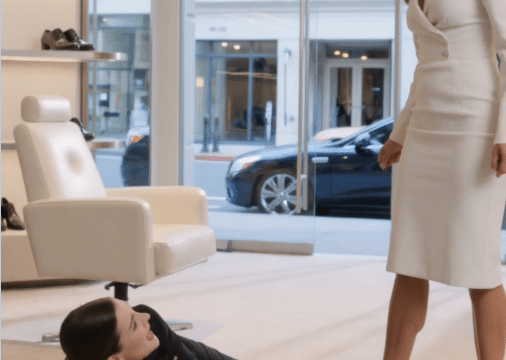
A silver-haired woman in a pristine white suit strode across the entrance, her eyes fixed on the man standing over the injured valet.
She was Margaret Sinclair, the hotel’s general manager.
And she had seen enough to know this was no ordinary guest complaint.
Richard thought the uniform made Ethan powerless. He had no idea that the young man he had just attacked was entrusted with far more than a set of car keys.
Act II
Ethan Brooks had never imagined that a valet’s uniform could become the center of a public humiliation.
When he first applied for the job, he had seen it as a temporary step toward something better. He was taking community college classes in hospitality management and hoping to build a career in the hotel industry. The job paid more reliably than his previous work, offered regular shifts, and placed him in an environment where he could learn how a luxury property operated.
He quickly discovered that the hotel was a world of its own.
Guests arrived in cars worth more than the homes of some of the employees. Their luggage was carried upstairs, their reservations were adjusted, and their preferences were remembered. A single smile from the right person could open a door, while one complaint from a powerful guest could make an employee’s week miserable.
Ethan had learned to recognize the difference between a demanding customer and a cruel one.
Demanding customers wanted things done correctly. Cruel customers wanted proof that somebody else could be made to feel small.
Most guests were perfectly reasonable. Some thanked him by name, asked how his classes were going, or left a generous tip without making a performance of it. Those moments reminded him that service work could be honest, dignified, and rewarding.
Then there were people like Richard Caldwell.
Richard had arrived at the hotel two days earlier for a series of private business meetings. He was a property developer with a portfolio of commercial buildings and a reputation for being aggressive in negotiations. He liked expensive restaurants, private elevators, and rooms with views that reminded him how far he believed he had climbed.
He also liked to announce his importance.
During check-in, he had complained that the receptionist had taken too long to confirm his suite. At breakfast, he had demanded that a server replace a coffee he had barely tasted. When the concierge explained that a requested car would take several minutes to arrive, Richard had threatened to speak with management.
Each time, someone had apologized and attempted to smooth things over.
Richard interpreted those apologies as evidence that he was right.
By the third day, he had become convinced that the entire hotel existed to remove even the smallest inconvenience from his life.
Ethan had encountered him twice before. The first time, Richard had tossed his keys onto the valet stand without looking at him. The second time, he had complained that the car wasn’t waiting at the exact second he reached the entrance, even though the request had been made only moments earlier.
Ethan had apologized both times.
He had not forgotten how Richard looked at him.
Not as a young man learning a profession, but as an object that could be ordered around.
Still, Ethan had no reason to expect what happened that afternoon.
The car that splashed the water had not even belonged to Richard. It had passed through the hotel driveway at a normal speed, and the few droplets near his shoes were barely noticeable.
Yet Richard had reacted as if someone had deliberately ruined his entire day.
The demand to clean his shoes by hand had never been about cleanliness. Ethan understood that when Richard refused the offer of a towel.
It was about obedience.
Richard wanted the young valet to kneel in front of the guests, to demonstrate that money could turn a human being into a servant in the most degrading sense of the word.
Ethan had refused, and Richard had answered with violence.
Now the young man lay beside the valet stand while the hotel entrance stood frozen around him.
Margaret Sinclair reached him first.
“Ethan, can you hear me?”
He nodded, wincing as he tried to shift his position.
“Don’t try to get up yet,” she said. “We’re getting medical help.”
She signaled to the staff, directing one employee to call emergency services and another to keep the entrance clear. Her voice was firm, but when she looked down at Ethan, the anger in her eyes softened into concern.
“How badly are you hurt?”
“My chest,” he managed. “My side.”
“Don’t move until someone checks you.”
Only then did Margaret stand and turn toward Richard.
The wealthy guest had begun adjusting his cuffs. He looked irritated rather than frightened, as though the manager’s arrival had interrupted a conversation he intended to win.
“Finally,” he said. “Someone responsible.”
Margaret did not answer immediately.
She looked at the damp pavement, the valet stand, and the witnesses who had seen what happened. Then she looked at Richard’s polished shoes.
“What happened here?”
Richard pointed at Ethan.
“Your employee refused to follow a simple instruction. I expect a certain standard of service, and he decided he was too good to provide it.”
Margaret’s eyes narrowed.
“What instruction?”
“To clean my shoes.”
“With a towel?” she asked.
“With his hands.”
A long silence followed.
Margaret studied him as if she were seeing him clearly for the first time.
“And when he refused?”
Richard lifted his chin.
“He became disrespectful.”
“You kicked him.”
“He needed to learn that guests deserve respect.”
Margaret looked toward Ethan, who was still being assisted by a staff member. Then she turned back to Richard.
“Respect is not something you can demand from someone you’ve just assaulted.”
Richard let out a dismissive laugh.
“You have no idea who you’re dealing with.”
Margaret’s expression became very still.
It was a sentence she had heard countless times from people who mistook money for authority. Usually, she allowed the hotel staff to resolve the matter through the proper channels. She did not need to prove her position by raising her voice.
But this time, a young employee was on the ground because a guest believed he had the right to hurt him.
Margaret stepped closer.
“Actually,” she said, “I think I’m beginning to understand exactly who I’m dealing with.”
Richard had expected another apology and another employee willing to absorb his anger. Instead, he had finally encountered someone who would not let his money speak for him.
Act III
Margaret Sinclair had managed luxury hotels for more than twenty-five years.
She had worked in New York, Chicago, and London before taking responsibility for the Los Angeles property, a landmark hotel known for its discreet service, international clientele, and exceptionally high standards. She knew how to handle demanding guests, how to protect an employee from an unreasonable complaint, and how to distinguish an honest mistake from deliberate misconduct.
She also knew that the hotel’s reputation rested on more than marble floors and expensive suites.
It rested on the people who kept everything running.
The housekeepers who noticed when an elderly guest needed extra assistance. The kitchen staff who stayed late to prepare meals for a delayed arrival. The bellmen who remembered which guests needed a little more time, and the valets who could retrieve a vehicle safely in a crowded driveway without losing track of a single key.
Margaret believed the employees were the hotel.
The building was beautiful, but beauty alone did not make people return. What guests remembered was whether someone had treated them with care when they needed help.
That belief had shaped the way she ran the property.
She had created a training program for young employees who wanted to move into management, encouraged staff to report abusive behavior without fear of retaliation, and insisted that guest complaints be investigated rather than automatically accepted as truth.
Ethan had been part of that program.
His supervisor had recommended him after noticing how carefully he handled difficult situations. He remembered regular guests, checked the keys before handing them over, and treated drivers with the same courtesy he showed the people arriving in luxury vehicles.
Margaret had reviewed his progress during a staff meeting only a few weeks earlier.
She had been impressed by his patience and his interest in hospitality management. He was still young, still learning, but he understood something that some senior employees had forgotten: service was not the same as submission.
Margaret had been considering him for a rotational training opportunity that would take him beyond the valet area and into the hotel’s operations department.
She had not told him yet.
Now, watching him struggle to breathe after being attacked, she felt a wave of anger that made her hands tighten at her sides.
Richard, meanwhile, was growing impatient.
“I want this employee removed,” he said. “And I want someone to explain why I’m being treated like a criminal when I simply asked for service.”
Margaret turned toward him.
“You are being treated as someone who has assaulted an employee. The incident will be documented, and the appropriate authorities will determine what happens next.”
Richard stared at her.
“Do you know how much money I spend here?”
“I know what your reservation costs.”
“Then you know I deserve better than this.”
“You deserved the towel Ethan offered you.”
The answer landed harder than an insult.
Richard glanced toward the guests gathering at a distance. He saw a man holding up his phone, a woman speaking quietly to a bellman, and another guest watching him with unmistakable disgust.
His face tightened.
“Everyone is making this into something it isn’t.”
Margaret did not look away.
“Your actions made it what it is.”
He stepped closer, lowering his voice.
“Listen carefully. I have relationships with people who matter in this city. I invest in properties. I sit on boards. I can make one phone call and turn your next six months into a nightmare.”
Margaret had spent enough time in the hospitality business to know that threats often became louder when the person making them began to lose control.
She remained calm.
“You can make whatever calls you believe are necessary. We will preserve the footage and cooperate with the authorities.”
Richard’s jaw clenched.
“You’re choosing a valet over a paying guest?”
“I’m choosing to protect an employee who was assaulted.”
The distinction seemed to infuriate him.
He looked past Margaret toward Ethan, who was now surrounded by staff waiting for the medical team. The young valet’s fingers remained closed around the keys he had been holding when he fell.
Richard shook his head in disgust.
“This is ridiculous.”
Then he moved abruptly toward Margaret, gesturing angrily as if he intended to push past her and reclaim control of the scene.
Margaret reacted with one forceful punch to his face.
Richard stumbled backward, clutching his mouth. A faint trace of blood appeared near the corner of his lip, and the shock on his face was almost greater than the pain.
The crowd gasped.
Margaret immediately moved between Richard and Ethan, ensuring that the injured valet was protected from any further confrontation.
For one moment, the hotel entrance fell completely silent.
Then Margaret spoke.
“You just attacked the man holding the keys to your entire stay.”
Richard blinked at her.
“My entire stay?”
“Yes.”
Margaret turned toward the security supervisor, instructing him to secure the relevant camera recordings and ensure that the responding authorities received the information they needed. She then directed another staff member to confirm that Ethan was receiving medical attention.
Only after that did she face Richard again.
“You seem to believe that because you can afford a room here, you own everyone who works in this building. You don’t.”
Richard looked around, searching for the person who might contradict her.
No one did.
He had arrived believing that the hotel existed to serve him. Now the manager was openly protecting the employee he had attacked, and the guests who had witnessed the confrontation were no longer pretending not to see him.
But Margaret’s warning carried a meaning Richard had not yet fully understood.
She was not merely threatening to have him removed from the entrance.
She controlled the hotel’s response to his behavior, its future relationship with him, and whether his name would ever again be welcomed at the property.
Richard had spent years using his status to make other people afraid. Now the hotel was preparing to show him that status could be revoked just as easily as a reservation.
Act IV
The medical team arrived within minutes.
Ethan was assessed and taken for further evaluation. His injuries needed proper attention, and Margaret insisted that the staff give him space rather than crowd around him with questions. One of the senior bellmen accompanied him while another employee gathered the information required for the incident report.
The keys were secured.
The security footage was preserved.
Witnesses were identified.
For once, the hotel did not begin by asking how the guest could be appeased.
Richard stood beside the red carpet, still holding his face, while the consequences of his behavior began to take shape around him.
He tried to speak with the security supervisor.
“I expect you to understand that this has been blown out of proportion.”
The supervisor listened without arguing, then explained that the incident would be documented and that he would need to remain available to the responding authorities.
Richard looked incredulous.
“You’re taking orders from her?”
“I’m following hotel procedure.”
Richard glanced toward Margaret, who was speaking with another manager.
“You’re going to regret treating me this way.”
Margaret turned.
“Mr. Caldwell, you are no longer welcome on the property while this incident is being reviewed. Your access to the hotel and its facilities is suspended, and our team will coordinate the appropriate arrangements for your departure.”
He stared at her.
“You can’t throw me out over a misunderstanding.”
“This is not being treated as a misunderstanding.”
“I have a suite upstairs.”
“Our team will help arrange the return of your belongings. You will not be permitted to use your room as a reason to remain here while the incident is addressed.”
Richard’s expression shifted from anger to disbelief.
He had assumed that paying for a suite would make him untouchable. The idea that the hotel could end its relationship with him seemed to violate a rule he had never questioned.
He reached for his phone.
“I want to speak to the owner.”
Margaret nodded once.
“You may contact whoever you wish. Our documentation will remain unchanged.”
The hotel’s owner was informed, but Margaret did not need him to intervene before taking immediate steps to protect the staff. The incident was already being handled through established procedures, and the security recordings provided an objective account of what had happened.
Richard’s calls began with outrage.
He told a business associate that the hotel manager had treated him unfairly. He described the valet as incompetent and claimed that the entire confrontation had started because an employee refused a reasonable request.
But when the associate asked whether there was video, Richard hesitated.
“Yes,” he admitted.
“And what does it show?”
Richard looked toward the entrance.
“It’s not the point.”
“It sounds like it is.”
The call ended sooner than he expected.
Another contact asked him to send a written account before discussing the matter further. A third said he would rather wait until the facts were clear.
For the first time, Richard discovered that people who valued their own reputations were reluctant to defend his without knowing what he had done.
The hotel did not release a sensational statement. It did not need to. The witnesses, the preserved recordings, and the formal documentation established the facts for those who needed to assess them.
The property also reviewed Richard’s reservation and future access under its policies. Any refund or cancellation questions were handled separately from the assault, and the staff were instructed not to argue with him or make promises outside their authority.
That measured response frustrated Richard more than a shouting match would have.
He wanted someone to blame. He wanted a dramatic confrontation he could describe as mutual hostility. He wanted to transform the incident into a story about an arrogant manager who had forgotten that guests paid her salary.
Instead, he was confronted with a series of calm, consistent decisions.
The hotel would not allow him to intimidate its staff.
The footage would not disappear.
The incident would not be rewritten to protect his ego.
And Ethan’s job would not be put at risk because a wealthy guest had decided to assault him.
When the authorities finished their initial work at the entrance, Richard was escorted away from the valet area while arrangements were made for his departure. His belongings would be handled according to the hotel’s procedures, and the incident would continue through the appropriate channels.
Margaret did not celebrate as he left.
She was still concerned about Ethan.
She checked on him later that evening and learned that he was receiving care and would need time to recover. She asked his supervisor to ensure that his shifts and pay were handled fairly while he was away, and she made it clear that no one should pressure him to return before he was ready.
The next morning, she visited the staff entrance before her first meeting.
The valet stand was quiet. The red carpet had been cleaned, and the driveway looked as polished as it always had.
But Margaret could not stop thinking about the keys.
Ethan had been in pain, frightened, and unable to stand, yet he had held on to them rather than let them scatter into the driveway. It was a small detail, but it spoke to the kind of person he was.
Even while someone was trying to strip him of his dignity, he had continued to take his responsibility seriously.
Margaret knew that kind of commitment should never be mistaken for weakness.
Richard had lost access to the hotel, but the young man he had attacked was about to receive an opportunity that would matter far longer than a luxury suite ever could.
Act V
Ethan returned to the hotel after his recovery period, walking more cautiously than before but determined not to let the incident decide the future of his career.
The first day back was harder than he expected.
The driveway looked exactly as it had on the afternoon of the attack. The same stone columns framed the entrance, the same glass doors reflected the sunlight, and the same red carpet ran between the valet stand and the lobby.
But Ethan remembered every second.
He remembered the demand to kneel. The shock of falling. The faces of the guests who had watched without moving. Most of all, he remembered the terrible feeling of being treated as though his dignity had no value simply because he was wearing a uniform.
His coworkers welcomed him quietly.
One bellman apologized for freezing during the attack. Ethan told him he understood. Another colleague admitted that he had been afraid Richard would turn on anyone who intervened.
Ethan did not pretend that fear was unreasonable.
He had been afraid too.
What helped was knowing that the hotel had not blamed him for what happened. His position remained secure, and the incident had been documented rather than dismissed as a customer-service dispute.
A few days after his return, Margaret asked him to come to her office.
Ethan entered nervously, expecting to discuss his schedule or the incident report.
Instead, he found a folder on the desk and two cups of coffee.
“Sit down,” Margaret said.
He did.
“I’ve been reviewing your progress in our development program,” she began. “Your supervisor has consistently praised your judgment, your attention to detail, and the way you handle difficult situations.”
Ethan looked confused.
“Thank you, ma’am.”
“We were already considering you for a rotation through hotel operations before the incident happened.”
He stared at her.
“You were?”
“Yes. I don’t want you to think this opportunity is a reward for being assaulted. You earned the consideration before any of that happened.”
Margaret opened the folder.
The hotel was offering Ethan a place in a paid training program that would allow him to work with guest services, front-office management, and operations. It was a step toward the career he had hoped to build when he first enrolled in college.
Ethan read the letter twice.
“I don’t know what to say.”
“You don’t need to say anything right now.”
He looked up at her, struggling to keep his voice steady.
“Why me?”
Margaret considered the question.
“Because you understand that doing a job well doesn’t mean surrendering your dignity. You remained professional when someone tried to humiliate you. And even when you were hurt, you didn’t stop caring about your responsibilities.”
She paused.
“But I want you to remember something. You never had to prove your worth by enduring what happened to you. What Richard did was wrong, regardless of how you responded.”
Ethan lowered his eyes.
For months, he had measured his success by how much he could endure without complaining. He had believed that staying calm meant accepting whatever came his way.
Margaret’s words helped him understand that professionalism did not require silence in the face of abuse.
He could be courteous without being submissive.
He could respect a guest without allowing that guest to treat him as less than human.
And he could build a career without allowing the worst person he met to define what that career meant.
“Thank you,” he finally said.
Margaret smiled.
“Now, let’s make sure you finish your classes.”
Over the following months, Ethan began his rotation. He learned how reservations were managed, how staff schedules were coordinated, and how the hotel responded when something went wrong. He discovered that the skills he had developed outside—patience, observation, and calm under pressure—were just as valuable inside the building.
He also learned how much responsibility came with authority.
Managers could make employees feel safe, or they could make them feel disposable. Policies could protect people, or they could become excuses for avoiding difficult decisions. A hotel’s reputation depended not only on what happened in its public spaces, but on what its leaders chose to do when someone was mistreated.
Ethan began to imagine himself in a management role.
Not because he wanted power over other people, but because he wanted to be the kind of manager who would have stepped forward on that afternoon.
Richard Caldwell, meanwhile, faced a very different future.
The hotel’s decision to suspend his access remained in place after the incident review. His conduct was no longer a private story that could be reshaped over dinner. Witness accounts and security footage had made the facts difficult to dispute, and the matter continued through the appropriate process.
His business contacts became more cautious. Some postponed meetings until they understood the situation. Others decided they had no interest in being associated with a man who had attacked a young employee over a few drops of water.
No single conversation destroyed Richard’s career.
But each conversation reminded him that reputation was not something a person could demand from others. It was something built through behavior, and once damaged, it could not be repaired simply by paying the bill.
The gold watch remained on his wrist.
The expensive suits remained in his closet.
The money was still there.
What had changed was the way people looked at him.
The hotel staff would remember him as the guest who kicked a valet because he refused to kneel. The witnesses would remember the young man on the pavement, still holding the keys. And the people who had once listened eagerly to Richard’s stories about his influence now had a reason to question the judgment behind them.
Months later, Ethan stood near the lobby entrance during a busy evening shift.
A car pulled up to the curb, and an older guest stepped out, looking uncertain as he searched for his walking cane. Ethan moved forward to help him, greeting him by name after checking the reservation.
The man thanked him warmly.
There was no dramatic moment. No one applauded. No one photographed the exchange.
It was simply a young professional doing his job with care.
Ethan glanced briefly toward the red carpet where he had fallen. The memory was still there, but it no longer felt like the whole story.
He had been hurt there.
He had been humiliated there.
But he had also discovered that one person’s cruelty did not have to determine the direction of his life.
Inside the lobby, Margaret watched him assist the guest. She did not interrupt or call attention to what she saw. She simply smiled and continued toward her next meeting.
The hotel would go on welcoming travelers. Cars would arrive, doors would open, and employees would continue doing the quiet work that made luxury feel effortless.
But the lesson of that afternoon remained.
Richard had believed that the price of his room made him superior to the people who served him. He had mistaken a uniform for weakness and a polite answer for permission to demand anything he wanted.
In the end, the keys Ethan held were never the source of the young man’s worth.
They were simply part of his job.
His dignity had never belonged to Richard, and it had never been Richard’s to take away.
The wealthy guest had arrived believing everyone would kneel if he demanded it.
He left discovering that even the most expensive hotel in the world could refuse to open its doors to him.
And the young valet he had tried to humiliate walked through those same doors toward a future built on something money could never buy: the respect he had earned by remaining himself.