Act I
The sound of skateboard wheels echoed where silence was meant to live.
The veterans memorial park had always been a place of reflection. American flags moved gently in the morning breeze. Fresh wreaths rested beneath a polished granite monument engraved with the names of men and women who never returned home.
Standing quietly near the memorial was sixty-eight-year-old Henry Collins.
He carried a small bouquet of white flowers in his remaining hand. His old military jacket was neatly pressed, and several service medals rested proudly over his heart. The empty sleeve pinned to one side of his jacket spoke of a sacrifice that needed no explanation.
Three young skateboarders flew across the brick pathway.
Their wheels scraped dangerously close to the memorial stone.
Henry waited until they slowed.
Then he spoke with calm respect.
“Please don’t skate on the memorial.”
The young men laughed.
The tallest among them rolled closer, jumped off his board, and sneered.
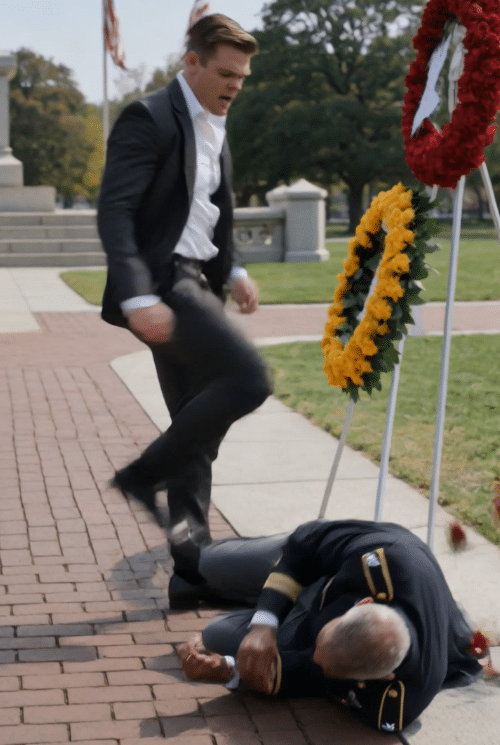
Without warning, he drove a brutal kick into Henry’s chest.
The elderly veteran crashed beside the wreaths. Flowers scattered across the bricks, and one of his medals tore free from his jacket, striking the ground with a sharp metallic ring. His remaining hand scraped against the rough path.
Visitors gasped.
A little boy clutched his father’s hand.
Even the wind seemed to disappear.
The skateboarder pointed toward the fallen veteran.
“Trash. This park isn’t yours.”
Henry looked at the medal lying on the ground.
Not because it was made of metal.
Because every medal carried the memory of someone who had never come home.
Far beyond the memorial gates, the low rumble of engines began to grow louder.
Act II
Henry Collins rarely wore his medals.
Only on two occasions.
Memorial Day.
And the anniversary of the battle where he lost his arm while shielding younger soldiers during an ambush.
He never considered the decorations personal achievements.
To him, they belonged to the men whose names were carved into the stone behind him.
Every year, he visited alone.
He placed flowers.
Read every name.
Then quietly went home.
The three skateboarders knew none of that.
To them, he was simply another old man interrupting their fun.
As Henry tried to push himself upright, the lead skateboarder stepped forward again.
His first follow-up kick struck Henry’s back.
The veteran staggered against the brick path.
A second kick landed hard against his ribs.
Nearby visitors cried out.
The other two young men remained where they stood.
They laughed instead of helping.
The leader pointed toward the medal lying on the ground.
“Go cry about your medals somewhere else.”
Henry closed his eyes.
Not in fear.
But in sorrow.
Because disrespect toward the memorial hurt more than the pain in his ribs.
Then several black SUVs rolled quietly through the park entrance.
Act III
The vehicles stopped in perfect formation.
Their doors opened almost simultaneously.
An elderly officer stepped out wearing a full military dress uniform covered with rows of medals earned over an extraordinary career of service.
He moved slowly.
With absolute confidence.
Park police immediately snapped to attention.
City employees straightened instinctively.
Several veterans visiting the memorial raised respectful salutes.
The officer acknowledged none of them.
His attention remained fixed on the elderly man lying beside the monument.
He walked directly to Henry.
Without speaking, he bent down and picked up the fallen medal from the brick pathway.
He carefully brushed away the dust.
Then, with steady hands, he fastened it back onto Henry’s jacket exactly where it belonged.
The tiny clasp clicked into place.
Only then did the general stand.
He faced the three skateboarders.
His voice remained calm.
“Don’t touch him again.”
The words carried no anger.
Only authority.
The park became completely silent.
The young men suddenly realized every uniformed person nearby was waiting for the general’s next instruction.
Act IV
General Thomas Whitmore had commanded thousands of soldiers during a career spanning four decades.
His leadership had earned him the nation’s highest military honors.
Yet whenever reporters asked who had inspired him most, he always declined to answer.
The story was deeply personal.
Forty years earlier, Lieutenant Thomas Whitmore had been a frightened young platoon leader during his first combat deployment.
One disastrous mission nearly ended his life.
Enemy fire trapped several soldiers beneath collapsing debris.
Orders were given to withdraw.
One man refused.
Sergeant Henry Collins ran back into the chaos.
He pulled Thomas to safety moments before another explosion destroyed the position.
Henry lost his arm that day.
Thomas kept his life.
For decades afterward, the general quietly visited Henry every Memorial Day whenever duty allowed.
They never sought attention.
They simply honored those who had fallen together.
Seeing Henry assaulted beside the very monument dedicated to sacrifice struck the general harder than any battlefield memory.
He turned toward the park police commander.
“What happened?”
Witnesses answered immediately.
Visitors pointed to phone recordings.
Security cameras overlooking the memorial had captured every second.
There was no uncertainty.
Only evidence.
The lead skateboarder attempted a weak excuse.
“We were just having fun.”
The general’s expression never changed.
“This place was built because others gave up every tomorrow they had.”
His voice remained steady.
“You treated that sacrifice like a playground.”
He turned calmly toward the officers.
“Preserve every recording.”
Then added quietly,
“Handle this with the respect the memorial deserves.”
Every officer nodded without hesitation.
Act V
Henry slowly stood with the general’s assistance.
For a long moment, neither man spoke.
Then Thomas smiled.
“You still insist on bringing flowers yourself.”
Henry returned the smile.
“And you still polish your medals too much.”
Several nearby veterans laughed softly.
The tension that had gripped the memorial finally eased.
Together, the two old soldiers walked to the granite wall.
Henry carefully placed the white flowers beneath the engraved names.
The general stood beside him in silent salute.
No cameras.
No speeches.
Only gratitude.
Visitors throughout the park instinctively removed their hats.
Even children who didn’t fully understand what had happened sensed the importance of the moment.
Across the pathway, the three skateboarders stood frozen.
The laughter that had filled the park only minutes earlier had disappeared.
Park police waited nearby.
City officials deferred to the general without question.
The lead skateboarder’s confidence collapsed.
His face turned pale.
His voice shook as he whispered,
“Who are you…?”
General Whitmore never answered.
Instead, he remained beside Henry, both men facing the memorial in respectful silence.
Because the names carved into stone deserved more attention than the arrogance of those who had forgotten what that place represented.
And on that quiet morning, everyone in the park learned that medals are not pieces of metal.
They are promises.
Promises carried by ordinary people who chose courage over comfort.
And those promises are always worth defending.