Act I
The bus hadn’t even arrived yet.
Morning commuters crowded the sidewalk, glancing impatiently at their phones while traffic crawled through the busy intersection. The only available seat beneath the Priority Seating sign was occupied by a young man wearing a black tank top, his tattooed arms stretched comfortably across the back of the bench as if the sign above him didn’t exist.
A few feet away, a pregnant woman shifted her weight from one swollen foot to the other.
She looked exhausted.
Nobody offered to help.
Most people noticed.
Most people kept walking.
Standing nearby was a sixty-five-year-old veteran wearing a faded military jacket. A polished prosthetic leg supported him while he leaned gently on a weathered cane. His own balance wasn’t perfect, yet his attention remained fixed on the woman struggling to stay upright.
After watching for several quiet seconds, he finally stepped forward.
His voice carried no anger.
Only kindness.
“Please give her the priority seat.”
The young man slowly lifted his head.
For an instant, the crowd hoped embarrassment might accomplish what decency had not.
Instead, arrogance answered first.
He stood.
Not to surrender the seat.
To attack.
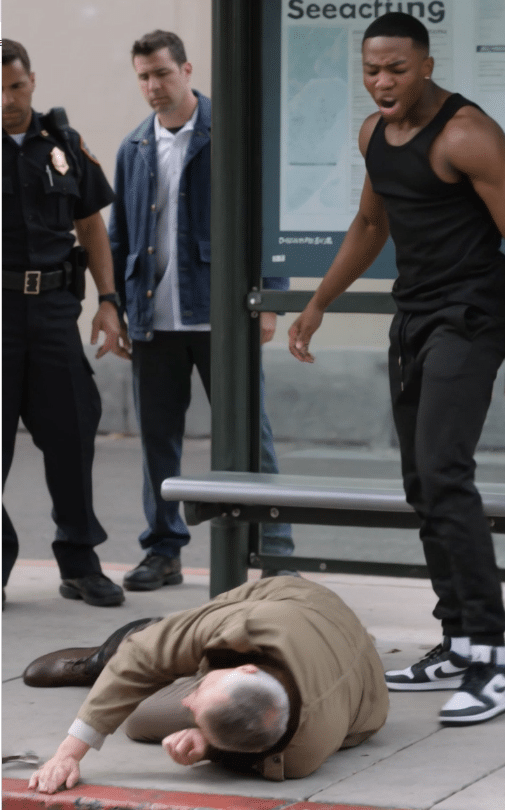
Without warning, his boot slammed into the veteran’s chest.
The older man stumbled backward before crashing onto the pavement. His cane spun across the sidewalk, striking the curb with a hollow clatter while horrified gasps echoed around the bus stop.
The pregnant woman instinctively reached toward him.
She was too far away.
The veteran lay on the concrete, his elbow scraped and reddened where it had struck the ground.
It should have ended there.
It didn’t.
Because cruelty rarely stops after proving it can begin.
And someone unexpected had just witnessed the entire scene from across the street.
Act II
The veteran drew a slow, painful breath.
Years earlier, an explosion overseas had taken his left leg but never his dignity. Even now, lying on the pavement, he searched first for his fallen cane rather than himself.
Old habits survived long after battlefields disappeared.
The tattooed young man stepped closer.
His breathing was heavy.
His pride even heavier.
He looked down with open contempt.
“Trash. Don’t tell me what to do.”
Silence spread across the sidewalk.
A teenager quietly started recording.
An elderly couple froze beside the bus schedule.
Nobody expected what happened next.
The young man lashed out again.
One hard kick landed squarely against the veteran’s back.
The older man’s shoulders jerked forward.
A second kick struck his ribs.
Exactly two.
The sound of those impacts seemed louder than the passing traffic.
Then the bully pointed dismissively away from the bench.
“Find another place to stand.”
Not one person sitting nearby remained comfortable.
The pregnant woman wiped tears from her eyes.
She blamed herself.
If she hadn’t been standing there…
If the veteran hadn’t spoken…
None of this would have happened.
The older man slowly shook his head as though reading her thoughts.
He managed a faint smile despite the pain.
“You did nothing wrong.”
Those four words carried more strength than the young bully had shown in his entire life.
Then, almost unnoticed beneath the noise of the city, a sleek luxury sedan eased quietly toward the curb.
Everything was about to change.
Because respect has a way of revealing itself without making a sound.
Act III
The sedan came to a smooth stop directly in front of the bus stop.
Its driver stepped out immediately and opened the rear door.
A woman in a perfectly tailored navy suit emerged with calm confidence. She looked to be in her late forties, carrying herself with the effortless authority of someone accustomed to making difficult decisions without raising her voice.
Conversations stopped.
Pedestrians instinctively stepped aside.
Even two nearby police officers, who had started moving toward the disturbance moments earlier, paused before respectfully clearing a path for her.
The tattooed young man finally sensed that something wasn’t right.
He glanced around.
Nobody was watching him anymore.
Every eye followed the woman.
She walked past him without saying a word.
Her attention settled entirely on the veteran still sitting on the pavement.
She bent down, picked up his cane with both hands, and offered it back as though returning something priceless.
The veteran looked into her face.
Recognition slowly replaced surprise.
Years ago, before she became one of the country’s most respected advocates for veterans and public accessibility, she had worked as a young attorney fighting disability discrimination cases.
One of her earliest clients had refused compensation after winning a landmark lawsuit.
Instead, he had asked that the settlement fund be used to improve accessibility at public transportation stops for every disabled veteran who came after him.
That client was the man now sitting before her.
His quiet integrity had shaped her entire career.
She never forgot his name.
She never forgot his sacrifice.
She helped him to his feet.
Then she stepped between him and the young man.
Her expression hardened.
The sidewalk fell silent.
Only one command broke the stillness.
Act IV
“Step back.”
The words were calm.
They didn’t need to be louder.
The tattooed young man laughed nervously.
“And who exactly are you supposed to be?”
The woman didn’t answer immediately.
Instead, she looked briefly toward the two police officers.
Neither officer moved.
Neither spoke.
They simply stood behind her.
Waiting.
That silence unsettled the young man more than shouting ever could.
The woman finally turned back toward him.
“You assaulted a disabled veteran.”
She paused.
“You assaulted him after he asked you to respect a priority seat reserved for people exactly like him… and for the woman you refused to help.”
The young man’s confidence began to crack.
The woman continued.
“You chose violence in front of dozens of witnesses.”
She glanced toward the phones now recording openly.
“And directly beneath city surveillance cameras.”
Only then did he notice the cameras mounted above the bus shelter.
Every second had been captured.
There would be no changing the story.
No pretending he had acted in self-defense.
The woman wasn’t merely a respected attorney anymore.
She had become chairwoman of a statewide foundation partnering with transportation agencies, law enforcement, and veterans’ organizations to improve accessibility and public safety.
The officers knew her.
Transit officials knew her.
City leaders knew her.
More importantly…
They trusted her.
One officer stepped forward quietly.
The other began speaking into his radio.
The bully swallowed hard.
For the first time all morning, he realized he wasn’t controlling the situation anymore.
The crowd wasn’t afraid of him.
He was becoming afraid of everyone else.
Especially the woman who still hadn’t raised her voice.
Act V
The approaching bus slowed to a stop, but almost no one boarded.
Every passenger looked toward the sidewalk instead.
The pregnant woman finally sat on the priority bench.
The veteran smiled as he saw her rest comfortably.
That had been his only goal from the beginning.
Not an argument.
Not recognition.
Just kindness.
The woman in the navy suit gently straightened the veteran’s old jacket before asking quietly,
“Can you stand?”
He nodded.
“I’ve stood through worse.”
She smiled with unmistakable respect.
“I know.”
The police officers moved into position.
Witnesses stepped forward willingly, offering statements and videos before being asked.
No one defended the assault.
There was nothing left to defend.
The young man’s bravado disappeared completely.
His tattooed arms, once folded with confidence, now hung stiffly at his sides.
His face lost its color.
His lips trembled.
He looked past the woman and saw the officers waiting silently behind her.
Then he understood.
Power wasn’t measured by who shouted the loudest.
It belonged to those who earned respect long before they entered the room.
His voice barely escaped as a whisper.
“Who are you…?”
The woman never answered.
She simply turned back toward the veteran, making sure he had his cane securely in hand before walking beside him.
Because her identity no longer mattered.
Her actions had already spoken.
As the bus doors finally closed and traffic resumed its endless rhythm, the crowd carried home a lesson far greater than the morning’s violence.
A priority seat was never just a bench.
It was a reminder that civilization depends on ordinary people choosing compassion over convenience.
The young man believed strength meant taking whatever he wanted.
The veteran believed strength meant standing up for someone who needed help—even when standing was painful.
By the end of that morning, only one of those men was still standing with honor.
And that was the only victory anyone remembered.