Act I
“Ticket, please.”
The words were calm, professional, and routine.
Morning commuters lined up at the fare gates, phones in hand, coffee cups steaming as trains rolled in and out of the station. Most barely noticed the transit officer checking tickets with practiced efficiency.
One man did.
Dressed in a tailored suit with an expensive watch glinting beneath the station lights, he strode toward the gate without slowing down.
The officer stepped into position.
“Ticket, please.”
His expression hardened instantly.
“I don’t wait for gates.”
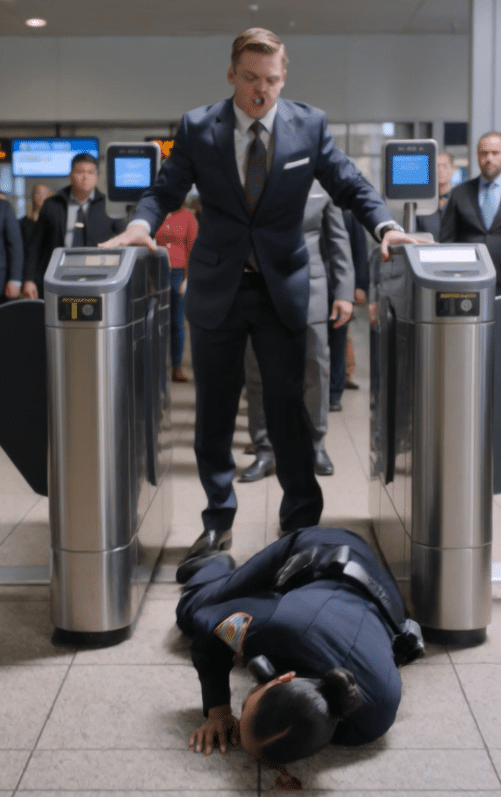
Before anyone could react, he lunged through the opening and struck her with brutal force, sending her crashing onto the polished floor beside the ticket scanner.
Her radio slid across the tiles.
Her badge twisted against her uniform.
As she caught herself with one hand, her palm scraped the floor, leaving only a faint trace of blood before she instinctively pulled it back.
A wave of shocked silence swept through the station.
Passengers froze.
Some reached for their phones.
Others simply stared.
The businessman looked down at her with open contempt.
“Trash.”
Then, loud enough for everyone waiting to hear, he sneered,
“I don’t wait for gates.”
The train doors remained open.
No one boarded.
Something far bigger than a ticket inspection had just begun.
Act II
The officer tried to push herself back onto one knee.
Not to fight.
Not to argue.
Simply to continue doing the job she had sworn to do.
She reached toward the fallen scanner.
The man stepped closer.
He struck her again with deliberate cruelty before delivering another forceful blow that sent her back against the floor.
Gasps echoed through the station.
A young commuter instinctively moved forward before another passenger quietly held him back, fearing the situation would only escalate.
The businessman straightened his jacket as though nothing unusual had happened.
“People like you don’t stop people like me.”
His words hung in the air.
To him, rules were obstacles designed for ordinary people.
He had spent years believing influence solved every inconvenience.
Parking tickets disappeared.
Reservations appeared.
Policies bent.
He assumed this moment would be no different.
What he failed to understand was that transit systems depend on one principle above all else.
The rules protect everyone equally.
Without them, order disappears.
The injured officer remained composed despite the pain.
She didn’t shout.
She didn’t insult him.
She simply watched the crowd, making sure frightened passengers stayed clear of the confrontation.
Duty came before pride.
Even now.
Then the atmosphere changed.
Act III
A sharp voice cut through the crowd.
“Make room.”
Transit police emerged first, moving swiftly through the waiting passengers.
Behind them walked a senior officer alongside the station manager.
Nobody announced who he was.
Nobody needed to.
The reaction around him said everything.
Employees immediately stepped aside.
Transit staff straightened instinctively.
Even the noise of the station seemed to fade.
The senior officer walked directly toward the injured transit officer before positioning himself between her and the businessman.
Two transit police officers secured either side of the fare gate.
The businessman smirked.
For a moment.
Then the senior officer spoke.
“Step away from her.”
His voice never rose.
It didn’t need to.
The businessman hesitated for the first time that morning.
The confidence that had carried him through the confrontation suddenly felt much smaller.
He took one involuntary step backward.
The station fell completely silent.
Act IV
Medical personnel were called to examine the injured officer.
She insisted on one thing before accepting treatment.
“Keep the passenger line moving.”
Even after being attacked, she remained focused on the people depending on the transit system.
Meanwhile, station staff quietly began gathering evidence.
Security cameras had captured the incident from multiple angles.
The fare gate cameras.
Platform surveillance.
Passenger cell phones.
Even nearby ticket machines had recorded portions of the confrontation.
The businessman slowly realized something horrifying.
The crowd he had expected to impress had become witnesses.
His own angry outburst had been preserved from every direction.
The station manager calmly spoke with investigators while transit police secured the area.
Passengers who had seen everything willingly stepped forward to provide statements.
No one defended the businessman.
Not even the colleagues who had been walking behind him when the confrontation began.
They quietly disappeared into the crowd.
For the first time all morning, the businessman found himself standing entirely alone.
Act V
The injured officer was helped carefully to her feet.
She thanked the medical team before checking that the fare gates had resumed normal operation.
Another commuter quietly picked up her dropped radio and handed it back with a simple nod.
Around the station, passengers began applauding.
Not because someone had been humiliated.
But because professionalism had refused to yield to intimidation.
The businessman looked toward the senior officer, his confidence completely gone.
His voice, once loud enough to dominate the station, barely carried across the platform.
“Who are you?”
The senior officer didn’t answer immediately.
Instead, he looked toward the injured officer.
“Are you all right?”
She nodded.
“I’ll be fine.”
Only then did he turn back toward the man.
His expression remained calm.
“The law doesn’t ask who you are before it asks what you did.”
Those words landed harder than any argument could have.
The businessman finally understood what everyone else in the station had known from the beginning.
The woman he attacked wasn’t trying to inconvenience him.
She was protecting a system that allowed thousands of strangers to travel safely every day.
Money could buy luxury.
Influence could open private doors.
But neither could purchase an exemption from public rules—or erase the consequences of attacking someone whose only mistake was doing her job.
Long after the trains continued on schedule and the morning rush faded, one memory lingered in the minds of everyone who had witnessed it.
A transit officer quietly asking for a ticket.
A wealthy man convinced the rules did not apply to him.
And a single calm command that transformed arrogance into silence.
“Step away from her.”