Act I
The gallery had been quiet only seconds earlier.
“Please don’t touch the artifact.”
The museum employee spoke softly, careful not to disturb the visitors studying centuries of history under the warm gallery lights.
The man in the bright designer suit didn’t even remove his hand from the display rope.
Instead, he smiled for the audience surrounding him.
“It’s just an old object.”
A few nervous laughs escaped from his companions.
Everyone else looked away.
The employee stood her ground.
“I’m sorry, sir. These objects are irreplaceable.”
His expression hardened.
“You’re nobody in a quiet room.”
The words echoed through the gallery louder than anyone expected.
No one realized that someone important had heard every single one.
Act II
The employee had spent nearly fifteen years preserving history.
She wasn’t an art dealer.
She wasn’t wealthy.
She wasn’t famous.
But she knew the story behind every artifact in the room.
Each object represented lives, civilizations, discoveries, and generations that could never be recreated if damaged.
Every visitor received the same reminder.
Every visitor followed the same rules.
Until today.
The wealthy guest believed money entitled him to special treatment.
He treated museum staff as obstacles rather than guardians.
Visitors quietly recorded the confrontation.
Security staff had already begun moving through the gallery.
The employee never changed her tone.
“The rules protect the collection for everyone.”
That calm response only embarrassed the man further.
Act III
As the argument escalated, security discreetly positioned themselves nearby before the situation could disturb the rest of the museum.
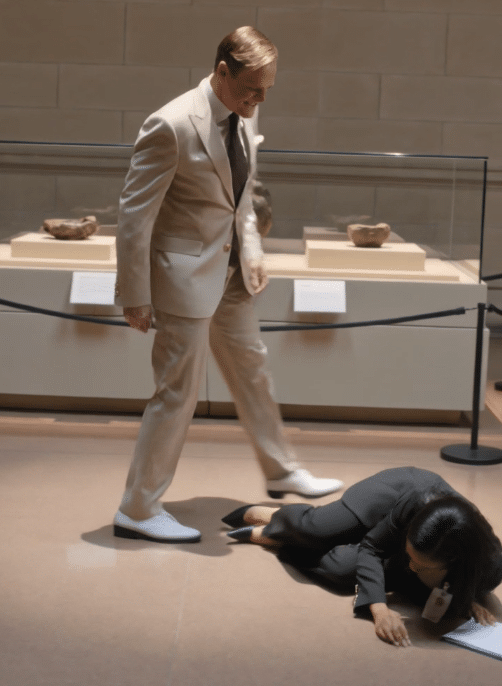
A guide booklet slipped from the employee’s hands during the commotion, scattering across the polished floor.
The priceless artifact remained completely untouched.
Then the gallery doors opened.
The museum director entered alongside the head of security and one of the institution’s most respected patrons.
Conversation stopped instantly.
Curators straightened.
Volunteers stepped aside.
Without introducing herself, the director walked directly between the employee and the disruptive guest.
Her voice was steady.
“Step away from her.”
No one questioned the instruction.
Only one man failed to understand why.
Act IV
He frowned.
“Who are you?”
No one answered.
They didn’t need to.
The reactions around the room spoke louder than words.
Security immediately formed behind the director.
Department heads quietly gathered nearby.
Even longtime patrons watched respectfully.
The director turned first to the employee.
“Are you alright?”
She nodded.
“I was protecting the collection.”
“And you did exactly what we ask every member of our staff to do.”
Only then did she face the guest.
“Our museum welcomes everyone.”
“But respect—for history, for our visitors, and for our employees—is not optional.”
The confidence drained from his face.
He finally realized this wasn’t merely another employee correcting him.
He had challenged the person responsible for protecting the entire institution.
Act V
Security escorted the disruptive visitor from the gallery while the museum gradually returned to its peaceful rhythm.
Families resumed exploring the exhibits.
Students gathered around display cases.
The soft hum of curiosity replaced the uncomfortable silence.
Before leaving, the director carefully picked up the fallen guide booklet and handed it back to the employee.
“You represented this museum exactly as you should.”
The employee smiled quietly.
She hadn’t defended an object.
She had defended the history it carried.
As visitors continued through the exhibition, many paused to read the small sign beside the display that few had noticed before.
Please Do Not Touch.
It wasn’t merely a rule.
It was a promise that generations to come would inherit the same history, preserved because someone had the courage to protect it—even when doing so wasn’t easy.