Act I
“Please stay behind the fence.”
The words had barely left Emma Carter’s mouth when the man laughed loud enough for every family on the walkway to hear.
He stood with one foot on the safety barrier, holding up his phone as though the warning signs were decorations instead of rules. Behind the fence, a massive tiger paced through its habitat, completely unaware that one visitor’s arrogance had just turned an ordinary afternoon into something unforgettable.
“Trash,” the man sneered. “Don’t embarrass me in front of my family.”
Parents instinctively pulled their children closer.
Emma didn’t raise her voice. She didn’t threaten him or argue. She simply repeated the policy every zoo guide was trained to enforce.
“Sir, please step back behind the fence.”
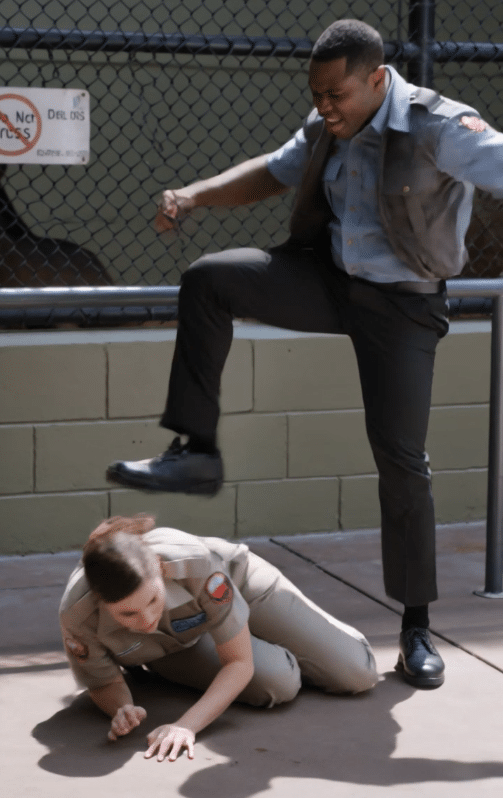
Instead, he jumped down, stormed toward her, and shoved past the invisible boundary of basic decency.
The crowd froze.
Her radio slipped from her hand and skidded across the pavement as she stumbled to the ground. A scrape against the rough walkway left a small mark on her knee, but she focused on something else entirely.
Not herself.
The fence.
She kept her eyes on the barrier, making sure no frightened visitor crossed it during the chaos.
Even lying on the pavement, she was still protecting everyone else.
No one realized that the next thirty seconds would completely change the man’s life.
Act II
Emma had worked at the zoo for nearly eight years.
Most visitors remembered the animals.
Her coworkers remembered something else.
She never ignored a safety rule.
Children sometimes cried because they couldn’t climb a railing.
Teenagers rolled their eyes when she stopped them from tossing food into exhibits.
Influencers complained whenever she interrupted a perfect photo.
Emma accepted every complaint with the same calm smile.
Because she knew exactly why those rules existed.
Years earlier, another zoo across the country had experienced a preventable accident after visitors ignored barriers. Emma had studied the incident during training, and she promised herself that no family under her watch would ever experience something similar.
To some people, she looked like a woman pointing at signs.
To everyone who understood wildlife safety, she was the final layer between curiosity and catastrophe.
The wealthy visitor saw none of that.
All he saw was someone who had dared to tell him no.
“You’re just here to point at animals,” he said loudly enough for strangers to hear.
His friends laughed.
The laughter echoed across the walkway.
Then it stopped.
Someone important had arrived.
Act III
Zoo security appeared first.
They moved quickly but without panic, creating space between the crowd and the confrontation.
Behind them walked a woman in a dark business jacket.
She wasn’t running.
She didn’t need to.
Every employee who saw her immediately stood straighter.
Radios became silent.
Conversations ended mid-sentence.
Even veteran staff members instinctively stepped aside.
She stopped beside Emma.
“Back away from my guide.”
Her voice wasn’t loud.
It didn’t need to be.
The visitor frowned.
“And who are you?”
Nobody answered him.
They didn’t have to.
The chief veterinarian had already arrived beside security, speaking quietly into a radio while keeping the animal habitats under constant observation.
Department supervisors lined up behind the woman in the blazer without a word.
The crowd noticed something before the visitor did.
Every employee was looking at her.
Not at him.
Act IV
The realization spread across the walkway like a wave.
The woman wasn’t simply another supervisor.
She was the Zoo Operations Director.
Every safety protocol.
Every employee.
Every emergency response.
Every decision protecting thousands of visitors and hundreds of animals.
All of it ultimately reported through her office.
She knelt briefly beside Emma.
“Are you alright?”
Emma nodded, insisting that someone check the nearby families first.
The director gave the smallest smile.
That answer was exactly why Emma had earned the respect of everyone who worked there.
Security escorted the visitor away from the public path while witnesses voluntarily stepped forward.
Parents offered phone recordings.
Teenagers shared videos from different angles.
Staff collected statements with practiced professionalism.
Within minutes, what the visitor had believed would become a story about “terrible customer service” had become something very different.
A documented incident witnessed by dozens of people.
The arrogance that had filled his face only moments earlier disappeared.
For the first time all afternoon, he looked genuinely afraid.
Act V
The zoo reopened the walkway later that day.
The animals remained calm.
The visitors returned.
Children continued asking questions about tigers, elephants, and bears as though the disturbance had never happened.
Emma returned several weeks later after recovering.
She wasn’t greeted with applause.
She was greeted with something better.
Respect.
Families who recognized her thanked her for protecting the rules that protected everyone else.
Some even told their children, “That’s the guide we told you about.”
The Operations Director quietly presented Emma with an internal safety commendation during a staff meeting.
Not because she had been involved in an incident.
Because even under pressure, she had never forgotten why she wore the uniform.
Rules, she reminded the team, are rarely written for the people willing to follow them.
They’re written for the one person convinced they don’t apply.
As for the man who believed money placed him above every barrier, the last image anyone remembered wasn’t his expensive clothes or confident smile.
It was the moment he looked around and realized that an entire organization—from frontline guides to senior leadership—had united behind the employee he had dismissed as “nobody.”
In the end, the fence had done exactly what it was built to do.
It protected more than the animals.
It revealed the character of everyone standing on the other side.