Act I
“Please wait your turn.”
The words were calm, but they landed like an insult to the man who had just pushed past dozens of exhausted families.
Around him, parents clutched sleeping children beneath emergency blankets. Elderly residents waited patiently beside stacks of bottled water after the storm had torn through their community only hours before.
The man glanced at the line with open contempt.
“Trash,” he snapped. “I don’t stand behind these people.”
Every conversation around the relief tent faded.
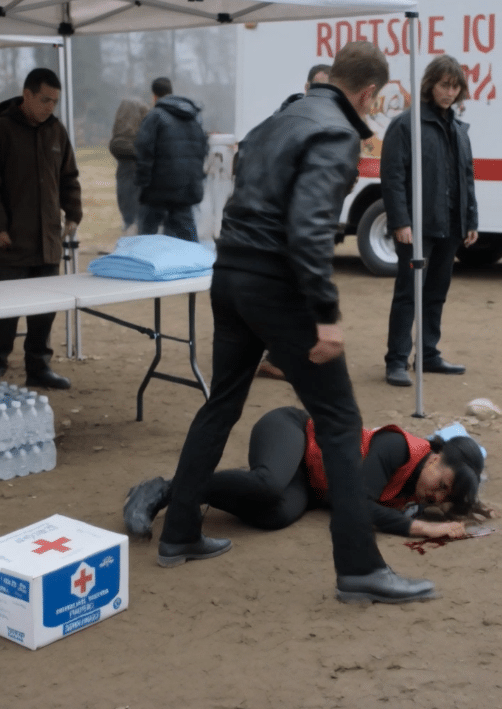
The American Red Cross worker standing behind the distribution table didn’t argue. Her red vest was stained with dust after nearly eighteen straight hours of helping survivors, yet she still greeted everyone with the same steady professionalism.
“I’m sorry, sir,” she replied. “Everyone receives supplies in order. Please wait your turn.”
His expression darkened.
To him, fairness felt like an insult.
No one realized the next few minutes would expose exactly who he was.
Act II
Emily hadn’t slept much since the storm made landfall.
She had helped unload trucks before sunrise, organized emergency shelters, comforted frightened children, and distributed food and clean water to hundreds of families.
The procedures weren’t about bureaucracy.
They were about survival.
Every case of water was counted.
Every blanket recorded.
Every family served according to urgent need.
One person taking more than their share meant another family might go without.
The wealthy visitor didn’t care.
He reached across the table, grabbed a box of supplies, and insisted that his time was more valuable than everyone else’s.
“You should bring me what I need first.”
Several people in line looked down, unwilling to make the confrontation worse.
Emily calmly placed the box back with the others.
“No one skips the line.”
That simple sentence humiliated him far more than any argument could have.
Then everything changed.
Act III
The sound of engines rolled across the relief site.
A convoy of emergency vehicles pulled beside the tents.
Volunteers immediately straightened.
Coordinators hurried toward the entrance.
Local security officers stepped into position without being asked.
Walking between them was a veteran relief leader wearing the familiar Red Cross jacket.
He didn’t rush.
He simply took one look at the scene before stepping between Emily and the furious visitor.
“Step away from her.”
The entire aid station fell silent.
The man frowned.
“Who are you…?”
No one answered.
They didn’t need to.
Every volunteer, coordinator, and security officer had already made it obvious.
Authority had arrived.
Act IV
The relief leader turned first to Emily.
“Are you alright?”
She nodded.
“My priority is finishing today’s distribution,” she answered quietly. “Families have been waiting.”
The leader’s expression softened for just a moment.
That single response reminded everyone why she had earned the respect of the entire disaster response team.
Security escorted the disruptive visitor away from the supply tables while witnesses voluntarily shared what they had seen.
Families spoke up.
Volunteers confirmed the sequence of events.
Several people had recorded the confrontation on their phones.
The man who had entered expecting special treatment suddenly found himself standing alone.
No applause.
No supporters.
Only silence.
For the first time all afternoon, his confidence disappeared.
Act V
As the sun began to set, the relief operation continued exactly as planned.
Children received blankets.
Parents carried home clean drinking water.
Neighbors helped strangers load supplies into damaged cars.
The line moved steadily because everyone understood that fairness mattered most when resources were limited.
Emily returned to work after a brief medical check, refusing special attention.
She smiled at the next family.
“How many people are in your household?”
The relief leader watched quietly before addressing the volunteers.
“In a disaster,” he said, “our greatest resource isn’t what’s inside these boxes.”
“It’s the people willing to treat every family with equal dignity.”
Weeks later, many survivors couldn’t remember the wealthy man’s name.
But they remembered the volunteer who stood her ground with kindness.
Because real strength isn’t measured by who demands to go first.
It’s measured by the person who makes sure no one is left behind.