Act I
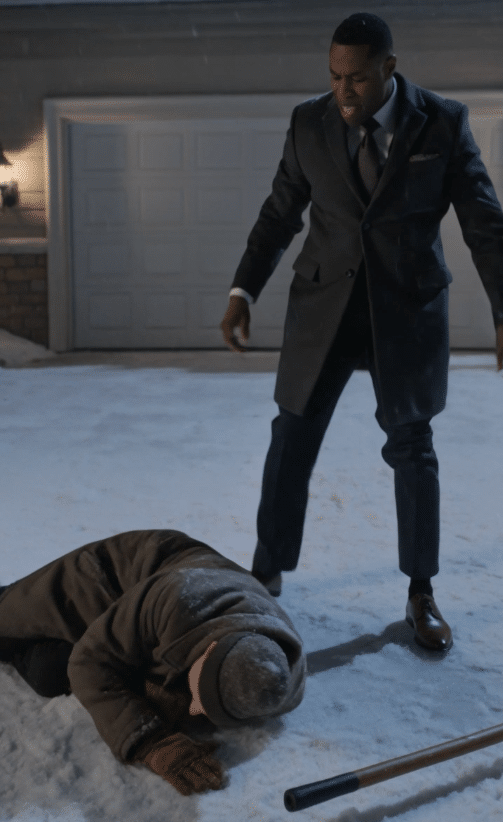
The old man’s shovel had barely completed its swing when a spray of snow and icy slush splashed across polished Italian leather.
For a heartbeat, nothing moved.
Then everything exploded.
The wealthy homeowner looked down at his expensive shoes as if they had been permanently ruined. His face twisted with disgust before his eyes lifted toward the seventy-four-year-old laborer standing only a few feet away.
The old man tightened his grip on the shovel.
“I’m sorry,” he began quietly.
He never had the chance to finish.
“Trash,” the businessman spat. “Look what you did to my shoes.”
The insult echoed down the snow-covered street as neighbors peeked through frosted windows. Thick flakes continued falling beneath the dim streetlights, covering everything except the anger burning in the man’s face.
Without hesitation, he ripped the shovel from the elderly worker’s frozen hands and hurled it into a snowbank.
The old man stumbled forward, trying only to keep his balance.
Instead, a brutal kick slammed into his chest.
His boots lost their grip on the ice.
His body crashed backward onto the frozen driveway, his elbow scraping across the rough surface before stopping against a ridge of packed snow. A thin streak of blood appeared on the torn sleeve of his coat—not enough to horrify anyone, but enough to reveal how violently he had landed.
He closed his eyes for a second, forcing himself not to cry out.
Dignity was all he had left.
The businessman wasn’t finished.
He stepped closer and drove another kick into the old man’s side.
Then another.
“People like you should disappear before sunrise.”
The words hurt almost as much as the blows.
No one moved.
No one intervened.
Everyone assumed this was simply another rich man reminding the poor of their place.
They had no idea someone else had just arrived.
Act II
For nearly twelve winters, Harold Bennett had shoveled snow across the neighborhood.
Most homeowners never bothered learning his name.
To them, he was simply “the old man with the shovel.”
Every storm, he walked miles through freezing temperatures carrying equipment older than some of the luxury cars parked in the driveways.
He charged less than anyone else.
Not because he wanted to.
Because people constantly told him they could find someone cheaper.
Years earlier, Harold had worked as a structural engineer before a devastating recession wiped out the company he’d spent three decades helping build.
His retirement savings disappeared while paying for his wife’s cancer treatment.
When she passed away, the house went with her.
The snow shovel became the only thing he still owned that consistently earned money.
Even then, he refused charity.
He believed that if he could still work, he should.
Some neighbors quietly admired him.
Others barely noticed him.
A few looked through him entirely.
Among those was Victor Ashcroft, the businessman whose mansion stood at the corner of the street.
Victor loved appearing in magazines that praised his philanthropy.
His office walls displayed awards for community leadership.
His social media overflowed with photos of charity galas and oversized donation checks.
Yet everyone who actually worked for him knew another version.
Housekeepers were fired over broken glasses.
Drivers were screamed at for traffic.
Gardeners were treated as disposable.
In Victor’s world, wealth measured human value.
Tonight, Harold had unknowingly stepped on the one thing Victor valued more than people.
His pride.
Across the street, headlights suddenly cut through the blizzard.
And every security camera on the block captured what happened next.
Act III
Three black SUVs rolled silently to a stop outside the villa opposite Victor’s home.
No sirens.
No flashing lights.
Just quiet precision.
Doors opened almost simultaneously.
Several bodyguards stepped out first before forming a respectful corridor.
Finally, a tall man in a long black overcoat emerged.
He wasn’t famous in the celebrity sense.
He didn’t need to be.
Anyone involved in banking, politics, or major real estate across Colorado knew exactly who Charles Whitmore was.
He had built one of the country’s largest private infrastructure groups and advised governors during disaster recovery projects.
Entire city developments carried his signature.
But tonight, titles meant nothing.
He wasn’t looking at the mansions.
He wasn’t looking at the convoy.
His eyes were fixed on the old man lying in the snow.
Without rushing, Charles walked directly across the icy street.
Snow collected on his shoulders as he approached.
Victor prepared another kick.
He never made contact.
Charles stepped between the two men.
His bodyguards halted several feet behind him, forming a silent wall.
The neighborhood fell strangely quiet.
Even the wind seemed softer.
Charles looked only once at the elderly worker before facing Victor.
His voice was calm.
“Step away from him.”
Nothing more.
No shouting.
No threats.
Just four words carrying the weight of unquestioned authority.
Victor laughed nervously.
“Who are you?”
The question sounded confident.
His expression did not.
Because he had begun recognizing the faces standing behind the man.
And suddenly, he understood exactly whose path he had crossed.
But the greatest revelation had nothing to do with Charles.
It had everything to do with Harold.
Act IV
Years earlier, when Charles Whitmore was only twenty-eight, he had managed a collapsing construction company burdened with impossible deadlines and unsafe structural designs inherited from previous executives.
One engineer refused to approve the blueprints.
Harold Bennett.
He warned everyone that the foundation would eventually fail.
The board ignored him.
Charles did not.
Instead of signing the project, Charles halted construction.
The decision nearly bankrupted the company.
Investors fled.
Newspapers mocked him.
Months later, inspectors uncovered catastrophic engineering defects that would have caused hundreds of deaths had construction continued.
Harold had saved lives.
Charles had simply listened.
From that day forward, Charles never forgot the quiet engineer who chose integrity over career advancement.
Years passed.
People retired.
Businesses changed.
Lives drifted apart.
Until tonight.
Charles knelt beside Harold and carefully helped him sit upright.
“You still refuse to stop working,” he said softly.
Harold managed a tired smile.
“Snow doesn’t shovel itself.”
Charles smiled back.
Then he stood.
The warmth disappeared from his face as he turned toward Victor.
“You judged a man by his coat,” he said.
“I judge men by how they treat people who cannot fight back.”
Victor suddenly realized every phone around him had been recording.
Neighbors who had remained silent were no longer looking at Harold.
They were looking at him.
His reputation had begun collapsing before anyone filed a lawsuit.
And Charles wasn’t finished.
Act V
Within forty-eight hours, security footage spread far beyond the quiet neighborhood.
People who had admired Victor’s polished public image witnessed something entirely different.
Several corporate boards announced internal reviews.
Business partners quietly distanced themselves.
Charitable organizations removed his promotional materials pending investigation.
His carefully crafted reputation dissolved far faster than the snow beneath the morning sun.
Harold, meanwhile, never asked for revenge.
He accepted medical treatment for bruised ribs and a scraped elbow before insisting he wanted to return to work once he recovered.
Charles refused to let him.
Instead, he offered Harold a permanent advisory role with his foundation, mentoring young engineers about ethics, responsibility, and courage under pressure.
When reporters later asked Charles why he had become personally involved over what many considered “just a street assault,” he answered with the same calm certainty he had shown that snowy night.
“The strongest structures are built on solid foundations.”
He paused.
“So are societies.”
“If we ignore how the weakest among us are treated, eventually everything above them collapses.”
Months later, another snowstorm blanketed the same Colorado street.
Fresh shovel marks stretched neatly across every driveway.
This time, Harold wasn’t holding the shovel.
A team of volunteers cleared the sidewalks before sunrise, refusing payment.
Some had never met him.
Others simply remembered the video.
Victor’s mansion remained strangely quiet behind closed gates.
The polished shoes that had once mattered more than a man’s dignity had long since disappeared from public memory.
What people remembered instead was an elderly worker who refused to surrender his dignity, and a powerful man who reminded an entire neighborhood that true status is never measured by wealth.
It is revealed in the moment someone chooses to stand between cruelty and the defenseless.