Act I
The fish slipped from the crate before anyone could catch it.
A splash of icy seawater landed on the polished leg of an expensive wool coat, and for a heartbeat the bustling New England seafood market fell strangely quiet. Workers paused beside stacks of fresh cod and lobster crates while gulls circled above the harbor, their cries swallowed by the winter wind.
An elderly laborer stood frozen.
His shoulders were bent from decades of lifting crates heavier than most men half his age could manage. His waterproof coat was faded from years of salt and rain, and his weathered hands tightened around the empty crate as though apologizing for an accident no one could have prevented.
Then the stranger’s voice cut through the cold.
“Trash. You got that filth on me.”
Customers turned.
The old man lowered his eyes, not out of shame, but out of habit. Years of hard work had taught him that some people never looked beyond a uniform stained by honest labor.
The confrontation escalated in seconds.
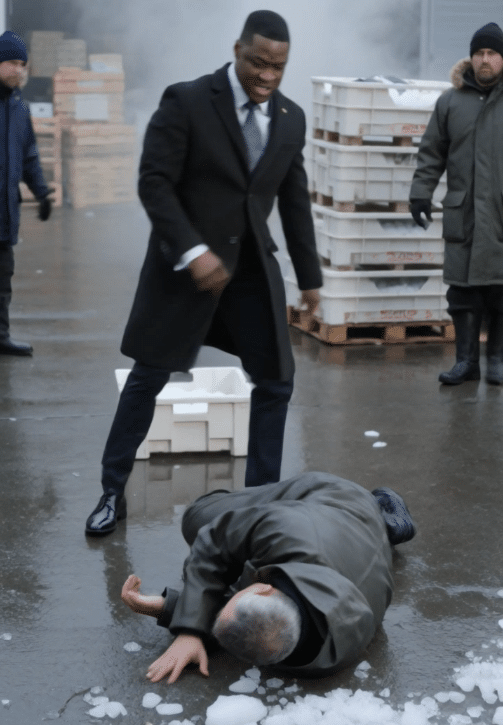
The crate crashed to the wet concrete, fish scattered across the ice, and the elderly worker stumbled heavily onto the slippery ground. He grimaced, one knee scraping against the concrete as he struggled to steady himself, refusing to complain despite the pain.
Instead of offering a hand, the wealthy man sneered.
“People like you should stay behind the stalls.”
The market fell silent.
No one knew the old worker’s story.
But someone arriving at the harbor did.
And before another word could be spoken, the sound of several black SUVs echoed through the narrow market lane.
Something had just changed.
Act II
The old worker’s name was Thomas Hale.
Most visitors never learned it.
To tourists, he was simply another aging dockhand hauling seafood through freezing mornings. To the fishermen, however, he was part of the harbor itself.
Thomas had worked those docks for nearly fifty years.
He had unloaded fishing boats during blizzards, hurricanes, and bitter winter tides. He had helped raise generations of fishermen, often taking the hardest shifts so younger workers could return home to their families.
When retirement finally came, it didn’t last.
His wife became seriously ill, and medical bills consumed the savings he had spent a lifetime building.
Rather than ask for charity, Thomas returned to the only place that had ever truly felt like home.
The harbor.
He never complained.
He simply worked.
What the arrogant visitor saw as dirt…
The fishermen saw as proof of an honest life.
As Thomas slowly pushed himself upright, he instinctively reached for the fish scattered across the ground before checking his own scraped knee.
That single act spoke louder than anything anyone could say.
Inside the market office, however, several people had already noticed the convoy pulling into the entrance.
The market owner hurried outside.
Security stopped talking.
Experienced fishmongers quietly removed their caps.
The wealthy stranger noticed the sudden change but misunderstood it completely.
He assumed they had come because of him.
He couldn’t have been more wrong.
Act III
The center SUV door opened.
A tall man stepped out wearing a dark suit beneath a heavy wool overcoat, moving with the quiet confidence of someone who never needed to raise his voice.
No one introduced him.
They didn’t have to.
Every worker at the harbor recognized him instantly.
The owner of the market walked behind him without speaking.
Security naturally fell into line.
The visitor’s confidence remained intact—until the newcomer ignored him entirely.
Instead, he walked straight toward Thomas.
For a long moment, the two men simply looked at each other.
Years seemed to disappear.
Decades earlier, when the suited man had been a teenager working his first exhausting job on the docks, Thomas had quietly taught him everything.
How to respect every worker.
How to earn trust before demanding it.
How success meant nothing if it came without humility.
Those lessons had built far more than a career.
They had shaped a life.
The suited man stepped between Thomas and the wealthy stranger.
His expression never changed.
His voice remained calm.
“Enough.”
The single word rolled across the harbor like thunder.
The gulls continued circling overhead.
But every human being in the market stood perfectly still.
For the first time that morning, the wealthy man realized he was no longer in control.
Act IV
The silence became unbearable.
The arrogant visitor glanced around, expecting someone to support him.
No one did.
Fishermen who had spent decades battling the Atlantic Ocean looked at him with quiet disappointment.
The market owner folded his arms.
Security waited without moving.
The suited man finally spoke.
“Do you know who this man is?”
The visitor hesitated.
Thomas looked away.
He had never cared about recognition.
“He carried this harbor through winters when many of us were still children,” the suited man continued. “When my father died at sea, he made sure my family never went hungry. When I started working here, he taught me what dignity looked like.”
No one interrupted.
“You see an old laborer.”
“We see the man who built this community.”
The visitor’s face slowly lost its color.
He finally understood why everyone had fallen silent the moment the convoy arrived.
This wasn’t simply an important businessman.
This was the owner whose family now operated one of the largest seafood distributors on the East Coast.
And he was defending the very worker the visitor had dismissed as worthless.
Act V
By afternoon, the market had returned to its familiar rhythm.
Ice was replaced.
Fish were sorted.
Boats prepared for the next tide.
But something invisible had changed.
Workers checked on Thomas throughout the day, though he insisted he was fine.
“You’ve got fish to sell,” he joked. “Don’t waste the morning worrying about an old man.”
The suited owner smiled.
He quietly announced that Thomas would never have to worry about medical bills again and that his position at the harbor would remain his for as long as he wanted it—not because of charity, but because respect had been earned long ago.
As for the visitor…
The expensive coat eventually dried.
The polished shoes were cleaned.
Even the faint smell of seawater disappeared.
But one memory never left him.
The moment an entire harbor chose to stand behind the quiet old laborer instead of the wealthy man who believed status could replace character.
Sometimes the strongest people in a room are not the loudest.
Sometimes they are the ones who have spent a lifetime carrying the weight that everyone else refused to lift.
And sometimes justice needs only one word.
“Enough.”