Act I
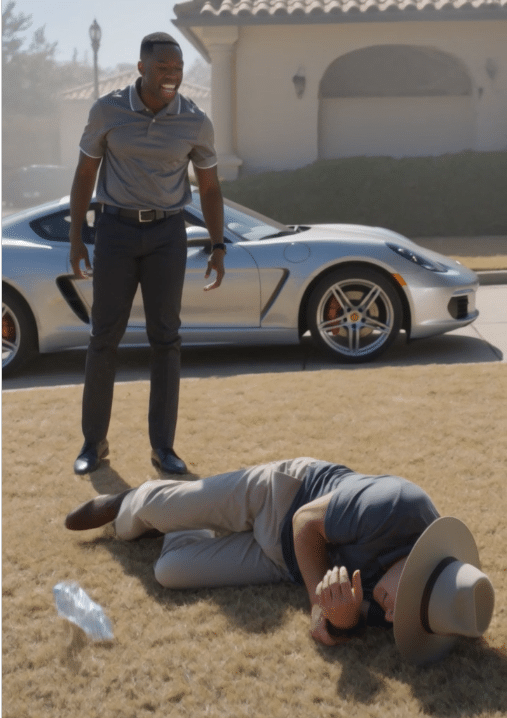
A few blades of grass drifted through the scorching Texas air and landed on the polished hood of a freshly washed sports car.
The lawn mower rattled to a stop.
The seventy-six-year-old man behind it immediately removed his gloves and reached for a rag, hoping to wipe away the tiny specks before anyone noticed. Sweat soaked through his faded shirt beneath the relentless midday sun, where the temperature hovered near one hundred degrees.
He never got the chance.
The homeowner marched down the driveway, his expensive polo untouched by heat or hard work.
“Trash. You got dirt on my car.”
The old lawn worker lowered his eyes.
“I’m sorry, sir. The wind caught it.”
The apology meant nothing.
The homeowner kicked the mower aside, sending it clattering across the dry lawn. The elderly man stumbled backward onto the brittle grass, scraping his elbow as he instinctively caught himself.
Even then, he reached first for the mower instead of himself.
“People like you ruin nice neighborhoods.”
The words echoed louder than the machine ever had.
Curtains shifted.
Garage doors opened.
Neighbors began watching from a distance.
Across the street, one man quietly stepped onto his front porch.
No one realized they were about to witness something far more important than an argument over a few blades of grass.
Act II
His name was Walter Briggs.
For nearly five decades, he had earned a living maintaining other people’s lawns.
He had watched children grow into homeowners, planted trees that now shaded entire streets, and cared for gardens whose owners rarely remembered the man responsible for their beauty.
Walter had once planned to retire.
Life had other ideas.
His wife’s long illness consumed their savings, and after she passed away, he chose work over dependence.
“I still have two good hands,” he often said.
Every summer morning, before the heat became dangerous, he loaded his aging mower into a trailer and drove from neighborhood to neighborhood.
Most people barely noticed him.
The ones who did usually smiled.
Only a few ever looked at him with contempt.
The homeowner believed expensive property determined a person’s worth.
Walter believed honest work did.
The difference between those two beliefs was about to become impossible to ignore.
Act III
The man from across the street crossed slowly, never raising his voice.
He wore a crisp white shirt and neatly pressed dress pants, as though he had nowhere urgent to be despite the heat.
Neighborhood security greeted him with quiet respect.
Several residents nodded before stepping aside.
The homeowner frowned.
“Can I help you?”
The newcomer ignored the question.
Instead, he walked directly to Walter.
“Are you all right?”
Walter nodded with his usual quiet smile.
“I’ve had hotter days.”
The stranger smiled back.
Then he turned toward the homeowner.
“Back away from him.”
Four simple words.
Every conversation on the street stopped.
The security officers remained still.
Even the homeowner hesitated.
For the first time since storming out of his house, he realized nobody around him seemed impressed by his wealth.
They were watching the man standing beside the lawn worker.
Act IV
The homeowner forced a laugh.
“And you are?”
One of the neighbors answered before the newcomer could.
“He’s the president of the homeowners’ association.”
Another added quietly,
“He also donated the land for our neighborhood park.”
A third neighbor spoke up.
“And Walter has worked on this street longer than most of us have lived here.”
The silence that followed felt heavier than the Texas heat.
The association president finally spoke.
“A clean car can be washed again.”
He looked toward Walter’s weathered hands.
“But respect, once lost, is much harder to restore.”
No one argued.
Several neighbors walked over to help Walter lift the mower upright.
Others offered cold water.
Not because anyone instructed them to.
Because someone had finally reminded them what kind of neighborhood they wanted to be.
Act V
The afternoon ended differently than it began.
Walter finished the lawn.
Not because anyone expected him to.
Because he believed unfinished work weighed heavier than exhaustion.
The homeowners’ association later created a summer safety program ensuring elderly contractors had access to shaded rest stations, drinking water, and flexible schedules during extreme heat.
Walter never asked for recognition.
He accepted it with quiet gratitude.
As for the homeowner, he eventually washed the sports car again.
The dust disappeared within minutes.
The memory didn’t.
Long after the grass had been cut and the driveway looked perfect again, neighbors remembered something far more important than a spotless vehicle.
They remembered the elderly man who protected his dignity without raising his voice.
And they remembered the calm stranger whose authority came not from power alone, but from character.
Sometimes the strongest person on the street isn’t the one with the biggest house.
It’s the one who knows exactly when to say,
“Back away from him.”