Act I
The aluminum can rolled only a few inches.
It brushed the polished sneaker of a man wearing expensive team gear as thousands of fans streamed out of the NFL stadium after a freezing night game. Wind swept discarded cups and paper across the parking lot while floodlights reflected off rows of parked cars.
The elderly woman immediately bent down.
“I’m sorry,” she whispered, reaching for the can before it could roll farther.
She was seventy-four years old.
Her small shopping cart was filled with aluminum cans collected one by one after every home game. What most fans saw as trash helped pay for groceries and medication.
The man looked at the can.
Then at her.
“Trash. You hit my shoe with garbage.”
Heads turned.
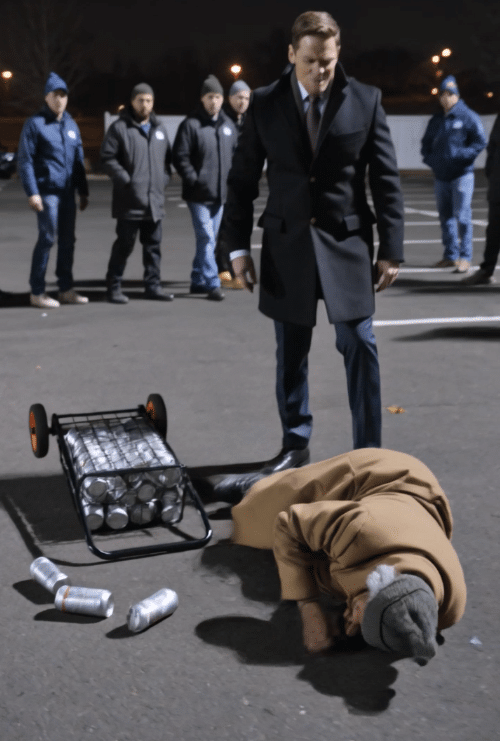
The woman quietly reached for her cart, but the man shoved it aside. Hundreds of cans scattered across the asphalt, clattering in every direction as nearby fans stopped walking.
She stumbled to one knee, scraping her forearm against the rough pavement while trying to keep the remaining cans from rolling away.
Even then, her first instinct wasn’t to defend herself.
It was to save what little she had spent the entire night collecting.
The man laughed.
“Pick it up, old trash.”
The words echoed through the cold parking lot.
Then every conversation suddenly stopped.
A convoy leaving the stadium had just come to a halt.
Act II
Her name was Eleanor Price.
For decades she had worked ordinary jobs that rarely earned recognition.
Factory shifts.
School cafeteria kitchens.
Hospital laundry rooms.
After retirement, rising living expenses slowly consumed everything she had managed to save.
Collecting cans became her final source of extra income.
She never begged.
She simply worked.
Most stadium employees knew her by name.
Security guards often greeted her with a smile after games.
She always waited until crowds were leaving before quietly collecting recyclables nobody else wanted.
To her, every can mattered.
To the angry fan, they represented something beneath his attention.
He never imagined dozens of people had already witnessed exactly what happened.
Nor did he realize who had just stepped out of the lead vehicle nearby.
Act III
The black SUV stopped only a short distance away.
A tall man wearing a long dark coat stepped onto the pavement, followed by stadium security and several members of his staff.
Nobody called out his title.
Nobody needed to.
Employees immediately cleared a path.
Security officers straightened instinctively.
The crowd sensed authority before a single word was spoken.
The man ignored the scattered cans.
Ignored the shouting.
He walked directly toward Eleanor.
Years earlier, when he had been a young operations employee working late-night events, Eleanor had quietly shared hot coffee and sandwiches with staff members who couldn’t afford dinner during overnight shifts.
She never expected thanks.
She simply believed no one should finish work hungry.
He had never forgotten.
Standing between Eleanor and the fan, he spoke only once.
“Step away from her.”
The sentence was calm.
Measured.
Final.
The entire parking lot fell silent.
Act IV
The fan looked around, confused.
Security wasn’t watching the elderly woman.
They were watching him.
Fans who had recorded the confrontation lowered their phones but remained where they stood.
Nobody laughed anymore.
Finally, the man in the long coat spoke again.
“This woman has shown more respect to this stadium than many people wearing our colors.”
His eyes shifted toward the scattered cans.
“You saw garbage.”
“I see someone who has spent years doing honest work after everyone else went home.”
The fan swallowed hard.
His confidence disappeared almost instantly.
Only then did someone quietly whisper the identity of the man beside Eleanor.
He wasn’t just another executive.
He was the stadium president.
Everything changed in that moment.
Act V
Long after the parking lot emptied, workers finished gathering the scattered cans.
Not because anyone ordered them to.
Because Eleanor had never deserved to do it alone.
The stadium later expanded its recycling program, hiring local seniors who wanted flexible work and creating designated collection stations after every event.
Eleanor accepted the opportunity with the same quiet smile she had worn for years.
She never asked for recognition.
She simply appreciated being seen.
The fan eventually disappeared into the departing crowd.
His expensive shoes remained spotless.
His reputation did not.
Months later, people still remembered the cold night when thousands of football fans learned an unforgettable lesson.
Character is never measured by what someone owns.
It is revealed by how they treat the person everyone else overlooks.
Sometimes justice doesn’t arrive with raised voices.
Sometimes it walks calmly across an empty parking lot, speaks a single sentence, and reminds everyone watching what dignity truly looks like.
“Step away from her.”