Act I
The metal bucket hit the wet concrete with a deafening clang.
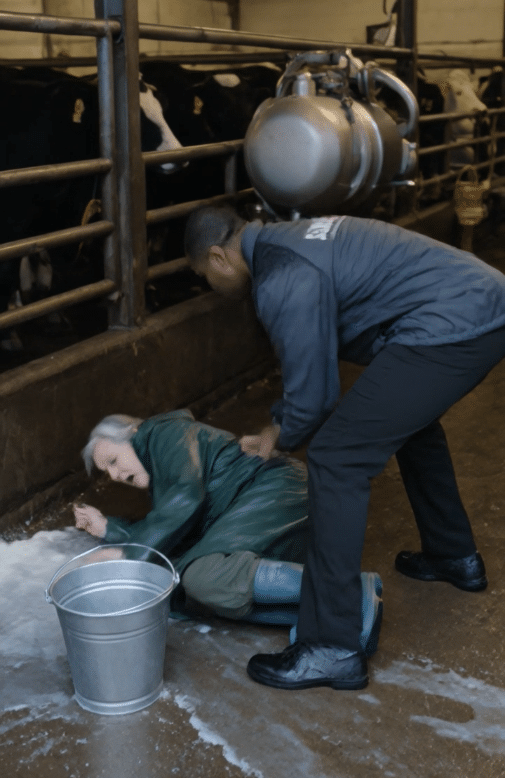
Milk spread across the barn floor as rain hammered the roof overhead. The elderly dairy worker immediately bent down, her trembling hands reaching for the overturned bucket before anyone else could.
“I’m sorry. The floor is slippery.”
Her voice barely carried over the sound of the storm.
She was sixty-eight years old. After forty years of farm work, aching joints and failing eyesight had become part of every shift. Tonight, the relentless heat had broken into a cold downpour, turning the barn entrance into a slick trap.
It was a simple accident.
One bucket.
A few gallons of milk.
Something that could be cleaned in minutes.
But the farm manager didn’t see an accident.
He saw someone to blame.
He marched across the barn, boots splashing through the spilled milk, his face twisted with rage.
“Trash. You just wasted my product.”
Before anyone could react, he kicked the metal bucket so hard it skidded across the concrete and crashed into a support beam.
The old woman instinctively stepped backward.
It wasn’t enough.
His boot slammed into her chest.
She crashed onto the wet floor beside the milking station, one hand scraping the concrete as she tried to break her fall. A thin red mark appeared across her palm.
The barn fell silent.
No one moved.
No one dared.
The manager wasn’t finished.
He stepped forward and delivered two brutal kicks into her side and back while workers watched in frozen disbelief.
Rain pounded harder outside.
Inside, only fear remained.
But someone unexpected had already arrived.
Act II
For years, everyone simply called her Margaret.
Few people knew her last name.
Even fewer knew she had once supervised three different dairy farms before arthritis forced her into lighter work.
Retirement had never been an option.
After her husband died from cancer, medical bills swallowed nearly everything they owned.
The farm became her second chance.
She showed up before sunrise.
She stayed after sunset.
She never complained.
Even on the hottest nights.
Even during freezing winters.
Even when younger employees quit after a single week.
Most of the workers respected her because she quietly helped everyone.
If someone’s machine jammed, Margaret fixed it.
If a new employee struggled, she trained them.
If someone forgot lunch, she shared hers.
She believed honest work deserved dignity.
Unfortunately, the new manager believed something very different.
Ever since taking over operations, he had become obsessed with productivity charts, labor costs, and hourly output.
Workers weren’t people.
They were numbers.
Especially older workers.
He mocked them openly during meetings.
He threatened layoffs almost every week.
He constantly reminded everyone that “slow workers are expensive workers.”
Tonight’s accident gave him the excuse he had been waiting for.
Standing over Margaret, he sneered.
“Workers like you cost me money.”
Several employees lowered their heads.
Not because they agreed.
Because they were terrified they might be next.
Then…
The sound of tires echoed outside.
Not one vehicle.
Several.
Everything changed.
Act III
SUVs rolled into the farmyard, their headlights slicing through the sheets of rain.
Brakes squealed.
Doors slammed.
The massive barn entrance swung open with enough force to make everyone turn.
A woman in a dark raincoat walked inside without hesitation.
Behind her came an operations director.
Two assistants.
Regional supervisors.
Several people carrying inspection folders.
The manager’s confidence vanished instantly.
She didn’t acknowledge him.
She didn’t ask questions.
She walked directly toward Margaret, knelt beside her, and helped her sit upright.
Only after making sure the elderly worker was breathing comfortably did she stand.
Then she faced the manager.
Her voice remained perfectly calm.
“That mistake is nothing compared to yours.”
The barn became completely silent.
The manager forced a laugh.
“You are?”
No one answered for her.
They didn’t have to.
The operations director stepped forward.
Every regional supervisor straightened.
Employees who had never saluted anyone instinctively stood taller.
The manager suddenly recognized several faces from corporate newsletters.
This wasn’t a routine visit.
It was an unannounced regional audit.
And he had just assaulted an employee in front of the entire inspection team.
His face turned white.
But the biggest surprise had yet to come.
Act IV
The executive slowly removed her rain-soaked gloves.
“I’ve been reviewing complaints from this farm for three months.”
She looked around the barn.
“Anonymous reports.”
Photographs.
Witness statements.
Medical leave records.
Safety violations.
Payroll discrepancies.
Every sentence landed harder than the last.
“We delayed today’s inspection because I wanted to observe normal operations.”
She glanced toward Margaret.
“What I just witnessed exceeded every allegation.”
The manager tried to interrupt.
“It was an accident. She—”
“No.”
The executive cut him off.
“The accident was spilled milk.”
She paused.
“The assault was your decision.”
The operations director quietly handed her a tablet.
Multiple security camera angles filled the screen.
Every kick.
Every insult.
Every second.
Recorded.
The manager looked toward his supervisors for support.
None met his eyes.
One by one, they stepped away from him.
For the first time in years, he stood completely alone.
Act V
Paramedics arrived minutes later to examine Margaret.
Thankfully, her injuries were limited to bruising and a scraped palm, but the emotional shock was obvious.
Coworkers who had remained silent moments earlier finally gathered around her.
Some apologized through tears.
Others admitted they had been too frightened to intervene.
Margaret simply nodded.
She understood fear better than anyone.
The executive addressed the entire workforce before leaving.
“No production target is worth a person’s dignity.”
She announced that the manager was terminated immediately pending criminal and civil investigations.
Every employee who had previously reported intimidation would receive confidential interviews with HR.
Safety policies would be rewritten.
Mandatory leadership retraining would begin across the region.
Most importantly, older employees would no longer be evaluated under unrealistic productivity standards designed for workers half their age.
As dawn approached, the rain finally stopped.
Golden light filtered through the barn doors.
Margaret looked across the same floor where she had fallen only an hour earlier.
One of the younger workers quietly picked up the dented milk bucket, washed it, and placed it beside her.
“You don’t have to finish your shift,” he said softly.
Margaret smiled for the first time that morning.
“No,” she replied.
“But maybe tomorrow will finally feel like a place worth coming back to.”
Sometimes justice doesn’t arrive with sirens.
Sometimes it arrives in the sound of tires on wet gravel, a barn door swinging open, and someone powerful enough to remind everyone that the greatest loss wasn’t a spilled bucket of milk.
It was forgetting that every worker deserves to be treated like a human being.