Act I
The first apples hit the dirt before anyone could react.
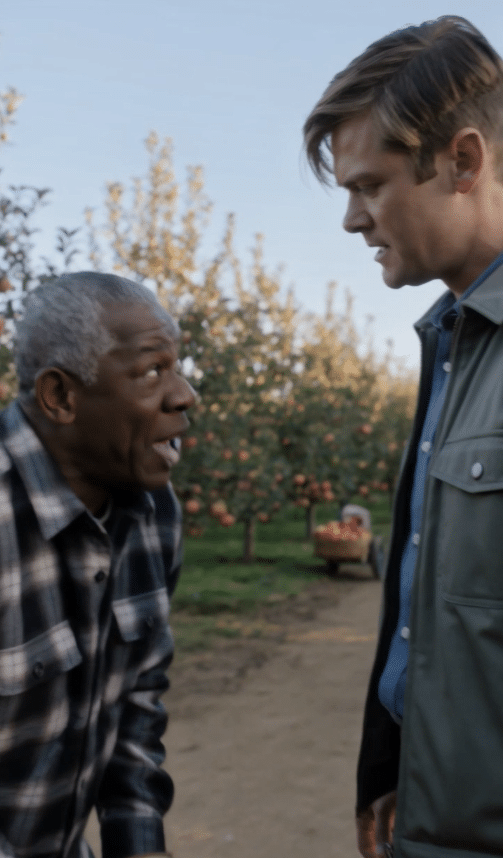
A worn wooden crate slipped from the elderly picker’s tired hands, sending bright red fruit rolling across the orchard path. Workers instinctively bent to help, but one voice cut through the late-afternoon air before anyone moved.
“Trash. Excuses don’t fill orders.”
The orchard manager strode forward, his spotless jacket standing in sharp contrast to the weathered clothes of the seventy-one-year-old man struggling to gather the scattered apples.
“The crate was too heavy,” the old worker said quietly, his breathing uneven after hours in the fields.
The explanation only seemed to fuel the manager’s anger.
In front of the entire harvest crew, he berated the old man, accusing him of slowing production, costing money, and embarrassing the farm. The workers lowered their eyes. No one dared interrupt.
The humiliation was far worse than the spilled apples.
But none of them noticed the vehicles pulling through the orchard entrance.
Something was about to change.
Act II
The old picker had worked those fields longer than many employees had been alive.
He never complained.
He arrived before sunrise, stayed until dusk, and treated every tree as though it belonged to his own family. While younger workers came and went, he remained season after season, believing honest work still mattered.
The new manager saw things differently.
To him, every worker was a number.
Every delay was a financial loss.
Every mistake deserved a public lesson.
Over the previous year, experienced workers had quietly resigned. Those who stayed endured constant pressure, impossible quotas, and daily humiliation.
Still, the old man never left.
He simply kept picking apples.
That loyalty was about to become far more important than anyone realized.
Act III
The sound of tires crunching over gravel echoed across the orchard.
A black pickup followed by two SUVs stopped near the entrance.
Conversation disappeared.
Senior managers climbed out first.
Then a distinguished sixty-year-old man stepped from the lead vehicle.
Nobody announced his name.
Nobody needed to.
Every supervisor immediately straightened their posture.
The orchard manager’s confidence wavered for the first time.
The visitor didn’t look at the scattered apples.
He didn’t inspect the harvest.
His eyes settled immediately on the elderly worker struggling to stand.
Without hesitation, he crossed the orchard and positioned himself between the old man and the manager.
Then, in a calm voice that somehow carried across the entire field, he asked a single question.
“Do you know who built this farm?”
Silence answered him.
The manager swallowed hard.
“Who is he?”
Act IV
The executive looked toward the elderly picker with unmistakable respect.
“This man planted the first commercial orchard on this property decades ago.”
The workers stared in disbelief.
Long before investors arrived…
Before the warehouses…
Before the distribution contracts…
There had only been a small family orchard and one determined farmer willing to risk everything.
That farmer was standing before them now.
When age finally made the work too difficult, he had quietly sold the business—but accepted one unusual condition.
He asked for a simple seasonal job.
Not because he needed the money.
Because he couldn’t imagine harvest season anywhere else.
Only a handful of executives knew the truth.
The new manager had never bothered to ask why an elderly worker received such quiet respect from the oldest employees.
He had assumed weakness.
He had mistaken humility for insignificance.
Now the entire harvest crew understood.
The man he had publicly humiliated wasn’t just another worker.
He was the reason the farm existed.
Act V
The orchard remained completely still.
The executive helped the elderly man to his feet before turning back toward the stunned manager.
“The apples can be picked up,” he said evenly.
“But respect is much harder to recover.”
The visiting executives quietly documented everything they had witnessed.
Human resources began interviewing workers immediately.
Employees who had stayed silent for months finally spoke.
Stories poured out—about intimidation, impossible demands, and public humiliation that had driven good people away.
By sunset, the manager had been relieved of his duties pending a full investigation.
The old picker never celebrated.
He simply returned to gathering the apples that had rolled across the path.
One by one.
Just as he always had.
Several younger workers joined him without being asked.
For the first time in a long while, no one looked away in silence.
They worked beside him—with gratitude.
Because the greatest harvest that afternoon wasn’t measured in crates.
It was the moment an entire orchard remembered that the people who build something deserve more respect than those who merely manage it.