Act I
The grocery bags were already slipping from Arthur Bennett’s trembling hands.
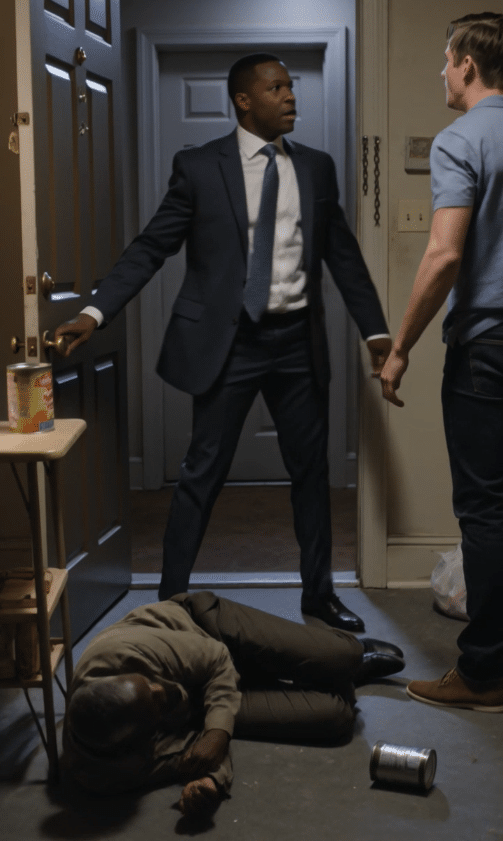
The seventy-nine-year-old widower had barely closed his apartment door when the man wearing a delivery jacket stepped farther inside instead of leaving. Under the weak glow of a single lamp, the tiny apartment revealed almost nothing—an old table, a nearly empty kitchen shelf, and a handful of canned goods that would have to last another week.
Arthur tightened his grip.
“Please…” he pleaded, his voice shaking. “That is all I have for the week.”
The stranger’s polite smile disappeared as quickly as it had appeared.
“Trash,” he scoffed. “You won’t even finish it.”
He yanked the grocery bags away, and the struggle sent canned food rolling across the worn floorboards. The old table rattled as Arthur lost his balance and fell beside it, too stunned to understand how a simple grocery delivery had turned into a robbery.
The thief dragged the bags toward the apartment door.
Arthur reached out anyway.
Not because he believed he could stop him.
Because hunger leaves people with very little left to lose.
The man looked back with cold impatience.
“Stay down and let me leave.”
For a moment, the apartment fell silent except for Arthur’s labored breathing and the soft clatter of a can spinning to a stop.
Then someone outside heard the noise.
And everything changed.
Act II
Arthur Bennett had spent most of his life fixing things.
For nearly four decades he worked as a maintenance technician in the city’s public schools, repairing broken desks, replacing light fixtures, and making sure children arrived each morning to classrooms that felt safe.
He retired with little more than a modest pension.
When his wife, Eleanor, passed away three years earlier, the apartment became painfully quiet.
He learned to count every dollar.
Every loaf of bread.
Every can of soup.
The grocery bags on the floor weren’t just food.
They represented an entire week’s survival until his next check arrived.
The thief couldn’t see that.
He saw only an elderly man living alone.
Someone slow.
Someone unlikely to fight back.
Someone whose disappearance from the evening news would never become tomorrow’s headline.
Arthur knew he couldn’t overpower him.
But he also knew something else.
His apartment walls were thin.
Very thin.
Act III
A deafening crash echoed through the hallway.
The apartment door burst open before the thief could reach it.
Standing in the doorway was Marcus Hayes.
Forty-five years old.
Broad-shouldered.
Still wearing the dusty work boots from his construction job.
His eyes swept across the room in a single second.
The scattered groceries.
The overturned table.
Arthur struggling to push himself upright.
The bags clutched in the stranger’s hands.
Marcus stepped into the doorway and planted his feet.
There was nowhere left to go.
His voice was calm, but every word landed with unmistakable weight.
“Put his food back.”
The thief frowned.
“You don’t know what you’re getting into.”
Marcus didn’t answer.
He simply held his ground.
For years the neighbors had watched out for one another without making a show of it.
They accepted packages.
Checked on elderly residents during storms.
Shared meals when times became difficult.
Tonight, that quiet habit became Arthur’s greatest protection.
The thief looked toward the only exit.
Marcus wasn’t moving.
Neither was fear.
Act IV
The apartment suddenly felt even smaller.
Arthur remained on the floor, watching the two men without saying a word.
Marcus never raised his fists.
He never shouted.
His confidence came from something stronger than anger.
He knew the thief had expected isolation.
Instead, he had found resistance.
“You picked the wrong door,” Marcus said quietly.
The thief laughed once, but it sounded forced.
His eyes darted between Marcus and the hallway beyond, measuring every possible escape.
None looked easy.
Slowly, he tightened his grip on the grocery bags.
Then, as though making one final desperate gamble, he reached inside his coat.
Marcus didn’t flinch.
Arthur held his breath.
A small folding knife appeared in the thief’s hand, held low between them.
It wasn’t swung.
It wasn’t used.
It was simply enough to transform the room into a tense standoff.
The silence became heavier than any threat.
Act V
“Move.”
The word came out harder than the thief intended, but beneath it was something new.
Uncertainty.
For the first time that night, he no longer looked like the man in control.
Marcus never stepped aside.
Instead, he looked directly into the thief’s eyes.
“You still have a choice.”
The hallway outside was no longer empty.
Doors had begun opening.
Neighbors, alerted by the commotion, stood just beyond the apartment entrance. Someone had already called the police.
The thief realized the opportunity he had counted on was gone.
Arthur wasn’t alone anymore.
Neither was he invisible.
Moments later, sirens echoed faintly from the street below.
The thief’s confidence crumbled.
He let the grocery bags fall to the floor.
Cans rolled gently back toward Arthur’s feet, almost as though finding their way home.
The knife lowered.
The illusion of power disappeared with it.
Long after the officers had arrived and the hallway had grown quiet again, Marcus helped Arthur place every can back into the cupboard.
Arthur looked at the shelves, still sparse but no longer empty.
Then he looked at his neighbor.
“I thought nobody heard me.”
Marcus smiled.
“I did.”
Outside, the city carried on as though nothing extraordinary had happened.
But inside that tiny apartment, one truth lingered long after the lights were turned off.
Criminals often search for people who appear alone.
What they rarely expect is that courage sometimes lives just beyond the next wall—and all it takes is one neighbor willing to answer a cry for help.