Act I
The old phone hit the wooden bench with a dull clatter before sliding across the surface and stopping inches from a group of laughing teenagers.
Nobody reacted at first.
Then one girl reached down, picked it up between two fingers as though it were something dirty, and smiled.
Across the laundromat, a twelve-year-old girl froze.
Her laundry basket rested beside an aging washing machine, overflowing with folded clothes she had spent the last hour helping her mother wash after another exhausting shift. The fluorescent lights above buzzed softly, casting pale reflections across rows of rumbling machines.
She wasn’t thinking about the laundry anymore.
She was staring at the phone.
It wasn’t worth much.
The cracked screen had survived more drops than anyone could count. The faded plastic case had once been blue but now looked gray from years of use. The battery barely lasted half a day.
To everyone else, it was junk.
To her, it was everything.
She hurried forward, trying to hide the panic rising inside her.
“Please,” she whispered, forcing a smile that never reached her frightened eyes. “I need that to call my mom.”
The older girl looked at her friends before raising the phone higher, just beyond the child’s reach.
The group burst into laughter.
“Trash,” the teenager sneered. “Then pay to get it back.”
More laughter echoed through the laundromat.
Several customers looked over.
None of them moved.
The little girl searched every pocket she had.
Nothing.
She wasn’t carrying money.
Her mother always kept what little they had tucked safely away because every dollar mattered.
“I really need it,” she pleaded again. “My mom worries if she can’t reach me.”
The bully tilted her head dramatically.
“Sounds like your problem.”
The child reached forward one last time.
That single movement changed everything.
But nobody realized how expensive that moment would become.
Act II
The teenager casually slipped the phone behind her back.
Then, without warning, she stepped forward.
Her foot slammed into the little girl’s chest with brutal force.
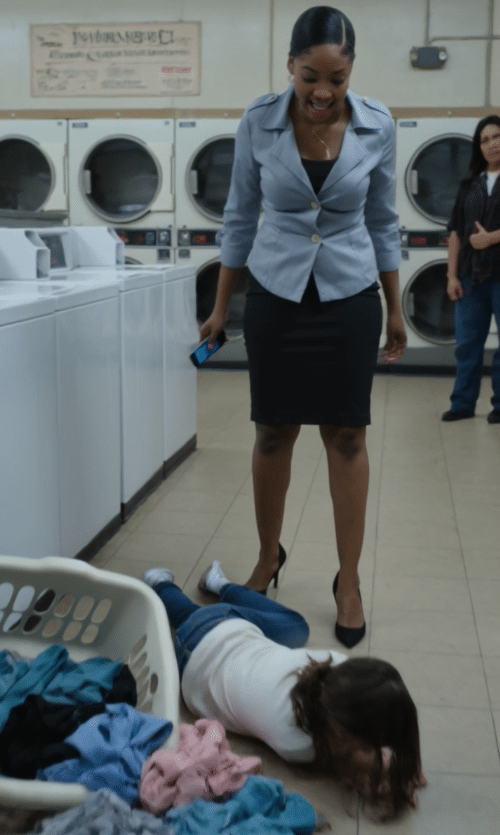
The child was thrown backward, crashing beside her laundry basket.
Plastic scraped loudly across the tile floor before tipping over completely.
Freshly washed clothes spilled everywhere.
White shirts.
Tiny socks.
A faded pink sweater carefully folded only minutes earlier.
The washing machines continued rumbling as if nothing had happened.
For a second, nobody breathed.
The little girl struggled to sit up, gasping more from shock than pain.
She instinctively looked around the floor.
Not for herself.
For the phone.
The bully slowly walked closer.
Her friends circled behind her like an audience waiting for the next performance.
Then came the first kick.
It struck the girl’s back, knocking the remaining air from her lungs.
Before she could even recover—
A second kick landed against her side.
Exactly two.
No more.
The laughter grew louder.
Someone even took out a phone, ready to record what they thought was another viral humiliation.
Customers shifted uncomfortably in their seats.
Some looked away.
Others stared without speaking.
Fear is strangely contagious.
Sometimes it silences an entire room.
The bully looked down at the child, still clutching the old phone like a trophy.
“Cry louder,” she mocked.
“Maybe your mom will hear.”
The words cut deeper than anything else.
The little girl lowered her head.
She wasn’t crying because she had fallen.
She wasn’t crying because strangers were watching.
She cried because somewhere across town, her mother would soon finish work, reach for her own phone, and wonder why her daughter wasn’t answering.
What nobody inside the laundromat knew was that this old building carried a history far older than the machines inside it.
And someone who knew every inch of that history was only seconds away.
Act III
Outside, headlights swept across the front windows.
A black SUV stopped abruptly.
The laundromat door burst open.
Cold night air rushed inside.
Conversation disappeared instantly.
Several security officers entered first.
They didn’t run.
They didn’t shout.
Instead, they moved with practiced precision, forming a quiet line across the room.
Only after they stepped aside did the woman enter.
She looked to be in her late forties.
Elegant without trying.
Calm without effort.
She said nothing.
Her eyes traveled across the scattered clothes.
The overturned basket.
The frightened child.
Finally—
The phone.
Still resting inside the bully’s hand.
Every security guard remained perfectly still.
Nobody needed instructions.
Their silence alone told everyone who held authority.
The bully laughed nervously.
“What’s this supposed to be?”
The woman never answered.
She took one slow step forward.
Then another.
Until only a few feet separated them.
Her voice was quiet.
Yet every washing machine seemed to disappear beneath it.
“Give her the phone.”
No yelling.
No threats.
Just four words.
The bully rolled her eyes.
“You serious?”
The woman never blinked.
Again—
“Give her the phone.”
Something about her stare unsettled everyone.
Even the teenagers who had laughed moments earlier suddenly looked at one another, unsure whether they should still be smiling.
Because this no longer felt like entertainment.
It felt like judgment.
And the woman standing before them looked frighteningly familiar to the employees working that night.
There was a reason for that.
One hidden behind years of quiet generosity no customer had ever noticed.
Act IV
The manager hurried out from the back office, his face draining of color the moment he saw the woman.
Without hesitation, he lowered his head.
“Ma’am…”
That single word spread through the laundromat faster than any whisper.
The customers exchanged confused looks.
The teenagers stopped laughing entirely.
The woman wasn’t a police officer.
She wasn’t a politician.
She wasn’t a celebrity.
She owned the entire building.
Years earlier, after growing up in poverty herself, she had quietly purchased the aging property instead of allowing developers to demolish it.
Most people never knew her name.
She preferred it that way.
The laundromat barely made a profit.
She kept it open anyway.
Not because it earned money.
Because families who couldn’t afford expensive laundry services still needed somewhere clean to wash their clothes.
She often visited without announcing herself.
Sometimes late at night.
Sometimes dressed so simply that nobody recognized her.
Earlier that evening, she had reviewed security footage from another section of the building before walking toward the laundromat.
Then she saw the crowd.
The little girl.
The phone.
Everything else.
She hadn’t intervened immediately because security needed only seconds to reach her.
Those seconds had felt like forever.
Now they were over.
The woman finally looked toward the frightened child.
“Are you hurt?”
The girl nodded uncertainly, trying to wipe away tears before speaking.
“I’m okay…”
It was the kind of answer children gave when they feared becoming a burden.
The woman’s expression softened for only a heartbeat.
Then she turned back toward the teenager.
“That phone.”
Her voice remained perfectly calm.
“Now.”
For the first time that night, the bully’s hand trembled.
She slowly held out the battered device.
It suddenly looked exactly like what it truly was.
Not garbage.
Not something worthless.
But the final thread connecting a frightened child to the only person waiting for her at home.
Security stepped between the group and the little girl, creating a silent barrier that no one dared cross.
The balance of power had shifted completely.
Yet the biggest lesson was still waiting to be learned.
Act V
The woman carefully accepted the phone.
She didn’t inspect it.
She didn’t comment on its cracked screen.
Instead, she walked directly to the little girl and gently placed it back into her hands.
“Here.”
The child gripped it tightly against her chest.
As though she had been reunited with something alive.
Moments later, her mother rushed through the entrance, breathless after receiving a call from one of the employees.
She immediately dropped to her knees, wrapping both arms around her daughter.
Neither spoke.
Neither needed to.
Some embraces say everything words cannot.
Around them, the laundromat remained silent.
The same people who had watched without acting now struggled to meet one another’s eyes.
The woman glanced across the room.
“Power isn’t measured by who you can humiliate,” she said quietly.
“It’s measured by who you choose to protect.”
No one argued.
No one laughed.
The security team escorted the teenagers toward the exit while employees began gathering the scattered clothes from the floor.
The washing machines never stopped rumbling.
Life rarely pauses for moments that change us forever.
But everyone inside that laundromat knew they had witnessed something they would never forget.
Not because an important woman had appeared.
Not because security had filled the room.
But because a battered old phone had revealed something far more valuable than money.
It exposed character.
As the little girl held her mother’s hand, the woman watched them leave before turning toward the exit herself.
Behind her, one voice finally broke the crushing silence.
The bully swallowed hard, staring after the woman whose authority had erased every ounce of confidence she once carried.
“You know her?”
No one answered.
They didn’t have to.
For the first time that night, the girl who had laughed the loudest understood exactly how small she had become.