Act I
The hallway smelled faintly of bleach and damp concrete, the kind of scent that never seemed to leave the aging temporary housing building.
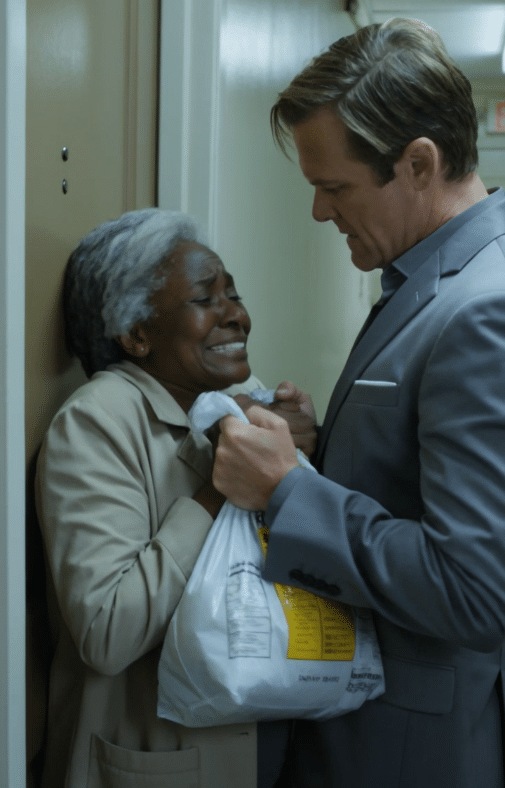
An elderly woman had barely reached her apartment door when a large man stepped directly into her path.
Before she could react, he grabbed the handles of the emergency food bag she had just received from the weekly community distribution.
She held on with both hands.
It wasn’t just another grocery bag.
Inside were canned vegetables, rice, soup, oatmeal, and enough food to help her survive the coming week.
Without it, she had nothing.
“Please…” she begged, her voice trembling. “That is my food for the week.”
Residents quietly peeked through half-open doors.
They recognized the man immediately.
Everyone did.
For months he had intimidated weaker tenants, borrowing things he never returned, making threats no one wanted to report, and relying on the silence of frightened neighbors.
He looked around with the confidence of someone who believed nobody would challenge him.
“Trash,” he scoffed. “You don’t need all that.”
The old woman tightened her grip.
She knew she couldn’t overpower him.
She only hoped he might still have enough humanity left to let go.
Instead, he yanked the bag away with force.
Food boxes tumbled across the hallway, cans rolling loudly against the walls as frightened residents watched from their doorways.
For one painful moment, no one moved.
No one spoke.
The silence made his cruelty feel even larger.
But someone else had already entered the building.
He just didn’t know it yet.
Act II
The elderly woman struggled to gather herself as scattered groceries rolled farther down the corridor.
She crawled toward a dented can of soup before it disappeared beneath a radiator.
The bully stood over the spilled food as though he had won a prize.
“Stay in your room, old woman.”
His words echoed through the narrow hallway.
Several residents looked down, ashamed they hadn’t intervened.
It wasn’t because they didn’t care.
It was because fear had become routine.
Many of them depended on the same housing program.
Many believed reporting him would only make life harder.
The old woman lived alone.
Her husband had passed away years earlier, and her children lived hundreds of miles away, struggling with families of their own.
She never asked for much.
She simply tried to remain invisible.
That was exactly why he chose her.
Bullies rarely search for strength.
They search for isolation.
What he failed to realize was that the building had recently become the subject of a community review after multiple anonymous complaints.
And the people conducting that review had arrived at exactly the wrong moment—for him.
Act III
The back hallway door swung open.
Footsteps echoed across the concrete floor.
Conversation disappeared.
The building manager entered first.
Behind him walked a senior official from the community-aid program responsible for funding and overseeing the housing complex.
Two security staff followed close behind.
No one raised their voice.
No one rushed.
Their calm presence carried far more authority than shouting ever could.
The large man slowly turned.
His grip on the food bag loosened.
The official’s eyes moved across the hallway.
The frightened residents.
The scattered groceries.
The elderly woman still on the floor.
Finally—
They settled on the food bag in the man’s hands.
The official stepped forward.
Her expression never changed.
“Put that food down.”
The hallway became so quiet that even the hum of the emergency lights seemed loud.
The man forced a laugh.
“What?”
No one answered.
The official repeated herself.
“Put it down.”
For the first time, uncertainty crossed his face.
Because he recognized her.
And he understood exactly what her presence meant.
Act IV
The building manager spoke before anyone else could.
“We’ve received repeated reports of intimidation in this building.”
His voice was steady.
“And today, we witnessed it ourselves.”
The bully’s confidence began to crumble.
The community-aid official didn’t argue with him.
She didn’t threaten him.
She simply explained the consequences.
The housing program existed to protect vulnerable residents, not those who preyed upon them.
Security stepped between the elderly woman and the man while another staff member carefully began collecting the scattered food.
Residents slowly opened their doors wider.
For months they had believed no one would listen.
Now they realized someone finally had.
One by one, voices began to emerge.
An older veteran described being threatened.
A disabled resident admitted groceries had disappeared before.
Another tenant quietly revealed she had stopped collecting food alone because she feared running into him.
Each testimony added another piece to the truth.
The bully suddenly found himself standing alone.
Not because people had stopped fearing him.
Because they had finally stopped fearing him more than they trusted justice.
Act V
The community-aid official personally handed the rebuilt food bag back to the elderly woman.
Nothing inside was treated as insignificant.
Every can.
Every box.
Every package represented another meal she would not have to worry about.
The old woman held the bag tightly against her chest.
This time, no one tried to take it.
The building manager assured residents that formal action would begin immediately and that additional security measures would be put in place to protect vulnerable tenants.
For the first time in months, neighbors stepped out into the hallway without immediately lowering their eyes.
The atmosphere had changed.
Not because the building itself was different.
Because fear had finally lost its monopoly.
The official looked around at the gathered residents.
“A community isn’t judged by how it treats the strongest,” she said quietly.
“It’s judged by whether the weakest can feel safe.”
No one argued.
The bully stared at the people surrounding him, realizing every excuse he had relied upon had disappeared.
His voice, once loud enough to intimidate an entire hallway, barely rose above a whisper.
“You saw that?”
The answer was written on every face in the corridor.
This time, everyone had.