Act I
“I’m sorry. The crowd pushed me.”
The apology came out before the eleven-year-old girl even understood what had happened.
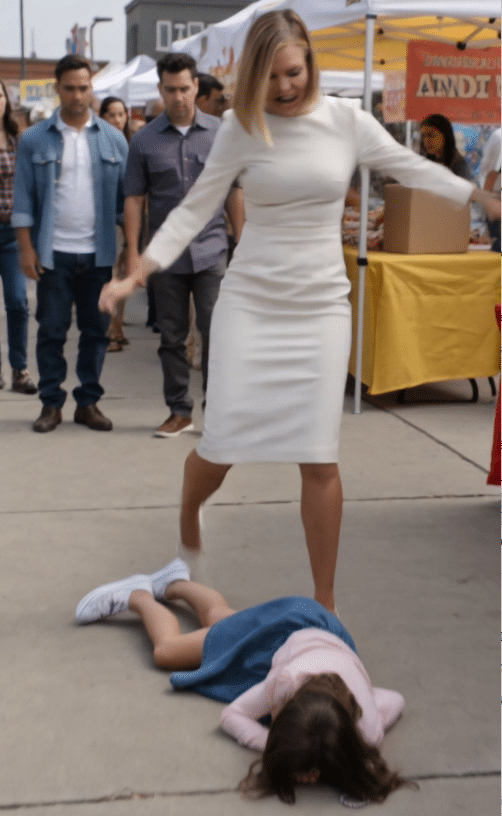
She tightened her grip on the small tray of handmade bracelets, but one accidental bump in the crowded community fair had already changed the mood around her. A wealthy woman in a pristine white dress looked down at the faint wrinkle in her sleeve as though something poisonous had touched her.
“Trash. Don’t touch me.”
The chatter around the fundraiser faded.
The little girl lowered her eyes. She wasn’t trying to sell luxury jewelry. Every bracelet had been woven by hand to help her family pay overdue bills after her father’s illness left him unable to work.
She simply whispered another apology.
Instead of accepting it, the woman slapped the tray from the girl’s hands.
Bracelets scattered across the pavement like tiny pieces of hope.
Nobody moved.
And then the woman said the words everyone would remember.
“Dirty kids shouldn’t sell here.”
The silence became almost unbearable.
But someone else had just heard every word.
Act II
The girl dropped to her knees, gathering bracelets one by one before they disappeared beneath hundreds of passing feet.
Some people looked away.
Others pretended not to notice.
She had learned long ago that pity rarely paid for groceries.
Her mother worked double shifts cleaning offices.
Her father spent most days recovering from surgery.
So every weekend, she stood at local events selling colorful woven bracelets that cost only a few dollars.
Each bracelet carried a handwritten tag.
“Thank you for helping my family.”
Many people smiled.
Some donated extra.
Most simply wished her luck.
But today, one wealthy stranger had decided that a frightened little girl made an easy target.
She never noticed the volunteers exchanging worried glances.
Or the event security turning toward the commotion.
Because someone far more important had already started walking through the crowd.
Act III
The crowd slowly parted.
Not because anyone ordered them to.
Because everyone recognized the man walking toward the fundraiser.
Beside him were several longtime volunteers and event security staff, all wearing expressions that instantly changed the atmosphere.
The head of the community organization stopped beside the scattered bracelets.
He didn’t raise his voice.
He simply looked at the little girl kneeling on the ground before turning to the woman.
“Step away from our fundraiser.”
The confidence drained from her face.
“Our fundraiser?”
Only then did she notice the volunteers greeting the man with quiet respect.
He wasn’t an ordinary visitor.
For years, he had organized scholarship drives, food banks, school supply programs, and emergency assistance for struggling families throughout the county.
And the little girl…
He knew exactly who she was.
Act IV
Months earlier, the organization had quietly begun helping the girl’s family after learning about her father’s medical condition.
The bracelets weren’t an unauthorized stand.
Every dollar had been approved through the community fundraiser.
Every sale was helping cover rent, medication, and school supplies.
The organizer knelt beside the child and carefully picked up one bracelet after another.
Soon the volunteers followed.
Then nearby families joined them.
Within moments, dozens of people were gathering the scattered bracelets with surprising care.
The wealthy woman suddenly found herself standing alone.
The organizer looked at her calmly.
“This event exists so children like her never have to lose hope.”
No one applauded.
No one cheered.
The disappointment in the crowd was louder than any shouting could have been.
Act V
Something remarkable happened next.
One customer purchased five bracelets.
Another bought twenty.
A local business owner quietly offered to match every donation collected that afternoon.
People who had walked past the stand only minutes earlier returned with cash, cards, and encouraging words.
The nearly empty donation box became completely full.
The girl tried to thank everyone, but emotion caught in her throat.
She simply smiled through tears she had been trying so hard to hide.
The organizer placed one bracelet gently around his own wrist.
“This,” he said quietly, “is the easiest donation I’ll make today.”
The wealthy woman stood speechless, surrounded not by anger but by something far more difficult to face.
Disapproval.
She had looked at a child and seen only poverty.
Everyone else now saw courage.
As the fair returned to life, the little stand became the busiest place in the entire event.
And the bracelets she feared would never sell again disappeared one by one—not because people pitied her, but because they wanted the world to know exactly which side they had chosen.