Act I
“I’m sorry. The wind blew them.”
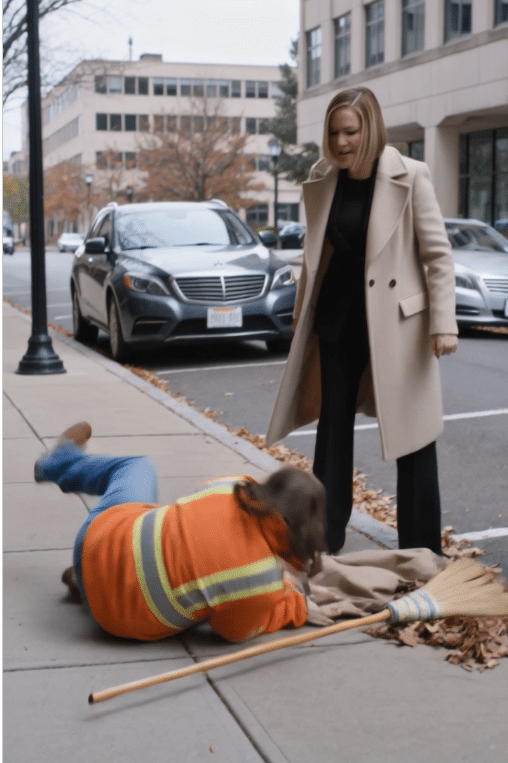
The words barely left the leaf cleaner’s mouth before the man in the tailored cashmere coat looked at his luxury car as though it had been vandalized.
Only a handful of dry autumn leaves rested against the polished door.
To everyone else, it was nothing.
To him, it was an excuse.
“Trash. Kneel and clean it.”
The woman froze, still holding her broom. She had been working outside the office building since sunrise, sweeping sidewalks before hundreds of employees arrived.
A sudden gust had carried a few leaves farther than she expected.
She apologized immediately.
It didn’t matter.
“Clean it with your hands.”
Office workers slowed their pace.
Nobody spoke.
And that silence made the humiliation even worse.
Someone, however, had just stepped through the revolving glass doors.
Act II
The woman had worked around the building for nearly fifteen years.
She knew every cracked section of sidewalk, every flower bed, every tree that shed too early in the fall.
Rain.
Snow.
Heat.
She showed up anyway.
She wasn’t invisible to everyone.
Security guards greeted her every morning.
Receptionists saved her coffee when the weather turned cold.
Maintenance workers joked that she knew the property better than they did.
Yet to one wealthy stranger, she wasn’t a person at all.
She was simply someone he believed he could order around.
He pointed again at the car.
“I said, use your hands.”
She slowly bent to gather the scattered leaves.
Not because he deserved obedience.
Because she wanted the confrontation to end.
It never got that far.
Act III
The revolving glass door turned again.
Conversations stopped almost instantly.
The building owner emerged alongside members of the management team, reviewing documents as they walked.
Then he looked up.
His eyes landed on the woman.
Then on the luxury car.
Then on the businessman standing over her.
He changed direction without saying another word.
Employees immediately recognized what was happening.
Management followed behind him in complete silence.
When he reached the sidewalk, his voice was calm enough to make everyone stop breathing.
“She works for this building.”
He paused.
“You don’t.”
The businessman frowned.
“You own this building?”
Act IV
The owner ignored the question.
Instead, he walked directly to the cleaner.
“Are you alright?”
She nodded, embarrassed by the attention more than anything else.
He turned toward the management team.
“How many years has she been with us?”
“Almost fifteen.”
“And has she ever received a complaint?”
“No.”
The owner looked back at the businessman.
“So today, after fifteen years of honest work, you’re demanding she kneel because the wind carried a few leaves?”
No one defended him.
Not even the coworkers who had arrived with him.
The owner brushed the leaves off the car himself with one effortless motion.
“There.”
“The problem is gone.”
His gaze hardened.
“The real problem is still standing here.”
Act V
Management quietly informed the businessman that his behavior had been witnessed by dozens of employees and recorded by the building’s exterior security cameras.
Several office workers who had remained silent stepped forward, confirming exactly what had happened.
The confidence that had filled the businessman only moments earlier disappeared.
The cleaner tried to apologize again.
The owner gently interrupted.
“You’ve spent years taking care of this property.”
“You never need to apologize for the wind.”
He picked up her broom and handed it back with both hands—a gesture of respect that everyone noticed.
Around them, employees who had witnessed the confrontation began thanking her for the work she had done for years without recognition.
Some offered coffee.
Others simply smiled.
For the first time that morning, she smiled back.
The leaves would be swept away in minutes.
But the lesson remained much longer.
Because everyone present learned the same truth:
Character is revealed not by how someone treats a luxury car—but by how they treat the person holding the broom.