Act I
The apology came before anyone had time to get angry.
“I’m sorry. I’ll wipe it up.”
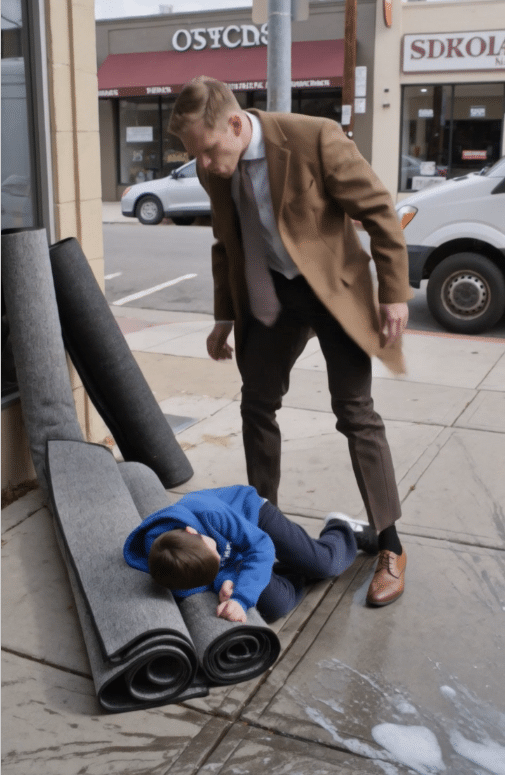
A thin stream of soapy water had escaped from a cleaning bucket and reached the polished leather shoe of a sharply dressed businessman walking past the carpet-cleaning van. The thirteen-year-old boy froze where he stood, clutching a rolled carpet that was almost too heavy for him.
Instead of accepting the apology, the man exploded.
“Trash. You soaked my shoes.”
His voice cut through the busy sidewalk, turning heads. Pedestrians slowed. Shopkeepers looked up. The boy instinctively stepped backward, frightened more than anything.
“Kids like you ruin everything.”
The businessman shoved the rolled carpet from the boy’s hands. It hit the pavement with a heavy thud, splashing more soapy water across the sidewalk. The bucket tipped over, and the clean water spread around the carefully washed carpets.
The boy stumbled and fell to one knee, staring at the mess he had worked all morning to avoid.
Nobody moved.
Not yet.
Then a van door slammed shut.
Everything changed.
Act II
The carpet-cleaning business wasn’t a large company. It had one aging delivery van, a loyal crew, and a reputation built over three decades.
The boy wasn’t there because child labor was expected.
He was there because his mother, recovering from surgery, had insisted she could still finish deliveries. He had begged to help after school rather than let her struggle alone.
Every customer on the route knew him.
They knew how carefully he carried every rolled carpet.
How he thanked every customer.
How he never complained.
The businessman knew none of that.
All he saw was worn sneakers, damp sleeves, and someone he assumed didn’t matter.
The silence around them suddenly shifted.
Several employees stepped out from the company van.
Behind them walked a silver-haired man whose calm expression carried more authority than any raised voice ever could.
The businessman hadn’t noticed him before.
He was about to wish he had.
Act III
The older man surveyed the scene without speaking.
The soaked sidewalk.
The scattered cleaning equipment.
The frightened boy trying to gather everything before anyone blamed him.
Then his eyes settled on the businessman.
“Get away from my worker.”
The words were quiet.
They didn’t need to be louder.
The company’s senior technicians instinctively stepped between the boy and the businessman. Even nearby shop owners straightened when they recognized the speaker.
This wasn’t simply another employee.
He had founded the company decades earlier with one used van and a promise that every worker would be treated like family.
Many of the surrounding businesses trusted him because he had never broken that promise.
The businessman frowned.
“Your worker?”
The question sounded confident.
But the confidence was beginning to crack.
Act IV
The owner helped the boy to his feet before saying another word.
“You all right?”
The boy nodded, embarrassed more than hurt.
Only then did the owner face the businessman again.
“You saw a child trying to help his family,” he said evenly. “You chose humiliation instead of kindness.”
No shouting.
No insults.
Just the truth.
Employees from neighboring stores had already begun describing exactly what they had witnessed.
Several phones had captured the confrontation.
The businessman looked around for support.
He found none.
People who had remained silent out of shock now quietly stood beside the boy instead.
The balance of power had shifted completely.
Not because someone yelled louder.
Because everyone finally understood who had acted with dignity.
Act V
The owner bent down and handed the boy the rolled carpet that had been knocked onto the sidewalk.
“You’ve done good work today,” he said. “Let’s finish the delivery.”
The technicians quickly cleaned the remaining water while nearby shopkeepers volunteered towels and helped reorganize the load.
What had started as a public humiliation became something entirely different.
A reminder that respect isn’t measured by expensive shoes or tailored coats.
It’s measured by how someone treats the person standing in front of them.
The businessman stood alone, watching as the crowd that had once watched in silence now gathered around the people he had dismissed.
For the first time that afternoon, he understood that the smallest act of contempt can become the largest public failure.
And no amount of wealth could buy back the respect he had just lost.