Act I
“This is my seat.”
The elderly veteran’s voice was calm, but his weathered hands tightened around the medal-and-paper bag resting on his lap.
Inside the Greyhound station, passengers glanced up from their phones as a sharply dressed businessman stepped directly in front of the wheelchair.
He looked at the old man as though he were an inconvenience.
Then he pointed toward the row of blue waiting seats.
“Trash. Move.”
The veteran didn’t argue.
He simply remained where he was.
His bus had been delayed twice already.
His legs no longer allowed him to stand for long.
The businessman lost his patience.
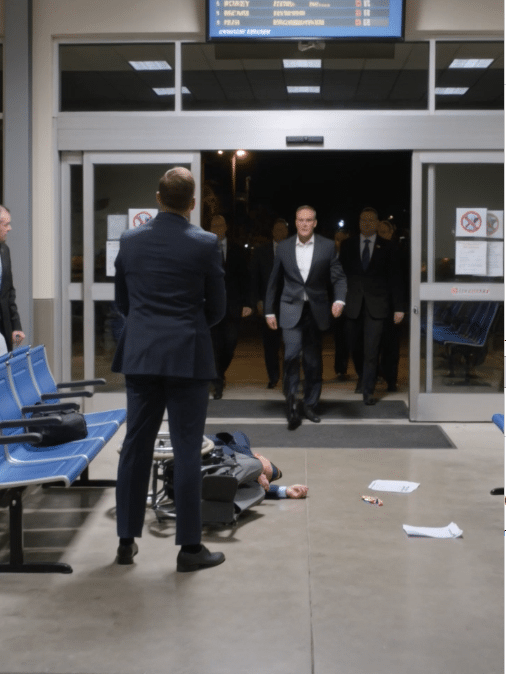
Without warning, he drove a brutal kick into the veteran’s chest, sending the wheelchair lurching backward. The elderly man crashed onto the hard station floor beside the waiting seats, the impact knocking the medal-and-paper bag from his lap.
His elbow struck the tile, leaving a thin streak of blood.
Loose papers scattered across the floor.
So did several military medals.
The veteran reached for them instinctively.
Before he could move, the businessman snatched up the bag.
Two more crushing kicks landed against the old man’s back and side while he lay helpless beside the wheelchair.
Passengers gasped.
No one stepped forward.
The businessman glanced toward the empty seat with smug satisfaction.
“Now the seat is mine.”
To everyone else, the bag looked old and worn.
To the veteran…
It carried a lifetime of honor.
And hidden beneath the medals was a document powerful people had spent decades protecting.
Act II
His name was Samuel Carter.
Seventy-two years old.
A decorated combat veteran.
A widower.
A father who had buried his only son years earlier.
After returning from military service, Samuel never sought recognition.
He worked as a mechanic.
Raised his family.
Lived quietly.
Only after losing the use of his legs did he begin traveling by bus to veterans’ hospitals across the country.
The worn canvas bag never left his side.
Most assumed it held medication and personal belongings.
Very few realized it contained every military medal he had earned, together with original service records, handwritten letters from fallen comrades, and a sealed recommendation that had never been publicly announced.
Decades earlier, Samuel had repeatedly refused publicity for an act of extraordinary courage that saved dozens of lives during combat.
His commanding officer submitted his name for the nation’s highest military honor.
Samuel declined every ceremony.
He believed the men who never came home deserved the spotlight instead.
The nomination remained sealed in military archives.
Only a handful of officials even knew it existed.
One of them had spent years trying to persuade Samuel to accept the recognition.
Tonight, after months of searching, he finally knew exactly where Samuel would be waiting.
He was only moments away.
Act III
Samuel struggled across the floor, ignoring the pain in his ribs.
His eyes never left the bag.
Not because of the medals.
Because of the letters inside.
Letters written by soldiers who never returned home.
Promises entrusted to him.
The businessman casually swung the bag over one shoulder.
Passengers looked away.
No one wanted trouble.
Then the station’s glass doors flew open.
Cold night air rushed inside.
A group of sharply dressed men entered with purpose, led by a silver-haired man wearing a black suit beneath a long charcoal coat.
Their footsteps echoed through the terminal.
Without hesitation, two members of the group hurried toward Samuel.
They carefully helped him back toward his wheelchair.
The leader never looked at anyone except the businessman.
Then he spoke.
“Lift him up.”
The command wasn’t directed at the bully.
It was directed at his own team.
Within seconds, Samuel was safely seated again.
The leader’s attention shifted to the medal bag.
His eyes narrowed.
Recognition crossed his face.
The businessman suddenly felt the room change.
Every passenger was watching now.
Every conversation had stopped.
He tightened his grip on the bag.
Too late.
The man standing before him already knew exactly what it contained.
Act IV
“My name is General Thomas Whitaker.”
The title alone silenced the terminal.
Retired four-star general.
Former Chairman of the Joint Veterans Commission.
The very officer who had spent years trying to honor Samuel Carter’s forgotten heroism.
Thomas slowly reached into his coat and removed a sealed military folder.
“I’ve carried this for twelve years.”
He opened it carefully.
Inside was the original recommendation naming Samuel Carter for the nation’s highest military decoration, signed by every surviving member of his unit.
Samuel lowered his eyes.
“I told them not to.”
Thomas smiled faintly.
“You never wanted recognition.”
“That’s exactly why you deserved it.”
One of the assistants recovered the medal bag and placed it gently back into Samuel’s hands.
The old veteran ran his fingers across the worn fabric as though greeting an old friend.
Meanwhile, station security arrived after receiving multiple emergency calls.
Several passengers finally admitted what they had witnessed.
Security cameras had captured every second.
The assault.
The theft.
The kicks.
The businessman who believed money gave him the right to treat another human being as disposable suddenly found himself surrounded by witnesses instead of silent strangers.
The balance of power had shifted completely.
Act V
Several months later, Samuel reluctantly accepted the honor he had avoided for decades.
The ceremony wasn’t held because he sought applause.
It was held because history deserved the truth.
Families of fallen soldiers attended.
Many wept as they learned the full story of the man who had repeatedly risked his own life so others could return home.
Samuel’s medals remained inside the same worn bag.
He refused every offer to replace it.
“It reminds me,” he quietly said, “that courage isn’t something you display.”
“It’s something you carry.”
The Greyhound station later installed a plaque recognizing veterans who had traveled through its doors for generations.
Passengers rarely knew the story behind it.
But those who witnessed that night never forgot.
Not the scattered medals.
Not the old man’s dignity.
Not the moment two suited men lifted him back into his wheelchair with the respect he had always deserved.
And certainly not the expression on the businessman’s face.
The entitlement disappeared.
The arrogance faded.
Only fear remained as he stared at the silver-haired leader standing between him and the veteran.
His voice came out almost as a whisper.
“Who are you?”
By then, everyone in the station already knew.
The most powerful man in the room wasn’t the one wearing the expensive suit.
It was the aging veteran who had spent a lifetime proving that true honor never needs to announce itself.