Act I
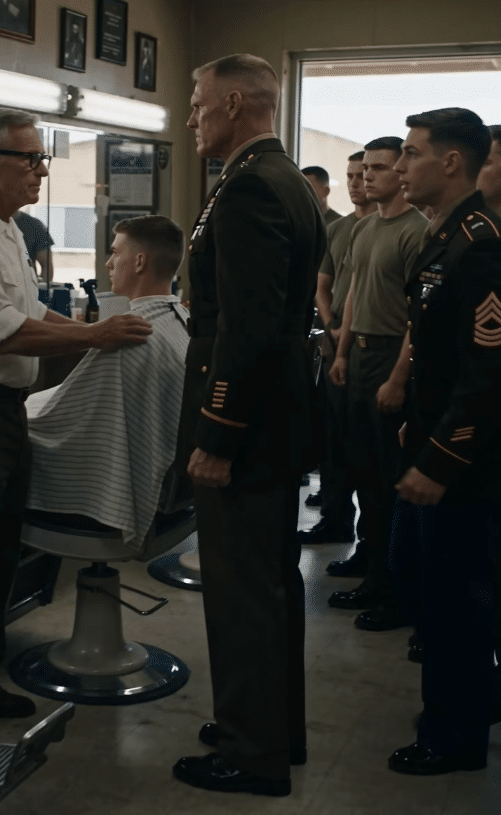
The barber shop had three chairs.
The Major General wanted all of them to move faster.
Young recruits were already waiting along the wall, numbers in their hands, while clippers buzzed beneath harsh fluorescent lights. Towels hung beside old mirrors, and the elderly barber moved calmly from one chair to the next.
Then the General walked in.
His uniform was immaculate.
His rank was impossible to miss.
His Captain approached the barber, expecting the waiting line to disappear.
A few seconds later, he returned.
“Sir, he says you have to take a number.”
The General looked toward the barber.
The old man didn’t look impressed.
He simply kept working on the recruit in his chair.
“Everyone in this chair waits their turn.”
The General’s expression hardened.
“Do you know who I am?”
The barber glanced at him.
“Yes.”
“Then you understand why I’m not waiting.”
“I understand you’re next after them.”
A recruit lowered his eyes.
Another stopped talking.
The Captain shifted his weight.
The General stepped toward an empty chair and threw the cutting cape aside.
The barber immediately moved between him and the waiting recruits.
“Don’t disturb them.”
The General stared at him.
Then his fist moved.
The punch struck the barber across the cheek.
The old man reeled backward into the barber chair.
It spun sharply beneath him.
For one terrifying second, the seated recruit nearly lost his balance.
But the barber caught the chair.
He steadied the recruit first.
Only then did he turn back.
His cheek was already reddening.
His breathing was tight.
But his eyes were completely steady.
The General looked at him with open contempt.
“Barbers don’t seat generals behind privates.”
The barber said nothing.
He placed the clippers safely on the counter.
Straightened his vest.
And stood upright.
As he turned, the back of his collar shifted.
Something appeared beneath his silver hair.
An old scar.
And beside it, a tiny mark.
A retired First Sergeant sitting near the corner saw it.
He stood so quickly his chair scraped the floor.
His face had gone pale.
He knew that scar.
Act II
The First Sergeant had spent decades learning which military stories were worth remembering.
Most disappeared into paperwork.
Some survived in photographs.
A very small number survived only in the memories of people who had been there.
The mark beneath the barber’s hair belonged to one of those memories.
He stared at it.
Then at the old man’s face.
Then at the Major General.
“General… I wouldn’t hit him again.”
The room became silent.
The General turned.
“You taking orders from a barber now?”
The First Sergeant didn’t answer.
His eyes remained fixed on the scar.
The recruits were watching him now.
So was the Captain.
A moment earlier, the Captain had expected the General to dominate the room.
Now he wasn’t so sure.
The barber adjusted his collar.
The scar disappeared again.
But the First Sergeant had already seen enough.
He remembered a different time.
A different command.
A man whose voice could stop an entire room without ever becoming loud.
A senior officer whose authority wasn’t measured by how aggressively he displayed it.
The First Sergeant had served under that kind of leader.
He had also seen what happened when people mistook restraint for weakness.
The barber picked up the clippers.
The recruit in the chair was still visibly nervous.
“You okay?”
The young soldier nodded.
The barber gave him a small reassuring look.
Then he returned his attention to the General.
The General noticed the exchange.
“You think you’re protecting these boys?”
“I’m doing my job.”
“You’re a barber.”
“Today.”
The General frowned.
The First Sergeant’s expression changed.
That single word landed differently on him.
Today.
Not always.
Not forever.
The General stepped closer.
The barber didn’t move.
The First Sergeant quietly shook his head.
But the General was no longer listening.
He had been challenged in front of junior soldiers.
And he wanted the room to remember who held the rank.
What he didn’t know was that the room was beginning to remember someone else.
Act III
The barber shop had become a strange little battlefield.
No weapons.
No shouting.
Just a line of recruits, three chairs, a few stopped clippers, and an old man refusing to surrender a principle.
The General pointed toward the queue.
“Move them.”
“No.”
“You’re embarrassing me.”
“I’m not responsible for that.”
The Captain looked away.
The First Sergeant almost closed his eyes.
He knew that voice.
He had heard it years ago.
Calm.
Measured.
Completely uninterested in rank theater.
The barber reached behind the counter and placed a fresh towel beside the recruit.
The General watched him.
“You’re enjoying this?”
“No.”
“Then why aren’t you afraid?”
The barber looked at him.
“Because you haven’t given me a reason to be.”
The First Sergeant’s eyes dropped.
He remembered the scar.
He remembered the tiny mark beside it.
And he remembered the last time he had seen it.
Not in a barbershop.
Not beneath fluorescent lights.
It had been years earlier, under conditions no one in this room would have guessed.
There had been an operation.
A crisis.
A decision that had required someone to step forward when everyone else wanted to wait.
The scar had come from that period.
The mark had meant something to those who served under the person who carried it.
The First Sergeant never knew why that person eventually disappeared from military life.
He only knew that when the order came, everyone listened.
And now that same scar was sitting beneath a barber’s collar.
The General noticed the First Sergeant’s expression.
“What?”
The veteran looked at him.
Nothing came out.
The barber finally turned toward him.
“He’s remembering.”
The General’s eyes narrowed.
“Remembering what?”
The barber said nothing.
The First Sergeant’s shoulders had straightened unconsciously.
The recruits noticed.
The Captain noticed.
And eventually, the General noticed too.
Whatever the old man had once been, it had left an impression on people who had served long before the General’s current command.
The General looked at the barber again.
For the first time, the question wasn’t why an elderly barber refused to yield.
It was why an experienced First Sergeant seemed frightened of what that refusal represented.
Act IV
The General tried to recover control.
“You expect me to believe this scar means something?”
The First Sergeant remained silent.
The barber picked up his comb.
“It doesn’t have to mean anything to you.”
The General stared at him.
“Then why does he look like that?”
The barber glanced toward the veteran.
The First Sergeant immediately looked down.
The General’s irritation became suspicion.
“Who are you?”
The barber didn’t answer.
The General stepped closer.
“I asked you a question.”
The old man simply looked at him.
There was something different in his eyes now.
The calmness was still there.
But beneath it was something the General recognized without understanding why.
Command.
Not arrogance.
Not performance.
Command.
The kind that had been practiced so long it no longer needed a uniform.
The First Sergeant finally spoke.
“General, just let it go.”
“Why?”
“Because you’ve already done enough.”
The same words.
The same warning.
Only now the General understood that the veteran wasn’t worried about the barber.
He was worried about what would happen if the General learned who the barber really was.
The old man slowly adjusted his collar.
The tiny mark disappeared again.
The General’s eyes followed it.
He had spent years studying military history.
He knew the famous names.
He knew the commanders whose photographs hung in headquarters.
He knew the stories of officers who had risen through the ranks.
But there were stories that never made official histories.
Men and women who had led from the shadows.
Commanders whose authority had been unquestioned by the people who actually served with them.
The First Sergeant was looking at the barber as though he were looking at one of those figures.
The General swallowed.
“You’re saying he gave your last one?”
The barber didn’t correct him.
The First Sergeant didn’t explain.
The silence itself became an answer.
The General’s confidence began to fracture.
He looked at the old man’s scar.
Then at the veteran.
Then back at the barber.
Suddenly, the uniform on his own shoulders didn’t feel quite as powerful as it had five minutes earlier.
And the barber still hadn’t said a word about his former rank.
Act V
Nobody touched the waiting queue.
The recruits remained in their chairs.
The clippers stayed silent.
The General’s Captain stood near the doorway, no longer eager to speak.
The old barber calmly checked the recruit’s haircut.
“You’re good.”
The young soldier nodded.
The barber removed the cutting cape.
Everything about the gesture was ordinary.
That was what made the moment so unsettling.
The man the General had just punched was behaving as though rank had never been the issue.
Fairness was.
Respect was.
The First Sergeant stood nearby, still pale.
He had recognized the scar.
He had recognized the mark.
And he remembered who had once carried both.
But he wouldn’t say the name.
The barber didn’t ask him to.
The General looked at the old man’s neck again.
His mind began connecting fragments.
An old command.
A veteran story.
A scar.
A tiny mark.
A leader who had vanished from active service.
The General’s breathing changed.
He suddenly understood why the First Sergeant had warned him.
Why the veteran had stood.
Why the Captain had stopped smiling.
The old man hadn’t needed to announce his history.
The First Sergeant had already recognized it.
The General looked toward the veteran.
The older man wouldn’t meet his eyes.
That frightened him more than an answer would have.
The barber turned back to his work.
The General remained frozen.
His rank was still visible.
His uniform was still immaculate.
But the certainty behind it was gone.
He looked once more at the place where the old scar disappeared beneath the collar.
Then at the veteran who remembered what it meant.
His voice came out almost as a whisper.
“Who gave…?”