Act I
“I’m just delivering papers!”
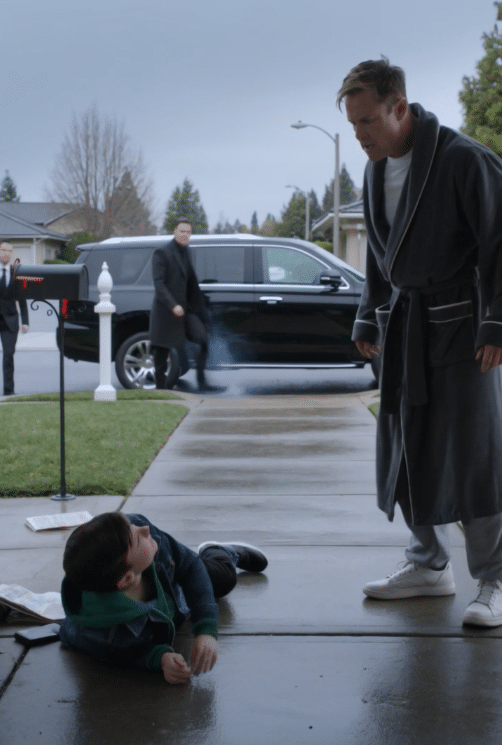
The boy’s voice cracked as he sprinted across the wet sidewalk, newspapers bouncing inside the worn canvas bag slung over his shoulder. Dawn had barely broken, but the quiet suburban street exploded with shouting as a furious homeowner charged after him.
“Trash. You woke my house.”
The thirteen-year-old didn’t stop. He couldn’t. Every newspaper had to reach a doorstep before sunrise, and every minute mattered. Missing deliveries meant losing money his family desperately needed.
But the wealthy homeowner wasn’t interested in excuses.
He caught up in three long strides.
A powerful kick slammed into the boy’s back.
The child flew forward, crashing onto the sidewalk beside a mailbox. Newspapers burst into the air like frightened birds, scattering across the rain-soaked pavement. His knee struck the concrete first, leaving only a thin trace of blood as pain twisted across his face.
He tried to push himself up.
Instead, his small leather wallet slipped from his pocket.
The homeowner smiled.
That tiny wallet held an entire week’s earnings.
He bent down, picked it up, and slipped it into his own hand as though taking candy from a child.
The neighbors watched from behind curtains and half-open doors.
No one moved.
Fear often sounds exactly like silence.
The boy reached toward the wallet.
“Please…”
The man looked down with complete contempt.
What happened next would make an entire neighborhood question how long they had mistaken wealth for respect.
Act II
The boy curled beside the scattered newspapers, trying to protect himself.
It didn’t matter.
The homeowner stepped closer and drove two more brutal kicks into the child’s back and side before finally stopping.
The newspapers drifted through puddles.
Headlines dissolved beneath dirty water.
“Earn silence next time.”
He tucked the wallet into his robe pocket as though he had earned it.
The child lay trembling, his hands refusing to obey him.
His name was Ethan.
Every morning since his twelfth birthday, he had ridden an old bicycle through the neighborhood before school. While other children slept, Ethan memorized delivery routes, greeted early commuters, and raced the sunrise.
Most people assumed he wanted spending money.
Very few knew the truth.
His mother worked nights cleaning office buildings after chemotherapy treatments had left her too weak for full-time work. His father, a former firefighter, had died three years earlier while rescuing a family trapped inside a burning apartment complex.
Insurance payments disappeared into medical bills.
Savings disappeared into rent.
The newspaper route wasn’t a hobby.
It kept food on the table.
Every dollar inside that little wallet had already been promised—to groceries, electricity, and the medicine waiting at the pharmacy.
The wealthy homeowner didn’t know any of that.
And even if he had…
It probably wouldn’t have mattered.
He believed people like Ethan existed beneath people like him.
The neighborhood believed it too.
That was why everyone stayed frozen.
Until the sound of squealing tires echoed through the morning air.
Act III
A black SUV slid to the curb so suddenly that water sprayed across the street.
The rear door opened before the vehicle came to a complete stop.
A tall man stepped out, dressed in a black tailored suit beneath a long dark coat. Two bodyguards followed without hesitation.
One immediately knelt beside Ethan, carefully gathering the scattered newspapers before helping shield the frightened boy.
The other quietly positioned himself between the child and the homeowner.
The newcomer never looked rushed.
His calm was far more intimidating than anger.
His eyes settled on the wallet still clutched in the homeowner’s hand.
“Don’t touch the boy.”
The street became completely silent.
The homeowner laughed.
“And why should I listen to you?”
The stranger didn’t answer immediately.
Instead, he looked at Ethan.
“Are you hurt?”
The boy nodded without speaking.
Only then did the man return his attention to the homeowner.
Most people knew him simply as Daniel Mercer.
To the business world, he was the billionaire founder of one of the nation’s largest logistics companies.
To Ethan…
He was a complete stranger.
Or so the boy believed.
Years earlier, before Mercer became one of the country’s most influential executives, he had been a struggling entrepreneur driving an old delivery truck across state lines.
One snowy night, his truck had overturned on a deserted highway.
Fuel leaked across the frozen road.
He was trapped inside.
Almost everyone drove past.
Except one firefighter.
A man who climbed into the wreck without waiting for backup.
That firefighter never asked who Mercer was.
He simply saved a stranger’s life.
His name…
Was Ethan’s father.
Mercer had spent years trying to locate the family.
But they had moved after the funeral.
Until one of his security analysts recognized Ethan during a charity program supporting children who worked before school.
The newspaper route.
The age.
The family history.
Everything matched.
Mercer had quietly ordered his team to keep an eye on the boy—not to interfere with his life, but to ensure he was safe.
That morning, one emergency phone call changed everything.
He arrived just in time.
Almost.
But not before seeing enough.
Act IV
The homeowner suddenly noticed something unsettling.
The bodyguards weren’t ordinary security personnel.
One wore an earpiece connected directly to local law enforcement.
Another had already retrieved surveillance footage from neighboring homes using emergency authorization requested moments earlier.
The wealthy man slowly removed the wallet from his pocket.
His confidence began to crumble.
Daniel Mercer walked closer.
“You stole money from a child.”
“I was teaching him a lesson.”
“No.”
Mercer’s voice remained calm.
“You were teaching everyone watching what cowardice looks like.”
The sentence landed harder than any shout.
One neighbor finally stepped outside.
Then another.
A retired teacher admitted she had witnessed the assault.
A delivery driver parked across the street offered dashcam footage.
A teenager revealed he had recorded everything on his phone.
The silence that protected cruelty disappeared.
One person found courage.
Then another.
Within minutes, the street was full of witnesses.
Mercer took the small wallet and handed it back to Ethan.
The boy opened it.
Every carefully folded dollar remained inside.
He looked up, confused.
“Why are you helping me?”
Mercer’s expression softened for the first time.
“Because your father once saved my life.”
Ethan froze.
His father had always been his hero.
Now he was discovering that heroism had continued protecting him long after death.
Mercer reached into his coat and unfolded a worn photograph.
It showed two younger men standing beside a damaged truck.
One was Mercer.
The other was Ethan’s father, smiling despite smoke stains covering his uniform.
“I’ve carried this picture for eighteen years.”
Tears filled Ethan’s eyes.
“So have I,” he whispered, pulling an identical photograph from the plastic sleeve inside his newspaper bag.
His father had told him only one thing about the stranger in the picture.
“Good people always remember kindness.”
Today…
He finally understood.
Act V
The assault became front-page news.
Ironically, Ethan delivered the newspapers carrying the story himself a week later.
Security footage left no room for denial.
Multiple witnesses testified.
The stolen wallet, the assault, and the attempted intimidation all appeared exactly as they happened.
The homeowner’s reputation collapsed far faster than his expensive legal team could repair it.
Community organizations cut ties.
Business partners quietly disappeared.
His wealth remained.
His respect did not.
Mercer established a scholarship in Ethan’s father’s name for children who worked before school to support their families.
It paid for school supplies, transportation, and college savings.
Ethan became its very first recipient.
He still insisted on delivering newspapers every Saturday.
Not because he needed the money anymore.
Because the route reminded him of where he came from.
Every morning, he stopped briefly at the same mailbox where everything had changed.
The faint scar on his knee remained.
Not as a reminder of pain.
But as proof that dignity can survive even the cruelest humiliation.
Years later, when people asked Daniel Mercer why he had personally rushed to help one frightened paperboy, he always gave the same answer.
“My life was once placed in the hands of a brave man who expected nothing in return.”
He would pause before looking toward Ethan.
“This was never repayment.”
“It was a promise finally finding its way home.”