Act I
“I worked all day. Please pay me.”
The old man’s single hand remained stretched toward the pay envelope while muddy water dripped from the sleeve where his other arm should have been.
He had spent twelve straight hours cleaning hog pens beneath the Iowa sun. His boots were soaked. His shoulders trembled with exhaustion. Yet the only thing standing between him and a warm meal that night was a thin paper envelope clutched in someone else’s hand.
The farm manager smiled.
Not kindly.
Cruelly.
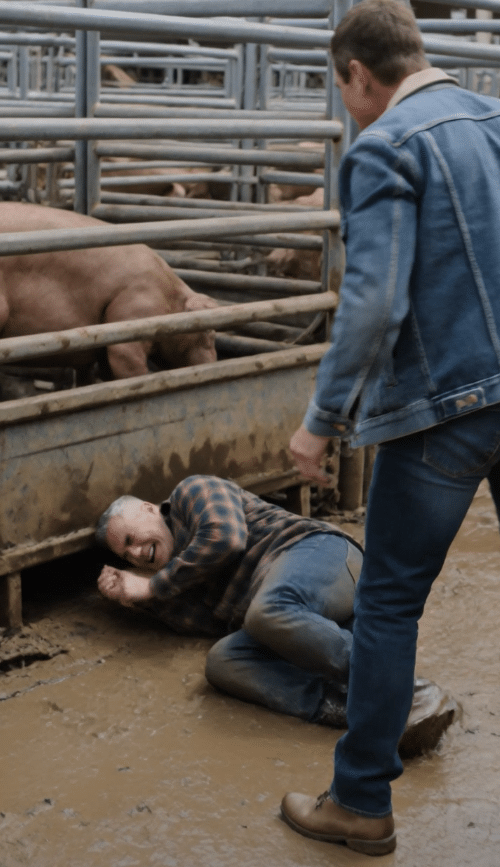
Without warning, he rushed forward and drove a brutal kick into the elderly worker’s chest.
The seventy-two-year-old was thrown backward into the metal feed trough beside the pen. Steel rang through the yard as muddy wash water splashed across his shirt. His elbow struck the sharp edge, leaving only a small streak of blood before he collapsed onto the slick ground, curling instinctively against the pain.
The surrounding workers froze.
No one moved.
The manager stood over him, still holding the pay envelope.
“Trash. You worked too slow.”
The old man struggled to breathe.
He wasn’t asking for charity.
He was asking for wages he had already earned.
What the manager didn’t realize was that the quiet laborer lying in the mud carried a history far greater than anyone on that farm imagined.
And someone else was already on the way.
Act II
The elderly worker tried to push himself upright.
His body refused.
The manager stepped closer and drove two more vicious kicks into his back and side before taking another step away, almost bored by the violence.
“You smell worse than the pigs.”
Laughter never came.
Even the workers who feared the manager couldn’t bring themselves to smile.
The old man closed his eyes.
Not because he wanted to give up.
Because he was remembering another farm.
Another lifetime.
His name was Walter Hayes.
Forty years earlier, Walter had owned two hundred acres of rich Iowa farmland. He wasn’t wealthy, but he had built everything with his own hands alongside his wife, Eleanor.
They raised livestock.
They grew corn.
They believed hard work solved almost everything.
Then came the drought.
Followed by disease that swept through the livestock.
Then Eleanor’s cancer diagnosis.
Walter sold piece after piece of his land to pay hospital bills.
When the money ran out, he sold the farmhouse.
When Eleanor died, only one thing remained.
His dignity.
He refused to beg.
Even after losing an arm in a machinery accident years later, he kept taking whatever work he could find.
Cleaning hog pens.
Repairing fences.
Hauling feed.
People often mistook his silence for weakness.
In truth…
It was grief.
Every dollar he earned had a purpose.
Rent.
Medicine.
The heating bill.
Nothing more.
The manager never cared.
To him, Walter was just another disposable laborer who could be replaced by sunrise.
He twirled the pay envelope between two fingers.
Walter watched it with desperate eyes.
Not because it contained much.
But because every dollar inside had already been spent in his mind.
Then…
The sound of powerful brakes echoed across the farmyard.
Act III
A luxury pickup truck burst through the entrance, tires spraying mud in every direction before stopping beside the hog pens.
The driver’s door opened.
A man wearing a premium brown leather jacket stepped out with two assistants close behind.
He walked with the confidence of someone who never needed to raise his voice.
The assistants immediately crossed the muddy yard.
One knelt beside Walter.
The other quietly positioned himself between the injured worker and the manager.
The newcomer never looked at the injured man first.
His eyes went directly to the pay envelope.
“Who said he doesn’t get paid?”
The manager frowned.
“And who exactly are you supposed to be?”
No answer came.
Instead, the newcomer slowly bent down beside Walter.
“You all right?”
Walter blinked.
Then recognition slowly crossed his weathered face.
It couldn’t be.
Twenty-six years earlier, during the worst flooding Iowa had seen in decades, Walter had rescued a young man trapped inside an overturned pickup that had nearly washed into the river.
The driver had been barely thirty years old.
Terrified.
Unknown to Walter, he had also been the struggling heir to one of the largest agricultural businesses in the Midwest.
Walter refused every reward offered afterward.
He simply said one sentence before walking away.
“If you ever own a farm someday, remember the people who do the work.”
The young man never forgot.
That man…
Now owned this entire operation.
For years he had searched for the farmer who had saved his life.
Only recently had an old insurance report finally revealed Walter’s identity.
The owner quietly ordered payroll records reviewed.
What he discovered sickened him.
Temporary workers had complained for years.
Missing wages.
Illegal deductions.
Threats.
The manager had built his authority on fear.
Today…
That fear ended.
Act IV
The assistants carefully helped Walter sit against the fence while another worker brought a clean towel for his injured elbow.
The owner stepped closer to the manager.
His voice remained calm.
“Hand me the envelope.”
The manager hesitated.
“I was disciplining him.”
“No.”
The owner’s stare never moved.
“You were stealing from him.”
Silence spread across the yard.
One employee slowly removed his cap.
Another admitted he had also been underpaid.
Then another.
Within moments, years of fear unraveled.
Payroll records were retrieved.
Time sheets appeared.
Workers who had stayed silent finally found their courage.
Every missing payment pointed to the same person.
The manager.
His confidence disappeared faster than the mud dripping from his expensive boots.
The owner finally handed Walter the envelope.
Then another one.
Walter looked confused.
“This isn’t today’s pay.”
“It isn’t.”
The owner nodded.
“It’s every dollar our investigation shows you were denied over the last five years.”
Walter’s hands trembled.
“I… I never kept count.”
“I did.”
The owner reached into his coat and unfolded an old newspaper clipping.
Its faded headline read:
Local Farmer Saves Stranger During Flood Rescue.
Walter stared at the photograph.
He barely remembered that day.
The owner smiled gently.
“I owe my life to the man in this picture.”
Walter looked away, overwhelmed.
“I only did what anyone should.”
The owner quietly shook his head.
“No.”
“Not everyone would have.”
Act V
News of the incident spread across Iowa within days.
The farm launched an independent audit covering every worker employed during the previous decade.
Those who had been cheated received compensation with interest.
Several employees who had quit years earlier were tracked down and paid what they had earned.
The manager’s career ended long before the legal proceedings did.
His title disappeared.
His reputation followed.
Walter was offered retirement.
He declined.
Instead, he accepted a new position no one expected.
Training young farmhands.
Not how to clean barns.
How to work with pride.
Every new employee heard the same advice on their first morning.
“Never judge a person by the mud on their boots.”
Months later, the old feed trough where Walter had fallen was quietly replaced.
He asked to keep one dented section of the original steel.
The owner mounted it inside the training building.
Below it hung a simple plaque.
Every honest day’s work deserves honest pay.
Visitors often assumed the old piece of metal honored a farming achievement.
Only a handful of people knew the truth.
It marked the exact place where one elderly laborer refused to surrender his dignity…
And where one powerful man finally kept a promise made beside a flooded Iowa river more than two decades earlier.
Some debts can never truly be repaid.
But gratitude has a remarkable way of finding its way home.