Act I
“I finished the trench.”
The sixty-eight-year-old veteran stood beside the small excavator, balancing on his crutch after ten relentless hours carving a drainage trench through wet, unforgiving soil. Mud covered his boots, his jacket, and the prosthetic leg that had carried him through another day’s work.
The subcontractor held the pay envelope in one hand.
The signed approval sheet in the other.
Neither moved toward the veteran.
Instead, the subcontractor charged forward.
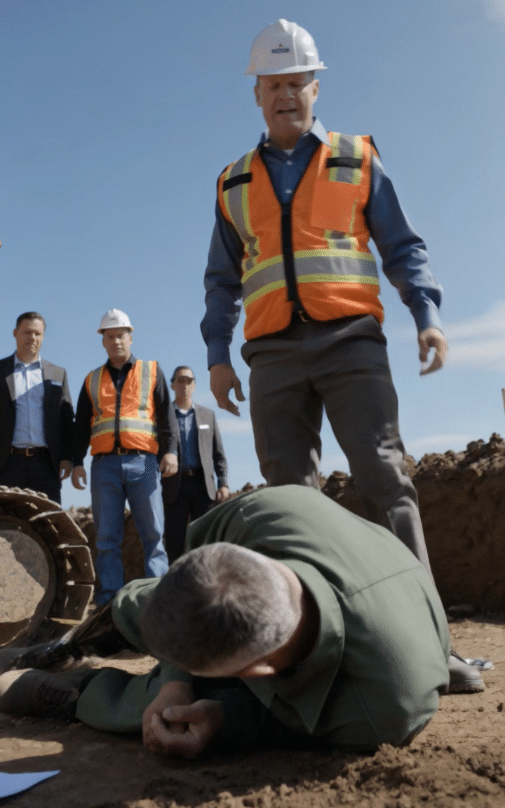
A violent kick slammed into the old man’s chest, throwing him backward against the excavator’s rubber track. His crutch disappeared into the mud as the approval sheet fluttered into the air. His elbow struck the steel edge, leaving only a thin streak of blood while his prosthetic leg shifted awkwardly beneath him.
Pain flashed across his weathered face.
But his eyes remained fixed on the envelope.
Around the trench, workers froze.
No one dared interfere.
The subcontractor looked down with open contempt.
“Trash. You barely stand.”
The veteran slowly tried to sit upright.
He hadn’t asked for sympathy.
Only the wages he had already earned.
What the subcontractor couldn’t possibly know was that the quiet man lying beside the excavator had once carried far heavier burdens than any machine on that site.
And someone who knew his story was already on the way.
Act II
The veteran’s breathing grew heavier as he tried to steady himself.
The subcontractor stepped closer.
Two more brutal kicks landed against his back and side before the younger man finally stepped away, satisfied with the humiliation.
“No pay for broken men.”
The words echoed across the construction site.
His name was Thomas Walker.
Long before gray hair and aching joints replaced his strength, Thomas had worn another uniform.
At twenty-one, he served as a combat engineer overseas.
His unit built emergency bridges, cleared minefields, and opened supply routes under enemy fire.
During one desperate mission, an explosion tore through the convoy.
Thomas pushed two younger soldiers to safety.
He lost his right leg.
They kept their lives.
When reporters later called him a hero, he laughed.
“I just did my job.”
Returning home proved harder than the battlefield.
Construction companies looked at his prosthetic before looking at his résumé.
Employers questioned whether he could still work.
Thomas answered the only way he knew how.
By working harder than everyone else.
Every paycheck mattered.
His wife had passed away several years earlier, leaving him to care for his disabled younger brother, whose medical equipment depended on electricity and expensive prescriptions.
Missing one day’s wages meant choosing which bill could wait.
The subcontractor knew nothing about that.
Or perhaps he simply didn’t care.
He believed disability made people powerless.
He was about to discover how wrong that belief could be.
The sound of engines rolled across the open field.
Every head turned.
Act III
A convoy of black SUVs surged onto the construction site, stopping beside the completed trench in a spray of wet dirt.
Doors opened in perfect sequence.
Engineers stepped out first.
Then a tall man wearing a white hard hat over a charcoal suit emerged without saying a word.
His eyes immediately found the trench.
Straight.
Precise.
Finished exactly to specification.
Only then did he notice Thomas lying beside the excavator.
The engineers hurried to shield the veteran while helping him sit upright.
The newcomer walked directly toward the subcontractor.
His gaze settled on the pay envelope.
“Pay him before I speak again.”
The subcontractor frowned.
“And who are you?”
The question hung unanswered.
Instead, the visitor crouched beside Thomas.
“It’s been a long time.”
Thomas stared.
Then recognition slowly appeared.
“David?”
The man smiled faintly.
Twenty-eight years earlier, David Harrington had been a terrified twenty-three-year-old engineer assigned to Thomas’s military unit during a humanitarian bridge operation.
When enemy fire erupted unexpectedly, panic spread through the convoy.
David froze.
Thomas didn’t.
He dragged the young engineer behind an armored vehicle seconds before an explosion destroyed the position where David had been standing.
Thomas never mentioned it again.
David never forgot.
After leaving the military, David built one of the nation’s largest infrastructure companies, specializing in highways, bridges, and public works.
He often said his second life began the day another soldier refused to leave him behind.
Years later, while reviewing subcontractor records for the rural trench project, David noticed one familiar name on a temporary equipment operator list.
Thomas Walker.
He planned to surprise the veteran with a personal visit after the shift ended.
Instead…
He arrived in time to witness something he could scarcely believe.
Act IV
David rose slowly to his feet.
His voice remained calm.
Dangerously calm.
“Give me the envelope.”
The subcontractor hesitated.
“He doesn’t deserve full pay.”
David looked toward the completed trench.
Laser measurements displayed on an engineer’s tablet confirmed every specification had been met.
Perfectly.
Then David looked back.
“He finished the work.”
Another silence.
“You failed yours.”
The construction crew exchanged uneasy glances.
One foreman quietly stepped forward.
“I’ve seen payroll deductions that never made sense.”
Another worker nodded.
“So have I.”
Within minutes, missing overtime sheets, altered approval forms, and falsified labor records surfaced from the site office.
Years of wage theft unraveled in front of everyone.
David accepted the pay envelope.
Then handed Thomas another.
The veteran frowned.
“This is too much.”
“It’s every dollar our auditors found you were denied.”
Thomas stared in disbelief.
“I didn’t even know.”
David reached into his coat and unfolded a faded military photograph.
Two young soldiers stood beside a temporary bridge built under impossible conditions.
One was David.
The other was Thomas.
“I’ve carried this picture for almost three decades.”
Thomas smiled through tired eyes.
“I barely remember taking it.”
“I never forgot the man in it.”
The entire site fell silent.
Not because of David’s wealth.
Because they suddenly understood who had truly been standing beside them all along.
Act V
The investigation reshaped every project David Harrington owned.
Independent auditors reviewed payroll records across every subcontractor under his company.
Workers who had been cheated received full back pay with interest.
Contracts with dishonest subcontractors were terminated immediately.
A new policy required wage records to be signed by both management and workers before every payment.
Thomas was offered retirement with full benefits.
He politely declined.
“I still have something to teach.”
Instead, David created a veterans’ apprenticeship program, placing Thomas in charge of mentoring former service members beginning new careers in construction.
Every class started the same way.
Thomas would tap his prosthetic leg with a smile.
“This isn’t what makes me strong.”
Then he’d point toward the construction site.
“Keeping your word does.”
Near the finished trench, David ordered a small stone marker installed where the confrontation had taken place.
It carried no company logo.
No corporate slogan.
Only a simple inscription.
Honor isn’t proven by what you build. It’s proven by how you treat the people who build it.
Years later, young apprentices often paused beside that marker before beginning their first shift.
Most never met the veteran whose story inspired it.
But they remembered the lesson.
A man may lose a limb.
He may lose youth.
He may lose almost everything life once promised him.
Yet no one has the right to steal the dignity he earns through honest work.
And on that muddy construction site, justice arrived not because power suddenly appeared…
But because gratitude had never forgotten the soldier who once refused to leave another man behind.