Act I
“My child needs medicine.”
The words barely left her lips before the barn fell silent.
She stood beside a stack of feed bags, her shoulders coated with dust after hours of carrying heavy loads across the turkey farm. Her boots were worn, her hands blistered, and every muscle in her body ached. None of that mattered to the manager standing across from her.
He held her pay envelope in one hand, studying it as though it belonged to him instead.
Then he let it fall onto the straw-covered floor.
The envelope landed just beyond her reach.
Workers froze.
No one moved.
No one dared.
The manager smiled with open contempt.
“Trash. You smell like the barn.”
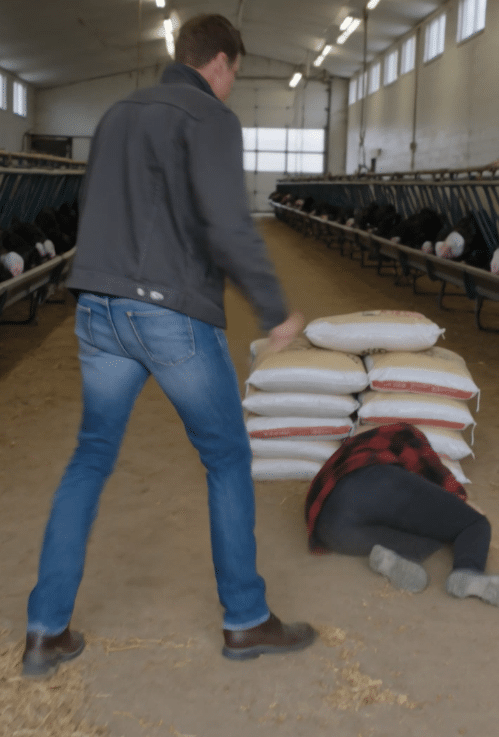
Before she could bend down, he suddenly lunged forward.
His kick slammed into her upper body, sending her backward into the stacked feed bags. One burst open, filling the air with a cloud of dust as she crashed against the edge of a feeding trough. Her elbow scraped the metal, leaving only a small cut, but the pain spread through her entire arm.
She collapsed onto the straw, gasping.
Her eyes never left the envelope lying only a few feet away.
It wasn’t just money.
It was her child’s medicine.
The manager stepped closer without a trace of sympathy.
He struck her again, twice, forcing her to curl instinctively on the ground.
Then he laughed.
“Buy medicine with dirt.”
Around them, every worker stared at the floor.
Fear had become part of the job long ago.
But none of them realized that someone unexpected had just arrived outside the barn.
Everything was about to change.
Act II
The woman had started working at the turkey farm only a few months earlier.
Her husband had died after a sudden illness that drained every dollar the family had saved. Overnight she became the only provider for her young son, whose chronic medical condition required expensive medication every week.
She accepted every shift available.
She lifted feed bags that weighed nearly as much as she did.
She stayed late cleaning troughs.
She never complained.
Other workers noticed something else.
Whenever payday came, the manager always found excuses.
Paperwork wasn’t finished.
The accountant hadn’t approved it.
The owner supposedly hadn’t signed anything.
Some workers quietly accepted partial pay.
Others simply disappeared.
No one challenged him because everyone believed he had complete control over the farm.
The woman refused to give up.
That morning, her son’s fever had climbed again.
The pharmacy would not extend another payment.
She needed every dollar she had earned.
That was why she stood in front of him instead of walking away.
She wasn’t asking for charity.
She was asking for wages she had already earned.
Unfortunately, the manager saw desperation as weakness.
What he didn’t know was that the real owner had decided to visit the farm without announcing his arrival.
And he was only seconds away.
Act III
Outside, the sound of tires cut across the quiet afternoon.
A black SUV stopped sharply beside the barn.
Several workers turned toward the entrance.
The farm owner stepped out, accompanied by one trusted assistant.
He had planned nothing more than a routine inspection.
Instead, he walked into complete silence.
The first thing he noticed wasn’t the workers.
It wasn’t the feed bags.
It wasn’t even the manager.
It was a woman lying on the straw, struggling to reach an unopened pay envelope while trying to hide the pain on her face.
His expression changed instantly.
The assistant hurried forward and positioned himself between the woman and the manager.
The owner looked down.
The envelope.
The scattered feed.
The frightened workers.
Then he lifted his eyes toward the manager.
No shouting.
No dramatic speech.
Just one calm sentence.
“Pick up her envelope.”
Every person inside the barn understood what those four words meant.
Authority had shifted.
The manager suddenly realized he no longer controlled the room.
Yet he still didn’t recognize the man standing before him.
That mistake would cost him everything.
Act IV
The manager’s confidence vanished almost immediately.
His hand trembled.
His breathing changed.
The owner slowly picked up the farm’s daily payroll ledger from a nearby table.
He compared it with the envelope lying on the floor.
Every number matched.
The wages had already been approved.
There had never been any administrative delay.
There had only been theft.
As more records were brought in, the pattern became impossible to ignore.
Missing signatures.
Delayed payments.
Workers marked as fully paid despite receiving nothing.
Several employees quietly admitted that the same thing had happened to them for months.
The barn remained completely silent.
The owner looked toward the injured woman.
Then toward the workers who had watched in fear.
Finally, he turned back to the manager.
Without raising his voice, he instructed his assistant to ensure the woman received immediate medical attention and every dollar she had earned.
The envelope was finally placed into her hands.
She held it tightly, not because of its value, but because it meant her son would receive his medicine.
Only then did the manager understand exactly who had confronted him.
His face lost all color.
The arrogance that had filled the barn only moments before completely disappeared.
There was nowhere left to hide.
Act V
The investigation continued long after the ambulance staff checked the woman’s injuries and confirmed they were minor.
Payroll records from previous seasons revealed the truth.
Dozens of workers had been underpaid.
Some had never received their final wages.
Others had quietly left because they believed no one would ever listen.
The owner ordered every missing paycheck to be issued.
New reporting procedures were introduced.
Workers were given direct access to payroll oversight instead of relying solely on one manager.
For the first time in years, people believed they could speak without risking their jobs.
The mother returned to work weeks later.
Not because she had no other choice.
Because she refused to let humiliation define her.
Her son recovered after receiving the medicine he desperately needed.
As for the manager, he stood alone in the center of the barn, stripped of every ounce of authority he had abused.
The workers no longer lowered their eyes when they passed him.
They remembered exactly who had protected them.
The owner paused one final time before leaving.
The manager stared at him, his confidence completely broken.
Only one question remained.
“Who are you?”
The answer no longer mattered.
Everyone in the barn already knew who held the real power.
And they also knew something even more important.
Respect can be demanded through fear for a while.
Justice only needs one moment to change everything.