Act I
“Why are you holding my pay?”
The question echoed across the lumber yard as forklifts idled between towering stacks of timber.
The sixty-seven-year-old veteran stood alone, one sleeve of his flannel jacket pinned neatly where his left arm had once been. Sawdust covered his shoulders after a full day of loading lumber alongside workers half his age.
The foreman barely looked at him.
Instead, he gripped the payroll sheet and smirked.
“Trash. One arm, half a worker.”
The surrounding workers lowered their eyes.
Everyone knew the foreman had a habit of delaying paychecks for temporary laborers. Most stayed silent because they couldn’t afford to lose their jobs.
The veteran didn’t raise his voice.
“I finished every load assigned to me.”
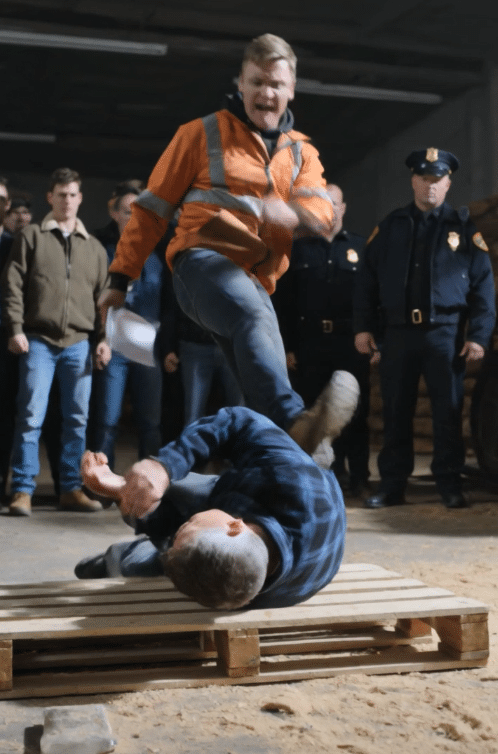
The foreman crumpled the payroll sheet in one hand and shoved him backward, sending him stumbling into a wooden pallet. Sawdust burst into the air as he caught himself awkwardly, refusing to fall.
“You should thank me for scraps.”
No one stepped in.
But the sound of several vehicles entering the yard changed everything.
Act II
The veteran had spent decades serving others.
After losing an arm years earlier, he never asked for sympathy. He simply learned to work differently.
When retirement savings disappeared paying medical bills for his late wife, he returned to manual labor to stay independent.
At the lumber yard, he quickly earned a reputation for reliability.
He arrived before sunrise.
He never complained.
He stayed until every truck was loaded.
The foreman saw those qualities not as strengths but as opportunities.
Workers whispered that missing wages had become common.
People who questioned payroll rarely came back.
The veteran decided this time would be different.
He wanted only what he had earned.
What he didn’t know was that the company’s owner had scheduled an unannounced inspection that same afternoon.
Act III
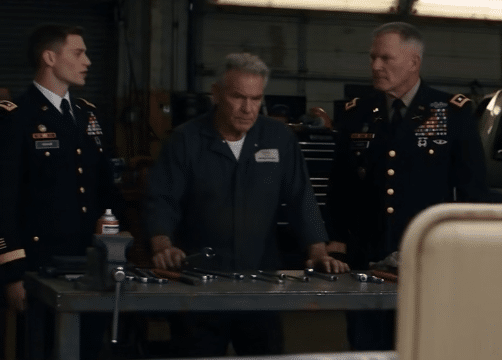
A management convoy rolled between the lumber stacks and stopped abruptly.
The company owner stepped out with senior managers and security personnel behind him.
Conversation across the yard disappeared.
His attention immediately settled on the veteran standing beside the damaged pallet.
Then he noticed the payroll sheet still clutched tightly in the foreman’s hand.
Without raising his voice, he gave a single instruction.
“Release his pay.”
Security quietly positioned themselves beside the veteran while the owner extended his hand for the payroll records.
The foreman’s confidence began to disappear.
He suddenly realized the inspection had arrived at the worst possible moment.
Act IV
The owner reviewed the payroll sheet alongside electronic time records.
Every shift had been completed.
Every load had been documented.
The veteran’s wages had been approved days earlier.
There was no administrative delay.
Only an intentional decision to withhold payment.
As accounting staff examined additional records, more discrepancies surfaced.
Other workers slowly found the courage to speak.
Several admitted they had experienced similar delays but feared retaliation.
The owner listened without interruption.
When the review ended, his decision was immediate.
The veteran received every dollar he had earned.
The remaining unpaid workers were instructed to report directly to payroll before leaving that evening.
The foreman stood speechless.
The authority he had relied on for years disappeared in minutes.
Act V
The investigation continued for weeks.
Payroll practices across the lumber yard were completely overhauled.
Workers gained direct access to human resources instead of depending solely on a single supervisor.
Anonymous reporting procedures were introduced, and every outstanding wage claim was reviewed.
The veteran returned to work only long enough to finish the contract he had accepted.
He left with his dignity intact and the respect of every worker in the yard.
Many later admitted that watching him calmly stand his ground had given them the courage to speak about problems they had endured for years.
As the management team prepared to leave, the former foreman looked toward the owner, his confidence completely gone.
Only one question escaped his lips.
“Who are you?”
The workers already knew the answer.
He wasn’t simply the owner.
He was the first person in a long time willing to prove that honesty mattered more than intimidation—and that every worker, regardless of age or disability, deserved to be treated with fairness and respect.