Act I
“Please keep shoes off the seat.”
The words were calm. Respectful. Barely louder than the screech of steel wheels beneath the subway car.
Cold white lights reflected off the stainless poles as exhausted commuters clung to straps or stared blankly at their phones. No one looked up at first. It sounded like nothing more than another quiet request between strangers.
The elderly man stood with one hand resting on a worn walking cane. His olive military jacket had faded with time, and the black veteran’s cap on his head revealed more about his life than any speech ever could. Beneath his gray khaki pants, a prosthetic leg supported the weight of a body that had already sacrificed more than most people could imagine.
Across from him, a young businessman lounged across the silver subway seat.
His polished black shoes rested comfortably where another passenger could have sat.
He slowly lowered one foot, looked the veteran up and down, and smirked.
“Trash. Mind your own business.”
Several passengers exchanged uneasy glances.
The old veteran didn’t answer with anger.
He had spent decades learning that dignity often meant saying less.
But some people mistake restraint for weakness.
The businessman stepped forward before anyone understood what was happening.
His expensive laptop bag swung behind him as he lunged.
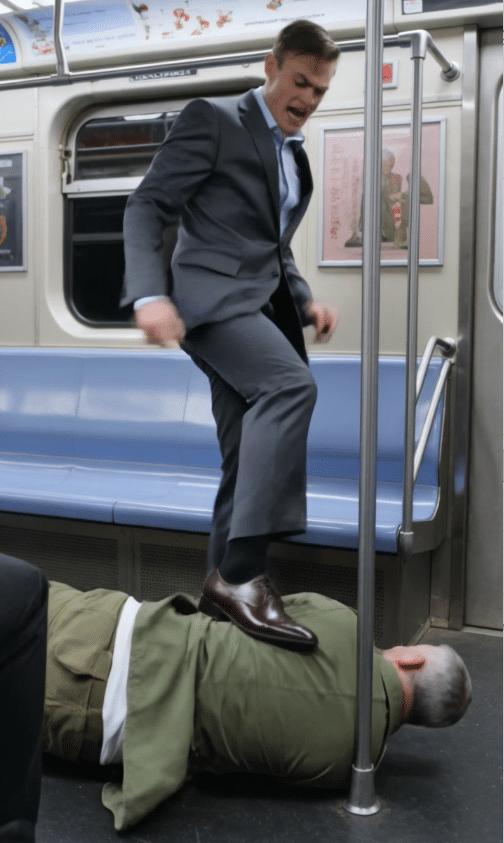
Then came the kick.
It slammed squarely into the veteran’s chest with terrifying force.
The old man’s body flew backward into a stainless steel pole. The impact echoed through the subway car louder than the grinding rails beneath them.
His walking cane clattered across the floor.
He collapsed beside the metal bench, his palm scraping against the rough subway floor, leaving only the thinnest streak of blood before he instinctively pulled his hand back.
Pain tightened every muscle in his face.
His breathing became short.
His fingers searched blindly for the cane that was no longer within reach.
The businessman wasn’t finished.
He drove two more savage kicks into the veteran’s side and back while the elderly man curled instinctively to protect himself.
No one moved.
Some passengers gasped.
Others froze.
A few looked away, ashamed of their own fear.
The entire car became a prison of silent witnesses.
And the worst part hadn’t happened yet.
Act II
The businessman stood over the fallen veteran as if he had already won.
“This train isn’t yours.”
His voice carried across the subway.
Nobody answered.
Not because they agreed.
Because fear is contagious.
The veteran slowly lifted his eyes.
There was pain there.
But there was no hatred.
Only disappointment.
He had worn that same expression years earlier while watching frightened young soldiers lose control during moments that separated courage from cruelty.
Long before New York commuters rushed between office buildings, he had learned that character only revealed itself when nobody expected consequences.
He had entered the military at nineteen.
He left part of his body on foreign soil.
The prosthetic leg beneath his trousers wasn’t a reminder of weakness.
It was the price of protecting people he would never meet.
His medals were locked away in a small wooden box inside a modest apartment.
He almost never spoke about them.
He believed service wasn’t something to display.
It was something to live.
Even after retirement, he followed the same quiet rules.
Hold the door for strangers.
Respect public spaces.
Offer kindness before judgment.
That simple request about dirty shoes had never been about authority.
It had been about respect.
The very value he had spent a lifetime defending.
The businessman never cared to know any of that.
To him, the old man was simply another powerless stranger occupying the same subway car.
He believed money created status.
He believed expensive suits created importance.
He believed nobody would ever challenge him.
The train began slowing toward the next station.
Then the doors opened.
And suddenly…
Every sound disappeared.
Act III
A tall man stepped inside wearing a long black coat over a charcoal suit.
A gray scarf rested neatly across his shoulders despite the winter air.
Behind him walked a single aide in a navy suit.
Neither man hurried.
Neither needed to.
Authority has a language that rarely requires volume.
The atmosphere changed before anyone recognized why.
Passengers instinctively shifted aside.
Even those who had never seen the newcomer somehow understood he belonged to a world where decisions carried enormous weight.
His eyes settled on the veteran lying beside the bench.
Then on the cane.
Then on the businessman.
The silence became unbearable.
He finally spoke.
“You just made a terrible mistake.”
The businessman laughed.
At least he tried to.
“What mistake?”
The confident grin didn’t quite reach his eyes.
Because something had already begun changing inside him.
The aide immediately stepped between the veteran and the attacker.
He carefully retrieved the fallen cane before kneeling beside the injured old man with surprising gentleness.
The newcomer never looked away from the businessman.
His expression didn’t show rage.
It showed certainty.
As though judgment had already been written.
The businessman suddenly noticed something everyone else had missed.
The veteran recognized the newcomer.
Not with surprise.
With familiarity.
The old soldier attempted to sit up straighter despite the pain.
The powerful man gave the slightest respectful nod.
It wasn’t the greeting of strangers.
It was the greeting of equals.
The businessman felt his confidence crack for the very first time.
And the truth behind that silent nod was far greater than anyone expected.
Act IV
Years earlier, both men had survived the same military operation.
The mission had remained classified for decades.
Only a handful of people knew what truly happened.
The younger officer—now one of the nation’s most influential transportation commissioners responsible for New York’s subway security and infrastructure—owed his life to the elderly veteran lying on the floor.
During a catastrophic evacuation, the veteran had refused to abandon wounded soldiers trapped beneath collapsing debris.
He carried them out one after another.
Including the young lieutenant who now stood only a few feet away.
The explosion that destroyed the veteran’s leg should have taken his life.
Instead, he sacrificed part of himself so others could return home.
The commissioner had spent decades trying to repay a debt he believed could never be repaid.
Yet the veteran always refused recognition.
He insisted that real heroes didn’t demand applause.
They simply hoped the next generation would choose kindness over cruelty.
Looking at the old soldier now, bruised on the floor of the subway he had helped inspire generations to protect, the commissioner felt something colder than anger.
Disappointment.
Not in the veteran.
In the society that allowed decent people to suffer while arrogance stood laughing above them.
Around the subway car, passengers lowered their eyes.
Many silently regretted doing nothing.
One woman began crying.
A father quietly pulled his young son closer and whispered something only the child could hear.
Perhaps he was explaining what courage truly looked like.
The businessman finally understood.
This wasn’t about power.
It never had been.
It was about character.
And he had revealed his to everyone.
But the deepest lesson was still waiting.
Act V
The commissioner slowly walked toward the businessman.
There was no need to shout.
No need to threaten.
The entire subway car had already become a courtroom.
Every witness had seen exactly what happened.
Every security camera mounted inside the train had captured the assault from multiple angles.
The businessman looked around desperately.
No smiling faces remained.
Only expressions of disgust.
The expensive suit that had once made him feel untouchable suddenly looked like a costume hiding an empty man.
Meanwhile, the veteran accepted his cane with quiet gratitude.
Even through obvious pain, his first concern wasn’t himself.
He simply asked whether the subway service had been delayed because of the incident.
The commissioner almost smiled.
After everything.
After the kick.
After the humiliation.
After the pain.
The old soldier was still thinking about other people.
That was the difference between them.
One man believed respect was earned through wealth.
The other had earned it through sacrifice.
As emergency personnel and transit officers approached the train at the station, the businessman finally understood that consequences had already begun long before anyone placed a hand on his shoulder.
He had mistaken silence for weakness.
He had mistaken age for helplessness.
Most of all, he had mistaken humility for insignificance.
The veteran never needed to announce who he was.
His life had already spoken louder than any title ever could.
Sometimes the strongest people are the ones who ask for nothing except basic decency.
And sometimes the cruelest mistake a bully can make is believing that nobody important is watching.
Because respect has a way of revealing who people truly are.
And on that subway ride, it revealed everyone.