Act I
“Please don’t feed the deer.”
The elderly volunteer didn’t raise her voice.
She simply pointed toward the weathered Do Not Feed Wildlife sign standing beside the pine-lined trail, its edges faded after decades of wind, snow, and summer heat.
Only a few yards away, several deer lingered between the trees, cautiously watching the visitors who had begun tossing handfuls of food toward them.
The father barely glanced at the sign.
Instead, he slowly turned toward the woman, adjusting the expensive sunglasses resting on his face as if the interruption itself were offensive.
His wife and children stood behind him, holding paper bags filled with snacks they had planned to share with the animals.
“Trash. We paid to be here.”
The words hung in the crisp mountain air.
Around them, hikers paused.
No one spoke.
The seventy-two-year-old volunteer remained calm.
Her olive volunteer jacket was worn at the sleeves, and the folded trail guide she carried had been opened thousands of times while helping lost visitors find their way through the park.
She smiled gently.
Not because she enjoyed confrontation.
Because she had spent years learning that patience often protected nature better than anger ever could.
“The deer become dependent on people,” she explained softly. “It isn’t safe for them.”
The father didn’t hear concern.
He heard inconvenience.
His face hardened.
Then, without warning, he charged.
The kick landed with shocking force.
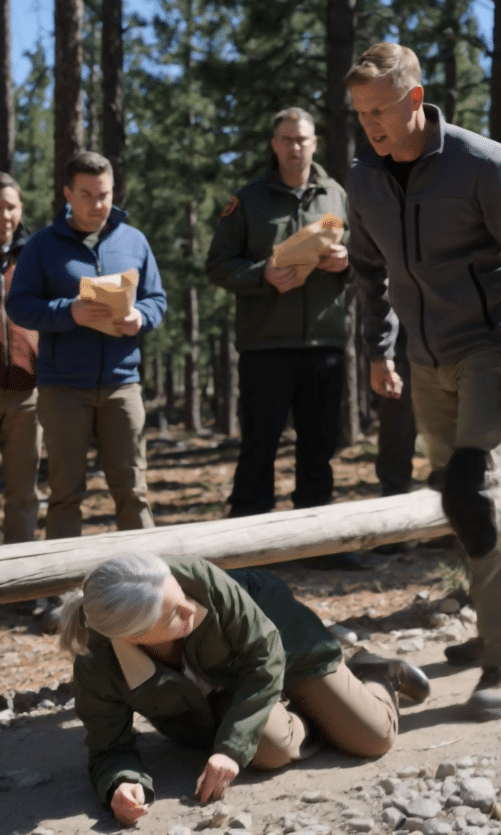
His heavy trekking boot slammed into the elderly woman’s chest, launching her backward across the rocky trail.
Her shoulder struck the low wooden rail with a sharp crack before she collapsed onto the dirt.
The folded guide sheet flew into the wind.
Small rocks scraped across the ground beneath her hand, leaving only the faintest streak of blood before she instinctively pulled it close to her chest.
Pain spread across her face.
She struggled to breathe.
Before anyone could react, the man stepped forward again.
He drove two more vicious kicks into her side and back while she curled against the trail, trying only to protect herself.
His own family stood frozen.
Children who moments earlier had laughed at the deer now stared in horrified silence.
The forest itself seemed to stop breathing.
And then the father made the mistake that would change everything.
Act II
He stood over the injured volunteer, chest rising with anger.
“Don’t lecture my family.”
Not a single hiker answered him.
Some looked away.
Others reached for their phones but hesitated.
Fear has an unsettling way of convincing ordinary people that someone else will step forward first.
The elderly volunteer slowly tried to push herself upright.
Every movement clearly hurt.
Yet the first thing she searched for wasn’t herself.
It was the scattered guide sheet blowing across the trail.
That small booklet mattered because every morning she folded dozens by hand for visitors who wanted to learn how to enjoy the park without harming it.
She had never accepted a paycheck.
After retiring from a career in environmental science, she volunteered nearly every day.
Rain.
Snow.
Heat.
Holiday weekends.
She was always there.
Children remembered her because she could identify birds by their songs.
Families remembered her because she knew every safe hiking trail.
Lost hikers remembered her because she never stopped searching until everyone returned safely.
To the millions who visited each year, she looked like nothing more than an elderly volunteer.
Few realized that many of the park’s wildlife protection programs existed because of recommendations she had written decades earlier.
She never cared who knew.
Recognition had never been her purpose.
Protecting the animals had been.
The wealthy father saw only an old woman wearing a volunteer badge.
He assumed kindness meant weakness.
He assumed age meant helplessness.
He assumed nobody important would ever care what happened on an isolated hiking trail.
Then the distant sound of tires sliding across gravel echoed through the forest.
Heads turned.
The deer vanished into the trees.
The ranger truck arrived much faster than anyone expected.
Act III
The truck braked hard beside the trail.
Before the dust had fully settled, four uniformed rangers stepped out.
Three moved immediately toward the injured volunteer.
But none of them drew the attention of the crowd.
The man walking behind them did.
The Chief Ranger removed his gloves with deliberate calm.
His dark green uniform carried decades of service.
His expression carried something far heavier.
Controlled disappointment.
His eyes found the elderly volunteer lying beside the wooden rail.
Then they settled on the scattered food covering the trail.
Finally…
They locked onto the father.
The temperature of the entire moment seemed to change.
The hikers instinctively stepped aside.
Even the children stopped crying.
The Chief Ranger took one slow step forward.
“Back away from her.”
The father’s confidence faltered.
Not completely.
Not yet.
He looked around, searching for support that no longer existed.
The three rangers immediately formed a protective barrier around the injured volunteer.
One carefully retrieved her guide sheet.
Another checked her shoulder.
The third quietly gathered the scattered food before nearby wildlife could reach it.
Meanwhile, the Chief Ranger never looked away from the man responsible.
There was no shouting.
No threats.
Only an icy silence that somehow felt far more dangerous.
The father swallowed.
“Who are you?”
He believed he was speaking to another park employee.
He had no idea who stood in front of him.
Or who the elderly volunteer truly was.
Act IV
Years before becoming Chief Ranger, the man had been a newly hired seasonal employee assigned to one of the most devastating wildfire seasons the park had ever faced.
He had been inexperienced.
Overconfident.
Certain that training alone prepared him for disaster.
He was wrong.
During one rapidly spreading fire, shifting winds trapped several firefighters deep inside a canyon.
Panic spread faster than the flames.
It was the quiet wildlife biologist volunteering beside the emergency team who noticed what everyone else had missed.
The behavior of the deer.
Instead of fleeing downhill, they were climbing toward an old migration corridor hidden beyond the smoke.
She convinced the rescue crews to follow.
That forgotten trail led every trapped firefighter to safety.
Including the young ranger who would eventually become Chief Ranger.
The official report credited teamwork.
But everyone involved knew the truth.
Without her knowledge of animal behavior, many people would never have gone home.
Later, she declined awards.
Declined interviews.
Declined recognition.
She simply returned to volunteering.
The Chief Ranger had never forgotten.
To him, she wasn’t just another volunteer.
She was one of the people responsible for shaping the modern conservation practices that protected the park’s wildlife and countless visitors every year.
Looking at her injured on the ground, something inside him hardened.
Not anger alone.
Responsibility.
The father finally understood he hadn’t assaulted an anonymous elderly woman.
He had attacked someone respected by every ranger standing there.
Every visitor watching.
And by an entire generation of conservation professionals whose careers she had quietly influenced.
But the greatest humiliation was still unfolding.
Act V
The forest remained silent except for the wind moving gently through the pines.
The Chief Ranger slowly walked toward the father.
He never raised his voice.
He didn’t need to.
Park surveillance near the trail entrance had recorded the family’s arrival.
Visitor cameras had captured the assault from multiple angles.
Dozens of witnesses stood only a few feet away.
There would be no confusion about what had happened.
The father looked toward his family.
His children no longer stood proudly beside him.
They stared at the ground.
Ashamed.
The expensive outdoor clothing that had once made him feel important suddenly meant nothing.
Money had purchased admission into the park.
It had never purchased the right to ignore its rules.
Behind him, the elderly volunteer accepted her guide sheet with trembling hands.
Despite the pain, her first concern wasn’t herself.
She quietly asked another ranger whether the frightened deer had safely returned to the forest.
The Chief Ranger closed his eyes for a brief moment.
Even after being assaulted…
Even after lying injured on the rocky trail…
She was still thinking about the wildlife she had spent decades protecting.
That was the difference between them.
One person believed nature existed for personal entertainment.
The other had dedicated an entire lifetime to preserving it for generations she would never meet.
As law enforcement officers approached from farther down the trail, the father finally understood the lesson he should have learned before entering the park.
Rules protecting nature are written because experience has already paid the price for ignoring them.
And the people who quietly enforce those rules are often carrying stories, sacrifices, and accomplishments the world never sees.
He had mistaken a volunteer badge for insignificance.
He had mistaken kindness for weakness.
Most of all, he had forgotten that true authority rarely announces itself.
Sometimes it wears old hiking shoes, carries a folded guide sheet, and asks only one simple thing.
“Please don’t feed the deer.”
And sometimes, that quiet voice belongs to the very person who helped protect the wilderness long before people like him ever came to visit it.