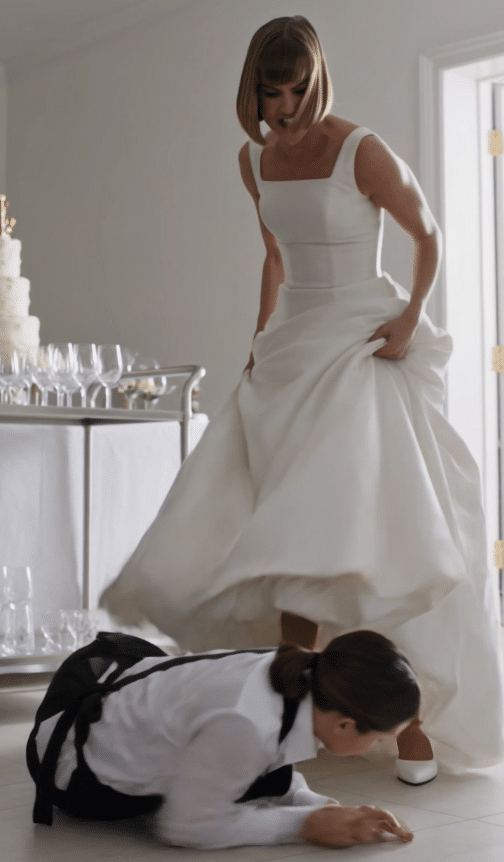
Act I
The wedding reception fell silent the instant the top tier of the towering cake collapsed.
Cream and flowers slid across the elegant display table as guests gasped in disbelief. Before anyone had time to understand what had happened, the bride’s eyes locked onto the nearest person—a twelve-year-old banquet helper carrying a tray of freshly polished glasses.
The frightened girl froze.
“I didn’t touch the cake…”
But panic had already turned into blame.
The bride pointed across the room, convinced she had found the perfect target. In her mind, the child standing nearby had to be responsible. The accusation spread through the ballroom faster than the whispers, leaving the young helper overwhelmed, frightened, and unable to make anyone listen.
“Trash. You ruined my wedding.”
The girl’s mother, busy washing glassware in the service area, heard the shouting and rushed toward the reception hall, only to find her daughter surrounded by staring strangers.
The child clutched the edge of the glassware cart with trembling hands, trying desperately to explain that she had never gone near the cake table.
No one seemed interested in hearing her.
And then someone unexpected walked through the ballroom doors.
Act II
The banquet helper had spent countless weekends assisting her mother after school.
She wasn’t an employee in the formal sense. She simply helped polish glasses, folded napkins, and pushed carts between the kitchen and reception hall whenever extra hands were needed.
Most guests barely noticed she was there.
That afternoon had started like dozens before it. She carefully carried clean glasses while her mother worked behind the scenes preparing for another elegant celebration.
Meanwhile, the wedding staff had quietly discussed a small concern earlier that morning.
One technician had mentioned that the support beneath the decorative cake stand seemed slightly unstable.
Unfortunately, with vendors arriving, photographers setting up, and hundreds of details demanding attention, nobody realized how serious that small warning would become.
The bride never knew any of this.
She saw only one thing: the cake collapsed while the young helper happened to be nearby.
Sometimes fear doesn’t look for evidence.
It looks for someone powerless.
Just as the tension threatened to spiral further, a calm voice cut through the room.
Act III
The banquet center owner entered with the technical chief close behind.
In his hands was a small metal support bracket removed from the cake display.
He looked first at the terrified girl.
Then at the bride.
“You just blamed the wrong child.”
The ballroom became completely silent.
The technical chief carefully placed the loose support on the nearby table.
No one spoke.
No one moved.
The owner calmly instructed staff to escort the young helper and her mother away from the center of the crowd while he examined the display.
Guests who had been whispering moments earlier now exchanged uncertain glances.
If the child hadn’t caused the collapse…
Then what had?
The bride stared at the metal piece, her confidence beginning to fade.
Act IV
The technical chief explained that the decorative support beneath the upper cake tiers had failed.
The instability had existed before the reception reached its busiest moment.
It wasn’t caused by a child brushing against the table.
It wasn’t caused by a guest.
It wasn’t caused by anyone walking nearby.
The owner also reminded everyone that ceiling security cameras covered nearly every angle of the reception hall.
The footage confirmed what several staff members already suspected.
The young helper had remained several feet away, carrying clean glassware toward the service station when the support underneath the cake suddenly shifted.
She had never touched the display.
The room filled with uncomfortable silence.
Moments earlier, many people had assumed guilt simply because the frightened child happened to be standing nearby.
Now the truth stood plainly in front of them.
The bride slowly realized the damage caused by a single reckless accusation could never be erased with a simple apology.
Act V
The banquet owner personally apologized to the girl and her mother in front of the guests.
He made it clear that no employee, volunteer, or family helper should ever become the target of accusations without evidence.
Several guests approached the child with quiet words of encouragement.
Others admitted they regretted staying silent instead of questioning what they had witnessed.
The bride lowered her eyes, no longer thinking about the ruined cake.
She was thinking about the frightened twelve-year-old whose happiest memory of helping her mother had almost become her worst.
As staff carefully removed the damaged display, the owner left the loose metal support resting on the table.
It wasn’t just a broken piece of hardware anymore.
It was a reminder that appearances can be dangerously convincing—and that the easiest person to blame is often the least responsible.
Long after the reception ended, people remembered very little about the wedding cake.
But they never forgot the day an innocent child was nearly condemned for something she had never done, and how the truth quietly restored her dignity when evidence finally spoke louder than assumptions.