Act I
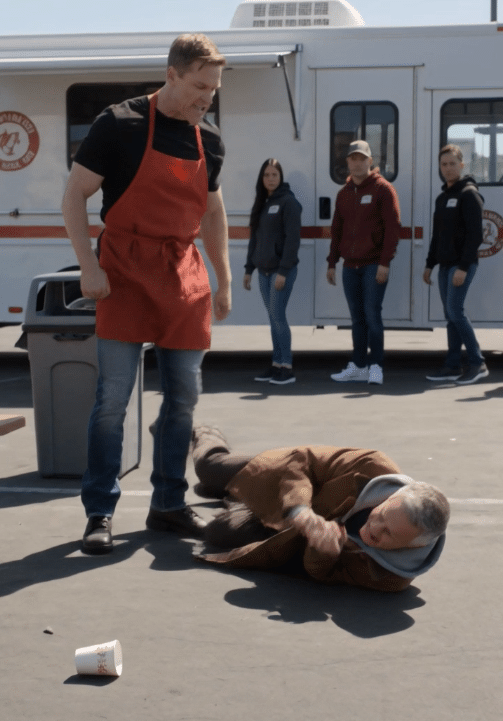
The lunch crowd went silent the moment the food truck owner stormed out of his serving window.
A meal was missing.
Without checking the register, the order screen, or asking a single question, his eyes landed on the seventy-year-old homeless man standing quietly near the picnic tables.
“I didn’t take any food…”
The elderly man held his hands where everyone could see them, his voice trembling with exhaustion rather than fear. He had been watching customers enjoy their meals, hoping to collect enough discarded bottles for a warm drink later that afternoon.
Instead, he became the center of a public accusation.
“Trash. Hungry thieves lie.”
People stared.
Some whispered.
No one knew what had really happened.
Then another voice echoed across the food truck court.
Act II
Most regular vendors knew the elderly man.
He never begged aggressively.
He cleaned abandoned tables when nobody asked him to.
Sometimes families quietly bought him lunch, and he always thanked them before sitting alone beneath the shade of a tree.
The food truck owner, however, had never bothered learning his name.
To him, the missing meal seemed simple.
An order was gone.
A homeless man happened to be nearby.
That was enough.
The accusation spread through the waiting line faster than facts ever could.
But someone had already begun paying attention.
Act III
A black SUV rolled into the lot.
The owner of the food truck court stepped out alongside a technician carrying a tablet angled away from the crowd.
He looked calmly from the frightened elderly man to the furious vendor.
“Replay the last order.”
The technician immediately began reviewing both the truck’s order records and the camera feed mounted above the serving window.
No one else could see the screen.
The silence became almost unbearable.
The vendor’s confidence slowly gave way to uncertainty.
If the replay was being checked…
Then assumptions would no longer matter.
Act IV
The technician quietly finished reviewing the records before handing the tablet to the court owner.
He nodded once.
The missing meal had never been stolen.
A duplicate order had been entered during the lunch rush, while another customer had already collected both bags after a numbering mistake on the screen.
The elderly man had never approached the pickup counter.
He had remained near the picnic tables the entire time.
Several witnesses suddenly remembered seeing exactly that.
The accusation collapsed under the weight of simple evidence.
The food truck owner realized everyone around him had just watched him condemn an innocent man because of how he looked.
Act V
The court owner publicly cleared the elderly man’s name and reminded every vendor that evidence must always come before accusations.
He also announced that the food truck’s ordering process would be updated to prevent similar mistakes in the future.
Customers who had remained silent earlier quietly approached the elderly man.
One offered him a meal.
Another handed him a bottle of water.
A young family invited him to sit with them while they ate.
The owner of the food truck stood speechless, finally understanding that the greatest mistake that afternoon wasn’t a missing order.
It was assuming that poverty was proof of guilt.
Long after the lunch rush ended, few people remembered the missing meal.
But everyone remembered the replay that revealed the truth—and the elderly man whose dignity was restored when facts finally spoke louder than prejudice.