Act I
The medal tore free before anyone had time to react.
Its ribbon snapped with a sharp crack, the bronze decoration spinning through the air before crashing onto the polished floor of the veterans’ reunion hall. The sound echoed beneath the rows of folding chairs, louder than the conversations that had filled the room only seconds before.
“I earned that medal…” the elderly veteran whispered.
His voice barely carried across the silence.
He was seventy-one years old, standing with only one arm beneath a navy blazer that had clearly been pressed with care. His white shirt was spotless. His dark red tie was perfectly centered. Every wrinkle on his face carried the weight of decades most people in that room could never imagine.
None of it mattered to the wealthy man standing over him.
Dressed in an immaculate black suit with a gleaming gold watch peeking beneath his cuff, the younger man curled his lip in disgust.
“Trash. Men like you fake honor.”
Gasps rippled through the crowd.
Nobody moved.
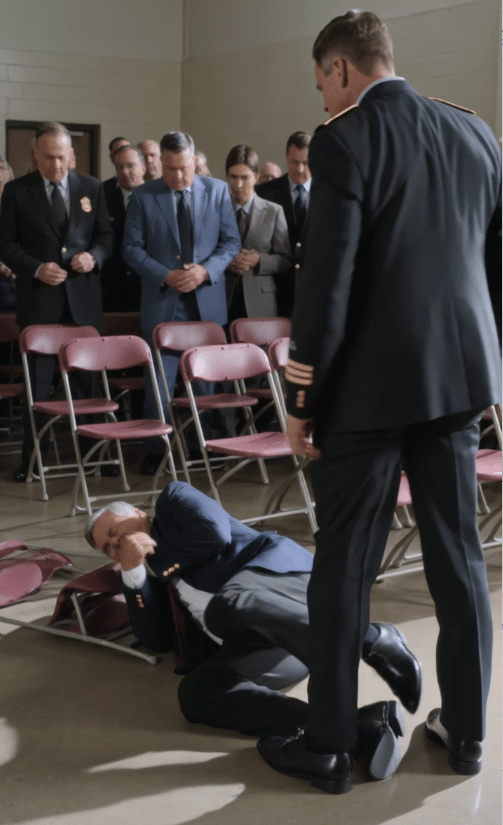
The wealthy attendee shoved the veteran backward with enough force to send him stumbling. Then, before anyone could breathe, he drove a brutal kick into the old soldier’s chest.
The veteran crashed backward into a row of folding chairs.
Metal legs screeched.
Plastic seats shattered against one another.
The entire row collapsed beneath his weight.
His elbow struck one of the chair legs, leaving only a thin streak of blood against weathered skin. He grimaced, fighting for breath, refusing to cry out.
Even lying among broken chairs, he reached toward the medal resting on the floor.
Not because it was valuable.
Because it represented every friend who never came home.
The hall remained frozen.
American flags stood motionless beside the memorial table, where photographs of fallen service members watched over the gathering like silent witnesses.
No one stepped forward.
No one wanted to challenge the rich man whose donations had funded countless community events.
That hesitation would haunt many of them forever.
But the worst was still coming.
Act II
The wealthy attendee wasn’t finished.
As the veteran struggled onto one knee using his remaining arm, another kick slammed into his side.
The impact drove him back against the twisted pile of folding chairs.
A third kick struck his back.
Not enough to cause serious injury.
More than enough to strip away dignity.
That was the point.
This wasn’t about violence.
It was about humiliation.
The wealthy man wanted every veteran, every family member, every child inside that hall to witness one thing:
A decorated old soldier being treated like an imposter.
He pointed toward the stage where several medals were waiting to be presented during the evening ceremony.
“Stay off that stage.”
His voice rang across the room with absolute certainty.
To him, honor belonged to successful men.
Powerful men.
Men who wore expensive watches instead of worn military ribbons.
The veteran lowered his eyes for only a moment.
Not in shame.
In memory.
Because this wasn’t the first time someone had questioned his sacrifice.
Years earlier, after returning from combat with one arm missing, strangers had stared at him differently. Employers had quietly passed him over. Some assumed he exaggerated his service.
Others assumed he had lost his arm through carelessness.
Very few ever asked what really happened.
He never volunteered the answer.
The truth belonged to men who had died beside him.
He carried it quietly for over forty years.
His medal wasn’t something he displayed for praise.
It stayed tucked away inside an old wooden box for most of the year.
Only one event convinced him to wear it again.
This reunion.
The same reunion attended by soldiers who had once trusted each other with their lives.
He had believed it would be safe.
Instead, he found himself lying on the floor while strangers watched in silence.
Then something changed.
Not inside the room.
Beyond its doors.
Act III
The heavy entrance doors swung open with surprising force.
Conversations stopped instantly.
Two uniformed officers entered first.
Behind them walked a commanding general whose decorated uniform reflected decades of service.
His expression remained calm for exactly one second.
Then his eyes landed on the elderly veteran.
Everything changed.
The general crossed the room faster than anyone expected.
His voice thundered through the hall before anyone understood why.
“Get your hands off him. He saved my entire unit.”
Silence.
Complete silence.
Even the wealthy attendee instinctively stepped backward.
The officers immediately positioned themselves between the veteran and his attacker while the general bent down, lifting the fallen medal from the floor with extraordinary care.
He brushed away invisible dust before holding it with both hands.
Almost reverently.
The veteran looked up.
Recognition slowly spread across his face.
“So… you made general.”
The older officer smiled despite the emotion gathering in his eyes.
“I only made it because you lived long enough to drag the rest of us home.”
Nobody in the audience understood.
Not yet.
The wealthy attendee certainly didn’t.
To him, this looked impossible.
The frail old man he’d just assaulted was suddenly being treated as someone whose name carried enormous weight.
The general carefully pinned the medal back onto the veteran’s jacket.
Then he turned toward the crowd.
“You all deserve to know whose honor was just insulted.”
Every eye in the room focused on him.
What followed would erase decades of silence.
Act IV
Forty-three years earlier, a young platoon had found itself trapped deep inside hostile territory.
Communication had failed.
Evacuation helicopters couldn’t reach them.
Enemy fire closed in from every direction.
Among those trapped was a young captain who would one day become the commanding general standing in this hall.
The one-armed veteran had been little more than a sergeant then.
When an explosion destroyed part of their position, he suffered catastrophic injuries to his arm.
Most soldiers would have retreated.
He refused.
Ignoring his own wounds, he organized survivors, carried ammunition between defensive positions, and repeatedly crossed open ground under relentless fire to rescue men who had already been given up for dead.
During the final evacuation, another explosion collapsed debris across the escape route.
The veteran pushed the future general clear.
He never escaped before the blast.
His arm didn’t survive.
Neither did several men who shielded the retreat.
Military investigators later concluded that without his actions, the entire unit would almost certainly have been wiped out.
The medal wasn’t awarded because he fought.
It was awarded because dozens of families kept their sons.
The commanding general looked around the hall.
“I’ve attended ceremonies all over this country.”
“I’ve met presidents.”
“I’ve accepted honors I never believed I deserved.”
“But every one of them exists because this man chose everyone else’s life before his own.”
Many veterans quietly wiped tears from their faces.
Some stood and saluted.
Others simply bowed their heads.
The wealthy attendee suddenly understood that he hadn’t attacked an anonymous old man.
He had publicly humiliated a living legend.
And everyone now knew it.
But one final truth remained.
Act V
The commanding general knelt beside the veteran one last time.
“You spent your entire life refusing interviews.”
The veteran gave a tired smile.
“The families mattered more than the headlines.”
That single sentence broke whatever composure remained in the room.
Because true courage rarely announces itself.
It simply keeps showing up.
The general helped the veteran stand—not because the old soldier was weak, but because respect demanded it.
The memorial table stood only a few feet away.
Photographs of fallen comrades rested beneath the American flag.
The veteran walked toward them slowly.
He stopped before each photograph.
Not one word left his lips.
None were necessary.
The applause began quietly.
Then spread through the hall.
Soon every person was standing.
Not because someone instructed them to.
Because they finally understood.
Honor isn’t measured by wealth.
It isn’t measured by influence.
And it certainly isn’t measured by appearances.
Sometimes the greatest heroes are the ones who spend decades asking for nothing at all.
Across the room, the wealthy attendee felt every pair of eyes settle upon him.
His confidence disappeared.
His face lost all color.
His expensive suit suddenly offered no protection against the crushing weight of shame.
His lips trembled.
The room waited.
Finally, barely able to force the words out, he whispered,
“He saved your unit?”
No one answered immediately.
They didn’t have to.
The silence itself carried the truth.
Because the medal he had ripped away had never been just a piece of bronze.
It was a promise.
A reminder that real heroes often walk among us unnoticed until someone makes the terrible mistake of questioning their sacrifice.
And on that day, inside a quiet veterans’ reunion hall, an old soldier’s dignity was restored—not by revenge, but by the truth that had waited more than four decades to be spoken aloud.