Act I
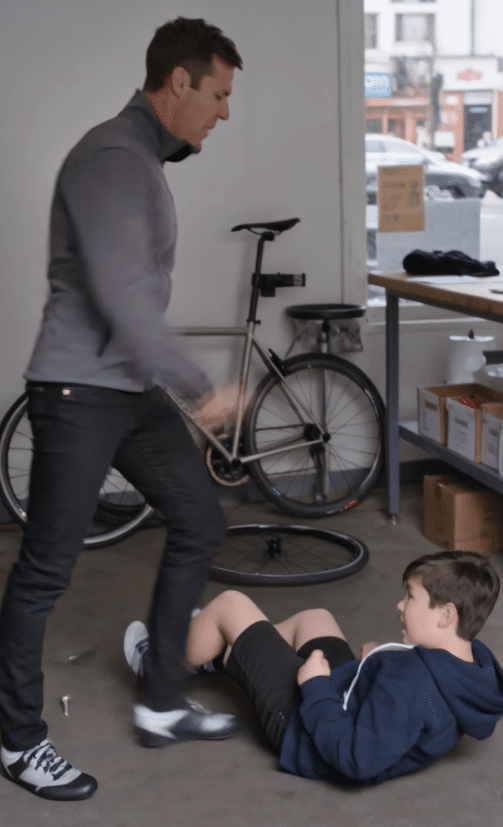
The repair shop went silent before anyone understood what had happened.
A wealthy cyclist stood beside his unfinished racing bike, his frustration boiling over as he demanded an explanation.
“My bike was supposed to be ready today.”
Across the workbench, fourteen-year-old Liam wiped the grease from his hands and tried to stay calm.
“The part hasn’t arrived yet…”
His explanation barely left his lips before the customer pointed at him.
“So you swapped my premium parts.”
Heads turned from every corner of the small shop.
Customers waiting near the open doorway stopped talking.
The apprentice felt dozens of eyes settle on him.
He wasn’t just being questioned.
He was being judged.
The customer folded his arms with complete certainty.
“Trash. You swapped my parts.”
No one had looked at the paperwork.
No one had asked the mechanic.
No one had checked the shipment records.
The truth was sitting quietly on the front counter.
Waiting to be read.
Act II
Liam had started helping at the bike shop only six months earlier.
His mother worked two jobs after his father passed away, and every dollar he earned as an apprentice helped keep food on the table.
He loved bicycles.
He loved understanding how every gear, brake, and bearing worked together.
The shop owner often joked that Liam treated every customer’s bike as though it belonged to his own family.
That was why the accusation hurt so deeply.
He hadn’t misplaced anything.
He hadn’t exchanged expensive components.
The replacement part simply hadn’t arrived from the supplier.
The delivery truck had been delayed after severe storms disrupted shipments across the region.
The invoice confirming that delay had arrived that very morning.
But anger has a way of ignoring facts.
The customer didn’t want an explanation.
He wanted someone to blame.
And the youngest person in the shop seemed like the easiest target.
Act III
The shop owner emerged from the back office with the lead mechanic beside him.
In the mechanic’s hand was a folder containing the latest delivery invoice.
The storage room camera device rested under his other arm, its screen turned away from the crowd.
Neither man raised his voice.
Neither rushed to defend anyone with emotion alone.
The owner simply looked at the angry customer.
Then he lifted the invoice.
“Read the invoice first.”
The room became still.
“The invoice?”
For the first time, uncertainty crossed the customer’s face.
He hadn’t expected documents.
He hadn’t expected records.
He certainly hadn’t expected evidence.
Everyone’s attention shifted from the frightened apprentice to the sheet of paper that had quietly been waiting on the counter all along.
Act IV
The owner handed over the invoice.
The customer scanned the page.
His expression changed with every line.
The shipment date.
The supplier’s notice.
The delayed delivery.
The exact serial number of the premium component still listed as “In Transit.”
Nothing had been removed.
Nothing had been exchanged.
Nothing had been stolen.
The lead mechanic calmly explained that the bicycle had remained untouched because installing the wrong part could compromise both performance and safety.
The storage room camera was available if any additional verification became necessary.
It never was.
The paperwork alone dismantled every accusation.
The shop fell into complete silence.
The confidence that had fueled the customer’s anger vanished almost instantly.
For the first time, he looked at Liam—not as a suspect, but as a frightened teenager who had simply been telling the truth.
Act V
The apology was quiet.
Much quieter than the accusation had been.
The customer admitted he had let impatience and pride outweigh common sense.
Liam accepted the apology with remarkable maturity.
He didn’t ask for revenge.
He didn’t demand satisfaction.
He simply returned to the repair stand and continued the work he loved.
Before reopening the shop to its normal routine, the owner addressed everyone present.
“In this business,” he said, “good mechanics solve problems with evidence—not assumptions.”
Those words stayed with many of the customers long after they left.
Several returned weeks later, specifically requesting Liam to service their bicycles.
Not because they pitied him.
Because they trusted him.
When the delayed shipment finally arrived, Liam completed the repair exactly as promised.
The wealthy customer returned to collect his bike.
This time, he shook the apprentice’s hand before leaving.
Years later, longtime customers still remembered the story.
Not because of the delayed part.
Not because of the expensive bicycle.
But because a frightened apprentice refused to compromise his honesty, even when someone tried to make him the easiest person to blame.
The missing component eventually arrived.
The damaged reputation was repaired.
And everyone in that little bike shop learned the same lesson:
Evidence can take time to appear—but when it does, it speaks louder than anger ever can.