Act I
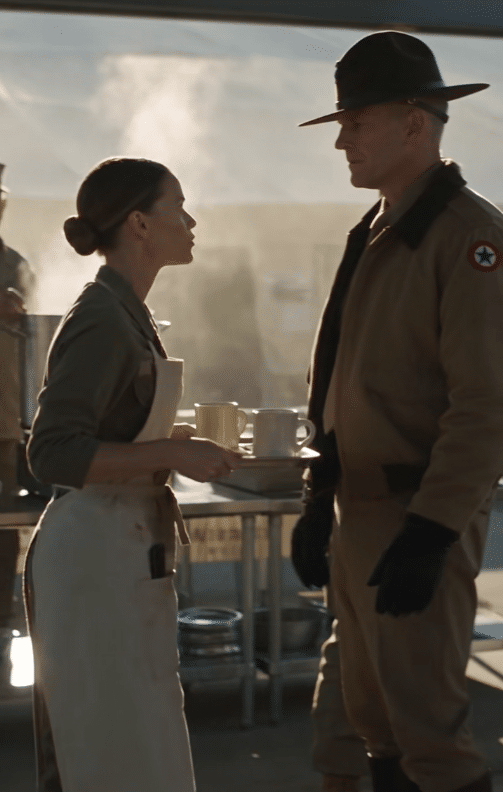
The breakfast line was already twenty soldiers deep when the Lieutenant Colonel decided that rules did not apply to him.
Steam rose from enormous stainless-steel pots. Coffee filled the morning air. Trays clattered against counters as exhausted soldiers moved through the field kitchen before another long day.
At the front of the line stood a young soldier with a bandaged forearm.
He was pale.
Tired.
And clearly trying not to draw attention to himself.
He had been waiting patiently.
Then the Lieutenant Colonel walked straight past him.
Clean boots.
Black gloves.
Field jacket perfectly pressed.
He placed his tray on the counter as though everyone else simply disappeared when he arrived.
“Serve me first.”
The woman behind the counter looked up.
She was thirty-five, brown hair pulled into a low bun, wearing an olive uniform beneath a plain field apron.
At first glance, she looked like kitchen staff.
Nothing more.
But her eyes moved immediately to the injured soldier.
Then back to the officer.
“He was next. He needs food first.”
The kitchen went quiet.
The Lieutenant Colonel slowly turned his head.
He couldn’t believe what he’d heard.
The woman hadn’t raised her voice.
She hadn’t insulted him.
She hadn’t even looked angry.
She had simply refused.
And that was enough.
“Kitchen girls don’t decide who matters.”
He reached for a coffee cup.
Before anyone could react, he threw the coffee across her apron and outer uniform.
Dark liquid spread across the fabric.
Gasps erupted along the line.
The woman didn’t move.
The Colonel knocked the tray from her hands.
Metal struck the floor.
She bent down to retrieve it.
His boot sent the tray skidding hard across the tiles.
The edge caught her hand.
A tiny scrape appeared across her palm.
Still, she didn’t react the way he expected.
She simply picked up the tray.
The Colonel stood over her.
“Did you understand me?”
The woman slowly straightened.
Her face was flushed from the heat and humiliation, but her eyes remained steady.
The Colonel sneered.
“Kitchen girls don’t decide who matters.”
Around them, soldiers stared at their boots.
Nobody spoke.
Then the older cook beside the largest food pot stopped stirring.
His ladle lowered slowly.
Something beneath the woman’s apron had shifted.
The coffee had soaked through.
The apron had pulled sideways.
And underneath it, barely visible against her uniform, was a dark credential.
The older cook’s face changed.
He looked at it.
Then at the Colonel.
“Sir… maybe check under the apron.”
The Colonel laughed.
“I don’t check aprons. I give orders.”
The woman looked at him.
Then down at the dark credential.
Her expression didn’t change.
“Then you just gave the wrong one.”
The Colonel’s smile disappeared.
His eyes followed the cook’s gaze.
Slowly.
Reluctantly.
Toward the thing hidden beneath the apron.
And suddenly, the busiest room on the base became completely silent.
Because the Colonel was about to discover that the person serving breakfast wasn’t who he thought she was.
Act II
The field kitchen had always been one of the few places where rank became temporarily irrelevant.
Everyone was hungry.
Everyone was tired.
Everyone needed coffee.
And everyone had to wait.
That was the point.
The woman understood it better than most.
She had been there since before sunrise, moving between steaming pots and stainless-steel tables.
She knew which soldiers were recovering from night exercises.
She knew which ones hadn’t slept.
She knew who needed extra food because they’d been working outside all morning.
And she had noticed the injured soldier the moment he entered.
His arm was bandaged.
His face was pale.
But he stood quietly at the end of the line.
He wasn’t asking for special treatment.
He was simply waiting his turn.
Then the Lieutenant Colonel arrived.
He didn’t ask.
He didn’t wait.
He expected the line to split around him.
Nobody challenged him.
Not until the woman spoke.
“He was next. He needs food first.”
The words had been simple.
But the Colonel heard something else.
He heard defiance.
He had spent years learning to interpret obedience as respect.
That morning, he confused the two.
The woman had no desire to embarrass him.
She didn’t know that refusing him would become a spectacle.
She simply couldn’t justify pushing an injured soldier aside because someone with more rank wanted breakfast sooner.
That was why the Colonel’s reaction was so revealing.
The coffee.
The tray.
The boot.
None of it was necessary.
It was punishment.
He wanted everyone watching to understand that he could make someone obey him whenever he chose.
The soldiers understood the message.
But they also saw something else.
The woman wasn’t afraid.
She was hurt.
Humiliated.
Angry, perhaps.
But not afraid.
That distinction mattered.
The older cook had been watching from beside the stove.
He was fifty-nine and had spent enough years around military personnel to recognize different kinds of authority.
There was the authority people wore on their sleeves.
There was the authority they carried in their voice.
And occasionally, there was another kind.
The kind that didn’t need to be announced.
He had noticed something strange about the woman when she first arrived that morning.
She moved differently from ordinary kitchen staff.
She knew where everyone was.
She knew when the injured soldier needed to be moved aside.
She knew exactly which line had priority.
And she never once checked the Colonel’s insignia before speaking to him.
She had simply looked at the situation.
Then made a decision.
Now the soaked apron had shifted.
The dark credential beneath it had become visible.
The cook recognized its shape.
His hand froze around the ladle.
He remembered seeing one years earlier.
Not often.
Never casually.
It belonged to a category of authority that wasn’t discussed in ordinary dining facilities.
It wasn’t something junior personnel were expected to ask about.
The cook looked toward the Colonel.
He almost felt sorry for him.
Almost.
Because the Colonel had just been given a warning.
And the Colonel ignored it.
“I don’t check aprons,” he said.
“I give orders.”
The woman looked at him with an expression that was almost strangely calm.
“Then you just gave the wrong one.”
The cook lowered his eyes.
He knew the Colonel had made a mistake.
The only question was how large that mistake would become.
Act III
The Colonel stared at the apron.
“What exactly am I supposed to be looking at?”
The woman said nothing.
She reached down and picked up the food tray.
Her scraped palm left a faint red mark against the metal.
The injured soldier watched her.
She placed the tray back on the counter.
Then she turned toward him.
“Go ahead.”
The young soldier hesitated.
He looked at the Colonel.
The woman nodded.
“Eat.”
He took the tray.
For the first time that morning, the Colonel didn’t stop him.
His attention was fixed on the dark credential beneath the apron.
The older cook slowly stepped away from the pot.
He didn’t approach.
He didn’t explain.
He simply watched.
The Colonel noticed.
“You know what that is?”
The cook remained silent.
“I asked you a question.”
The cook swallowed.
“Sir, I think you should leave it alone.”
The Colonel’s expression hardened.
“I think you should remember who you’re speaking to.”
The cook looked toward the woman.
Then back at the Colonel.
“I do.”
The answer was quiet.
But it made several soldiers look up.
The Colonel’s face tightened.
He reached toward the woman’s apron.
She moved one step backward.
Not frightened.
Simply refusing to let him touch her.
“Don’t.”
The word was soft.
The Colonel stopped.
For a moment, nobody moved.
Then the credential caught the overhead light.
Just enough.
The Colonel saw its surface.
Dark.
Plain.
Almost deliberately unremarkable.
There was no bright insignia.
No obvious rank.
No name large enough to read from across the room.
Yet the cook had recognized it instantly.
The Colonel’s eyes narrowed.
Where had he seen something like that?
He searched his memory.
An old briefing.
A closed-door meeting.
A folder he had once been told not to copy.
A warning from a senior officer years ago:
Some credentials exist precisely because the people carrying them cannot be identified publicly.
The Colonel’s breathing changed.
He looked at the woman again.
Thirty-five.
Brown hair.
Field apron.
Kitchen tray.
A scrape on her hand.
Everything about her seemed ordinary.
Too ordinary.
That was the problem.
He looked toward the older cook.
The cook’s expression answered him without words.
Yes.
He had seen it too.
The Colonel’s arrogance began to crack.
But he still wasn’t ready to admit it.
“So you’re telling me,” he said slowly, “that this apron makes you important?”
The woman looked at him.
“No.”
She adjusted the soaked apron.
“The apron is exactly why you thought you could treat me that way.”
Silence.
The Colonel stared at her.
The injured soldier had already moved away from the line.
The other soldiers were standing perfectly still.
No one wanted to be caught staring.
But everyone was listening.
The woman reached beneath the apron.
She touched the credential.
Then let her hand fall.
“You saw a kitchen worker.”
She paused.
“That was your first mistake.”
The Colonel’s face tightened.
“And your second?”
She met his eyes.
“You assumed rank was the only authority in the room.”
The older cook closed his eyes for a moment.
Because he knew what came next.
The Colonel didn’t.
Not yet.
But the dark credential had already changed the room.
Act IV
The Lieutenant Colonel stepped backward.
It was only one step.
But everyone noticed.
The woman noticed too.
She didn’t smile.
She didn’t celebrate.
She simply looked at him.
The Colonel glanced around the kitchen.
A dozen soldiers stood frozen.
The injured soldier was eating quietly at a nearby table.
The older cook still held his ladle.
Steam rose between them.
For the first time, the Colonel looked uncomfortable in a place where he had expected absolute control.
“What is that credential?” he asked.
The woman didn’t answer.
“You heard me.”
“I did.”
“Then answer.”
She shook her head.
“That’s not your question to ask.”
The Colonel’s jaw tightened.
He looked toward the cook.
“Does he know?”
The older man remained silent.
The Colonel took another step back.
Now he was beginning to understand.
The credential wasn’t there to give her power over him.
It existed because she already possessed responsibilities he had no business interfering with.
The woman had been disguised by circumstance.
Not by deception.
She was wearing the apron because she had chosen to observe the kitchen from inside it.
She had wanted to see how people behaved when they thought nobody important was watching.
And the Colonel had answered that question perfectly.
The older cook finally spoke.
“You should apologize.”
The Colonel stared at him.
The cook’s voice remained calm.
“Not to me.”
The Colonel looked at the woman.
She said nothing.
That silence was devastating.
He remembered every action.
Cutting the line.
Throwing the coffee.
Knocking away the tray.
Kicking it while she was reaching for it.
Calling her a kitchen girl.
All because she had protected a wounded soldier’s place in line.
The Colonel looked at the young soldier.
The injured man lowered his eyes.
The Colonel suddenly seemed ashamed to meet them.
The woman picked up another clean tray.
She handed it to the next soldier.
“Next.”
The line began moving again.
Just like that.
No speech.
No dramatic announcement.
No one had to tell the Colonel to leave.
He simply understood that his authority had evaporated in front of the people he had tried to intimidate.
He looked down at his own uniform.
The insignia on his chest suddenly seemed meaningless.
He had thought the apron made the woman insignificant.
In reality, it had made him careless.
The woman turned toward him one final time.
“Lieutenant Colonel.”
He looked up.
She held his gaze.
“You wanted to decide who mattered.”
A pause.
“Start by remembering the soldier you pushed aside.”
The Colonel looked toward the injured soldier.
The young man was eating.
Quietly.
Safely.
Exactly where he should have been.
And for the first time, the Colonel seemed to understand what his real mistake had been.
He hadn’t challenged a kitchen worker.
He had challenged someone who had been watching him.
Act V
Breakfast continued.
That was the strangest part.
The pots were still steaming.
Coffee was still being poured.
Trays still moved down the line.
The kitchen did not stop because one man’s ego had finally collided with reality.
The woman removed her stained apron.
Underneath it, the dark credential was visible for only a moment.
The older cook looked away.
He knew better than to stare.
The woman folded the apron and placed it beside the sink.
The Colonel remained near the doorway.
He hadn’t spoken for nearly a minute.
Finally, he looked toward the injured soldier.
“Are you all right?”
The young man looked up.
“Yes, sir.”
The Colonel nodded.
Then he looked at the woman.
His mouth opened.
For once, no command came out.
No threat.
No insult.
No demand.
Just silence.
The woman picked up a clean tray.
She handed it to another soldier.
“Next.”
The Colonel finally walked away.
He didn’t slam the door.
He didn’t issue orders.
He simply disappeared down the corridor.
The older cook watched him go.
Then he looked at the woman.
“You knew he’d do that?”
She shook her head.
“No.”
“You knew someone would recognize it?”
“No.”
The cook studied her.
“Then why wear it under an apron?”
She looked toward the breakfast line.
“Because sometimes the easiest way to learn who people really are is to let them think you have no power.”
The cook nodded slowly.
That explained everything.
She hadn’t been trying to trap the Colonel.
She hadn’t planned the humiliation.
She had simply given him a choice.
Respect the line.
Or abuse his rank.
He chose.
And now everyone knew what that choice said about him.
The injured soldier eventually finished his breakfast.
Before leaving, he stopped beside the woman.
“Thank you.”
She looked at him.
“You were next.”
He smiled faintly.
“Yes, ma’am.”
He walked away.
The woman watched him disappear through the door.
Then she looked down at the scrape on her hand.
It was tiny.
Barely worth mentioning.
But it had come from a tray the Colonel had kicked away because he couldn’t tolerate being told to wait.
She cleaned the scrape.
Then returned to work.
Outside, the morning sun climbed over the base.
Inside, the breakfast line moved normally again.
Nobody announced what the credential meant.
Nobody explained who the woman really was.
And perhaps that was the point.
The Colonel had believed power was something displayed.
Something sewn onto a uniform.
Something that made other people move when you spoke.
But the woman had carried hers beneath an ordinary apron.
Hidden.
Quiet.
Almost invisible.
And when he finally saw it, he understood the lesson too late.
The most dangerous person in the room isn’t always the one wearing the highest rank.
Sometimes it’s the person quietly watching to see what you do when you think nobody important is looking.