Act I
The accusation came with a boot before anyone could ask what had really happened.
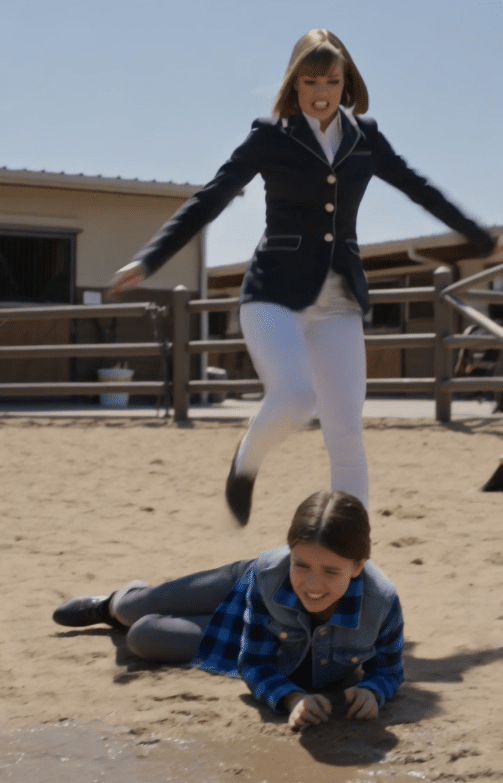
The wealthy horse owner drove a brutal kick into the fifteen-year-old stable girl’s chest, sending her crashing backward across the sandy riding yard. She slammed into a metal water bucket, spilling water across the ground as a stable broom bounced away with a loud clatter.
The horse had already disappeared beyond the training fence.
Now every eye was on the girl.
She tried to catch her breath, but pain seized her chest. Her elbow scraped against the bucket’s edge, leaving only a thin streak of blood before she curled into the sand, trembling.
“I… I didn’t scare the horse…”
Her voice barely rose above the distant whinny echoing from the stables.
The owner stood over her, his expensive riding boots sinking into the sand.
“Trash. You ruined my horse.”
Around them, riding guests froze in disbelief.
One instructor-in-training covered her mouth.
Parents instinctively pulled their children closer.
Nobody stepped forward.
The owner wasn’t finished.
He struck her twice more with vicious kicks to her side and back.
“You don’t belong in a stable.”
To him, the frightened teenager wasn’t a person.
She was simply the easiest target for his humiliation.
But while everyone stared at the girl…
No one noticed the object lying beside the fence.
The one thing that had frightened the horse long before anyone blamed her.
Act II
The girl’s name was Emma.
She had grown up around horses, though never as their owner.
Her mother cleaned tack rooms.
Her late grandfather had repaired saddles for ranches across the county.
After school, Emma swept stalls, groomed horses, filled water buckets, and completed every task no one else wanted.
She loved horses enough to accept the hardest jobs without complaint.
The trainers trusted her because she understood something every experienced handler knew.
A frightened horse remembers panic.
A calm horse remembers kindness.
Emma never shouted.
Never waved tools.
Never ran behind nervous animals.
She treated every horse as though it could sense her intentions.
The riding center owner often joked that even their most stubborn gelding relaxed whenever Emma entered the stall.
That afternoon, she had been sweeping near the training arena while riders prepared lessons.
The valuable stallion had been standing quietly only moments before.
Then everything changed in an instant.
A powerful gust swept across the open yard.
Something large flipped through the air.
The horse exploded with fear.
By the time people turned around, the animal was already racing across the paddock.
The wealthy owner saw only one thing.
Emma standing nearby.
He never searched for another explanation.
Because blaming someone powerless was easier than admitting accidents happen.
What he didn’t realize was that several experienced horsemen had already noticed something he hadn’t.
Act III
Urgent footsteps thundered from the stable gate.
The head riding trainer arrived first.
The riding center owner followed close behind.
Both men ignored the shouting.
Both looked immediately toward Emma lying in the sand.
The trainer stepped between her and the furious owner without hesitation.
Then his attention shifted toward the riding fence.
A large patio umbrella lay upside down, its fabric snapping wildly in the wind.
The riding center owner stared at it for only a second before turning back.
His expression hardened.
“You blamed the wrong cause.”
The words silenced the yard.
The wealthy owner’s confidence faltered.
“What?”
The trainer never raised his voice.
“Look.”
Every witness followed his gaze toward the overturned umbrella.
The owner did the same.
His expression changed.
Because he remembered.
Earlier that afternoon, stable staff had suggested closing the umbrella as the wind grew stronger.
He laughed it off.
“It’s expensive,” he had said. “It won’t move.”
Minutes later, a violent gust ripped it from its stand.
The sudden motion and loud crack of the frame had startled the horse.
Emma hadn’t even been facing the animal.
She had been sweeping another stall entrance several yards away.
The trainer didn’t need to explain further.
Every experienced rider present already understood exactly what had happened.
And so did the horse owner.
Act IV
The riding center owner walked slowly toward the fallen umbrella.
He examined its broken base, then looked across the hoof prints carved into the sand.
The trail told a clear story.
The horse had bolted away from the fence.
Not from Emma.
He turned back toward the crowd.
“She wasn’t the danger.”
Silence answered him.
“The horse reacted exactly as a frightened horse would.”
Another pause.
“You assaulted a child before asking a single question.”
The wealthy owner’s jaw tightened.
Guests who had watched from a distance now quietly stepped away from him.
A stable worker hurried to Emma with a first-aid kit.
Another employee called emergency services.
Several riders who had witnessed the attack offered statements before anyone even requested them.
Moments earlier, the owner believed his wealth and status would make everyone accept his version of events.
Instead, they had watched him expose his own character.
The panic wasn’t the accident.
It was what he chose to do afterward.
Act V
Emma sat outside the stable office while a medic cleaned the scrape on her elbow.
The cut was minor.
The fear she carried was not.
The head trainer knelt beside her.
“You stayed calm when everyone else lost theirs.”
Those words meant more than she could express.
Later that afternoon, the riding center reviewed statements from instructors, guests, and stable staff. Every account pointed to the same conclusion: the horse had been startled by the wind flipping the large umbrella near the fence. Emma had never approached the animal or done anything to provoke it.
The wealthy owner wasn’t held accountable because his horse panicked.
He faced consequences because he chose violence instead of truth.
The riding center suspended his boarding privileges while authorities investigated the assault. News spread quickly through the local equestrian community, and invitations to exclusive riding events quietly disappeared.
Emma returned to the stable weeks later.
This time, riders greeted her with respect rather than sympathy.
The head trainer offered to mentor her formally, recognizing the patience and composure she had shown under impossible circumstances.
Years later, Emma would remember that afternoon for two reasons.
One was the cruelty of a man who valued his reputation more than an innocent child.
The other was the moment the truth turned everything around.
Sometimes justice doesn’t arrive through complicated evidence.
Sometimes it begins with someone willing to notice what everyone else ignored.
A frightened horse.
A wind-blown umbrella.
And one quiet sentence that ended a lie.
“You blamed the wrong cause.”