Act I
The formation was perfect.
At least, that was what everyone wanted the ceremonial officer to believe.
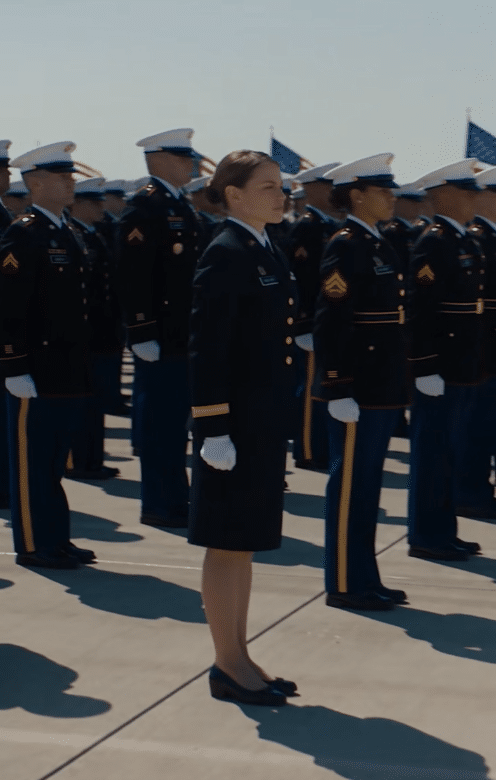
Rows of soldiers stood motionless across the open parade ground, uniforms pressed, white gloves spotless, flags hanging perfectly in the morning air. Ceremonial drums waited beside the formation, their polished surfaces catching the light.
Empty VIP chairs faced the field.
Everything was ready.
Everything except one detail.
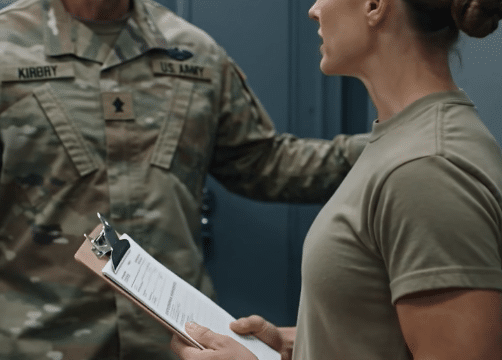
A 33-year-old soldier stood several paces away, studying the formation with quiet concentration.
Her brown hair was pulled into a high bun. Her ceremonial uniform was simple compared with the decorated officer standing opposite her.
But she had noticed something no one else seemed willing to acknowledge.
“The formation is wrong.”
The words were quiet.
They still carried.
The ceremonial officer turned slowly.
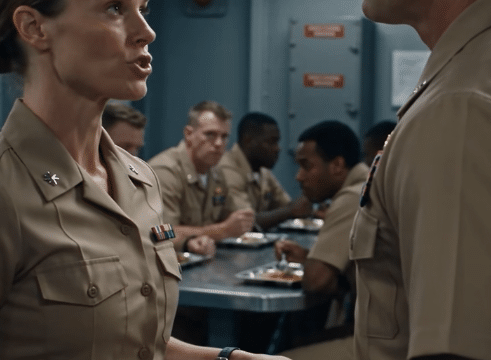
He was 52, covered in ribbons and polished insignia, with the kind of uniform designed to make people stop talking when he entered a room.
He looked at her as though she had committed an offense simply by speaking.
“You’re questioning my formation?”
She didn’t flinch.
“I’m correcting it.”
That was enough.
His jaw tightened.
The soldiers behind them remained perfectly still.
The drummer closest to the confrontation lowered his eyes.
Nobody wanted to watch.
But nobody could stop watching either.
The officer stepped around the woman.
Then, without warning, he kicked her hard from behind.
She went down onto the pavement.
Her white-gloved hands struck the ground first. Dirt smeared across the fabric. Her breath caught sharply from the impact, but no cry escaped her.
The officer stood over her.
“You don’t correct my formation,” he said. “You disappear from it.”
The soldiers remained frozen.
Then something beneath the woman’s shoulder shifted.
A small piece of dark ink appeared beneath the displaced fabric.
The young drummer saw it.
His expression changed instantly.
Because he had seen that mark before.
And suddenly, the parade formation wasn’t the only thing that had been wrong.
The officer had just made a mistake he couldn’t take back.
Act II
The woman slowly pushed herself upright.
Her gloves were dirty now.
That seemed to bother her less than the fact that the formation was still incorrect.
She brushed one palm against the pavement and looked toward the soldiers.
Nobody moved.
Nobody dared.
The officer had made his point.
At least, that was what he believed.
“You’re dismissed,” he said.
She said nothing.
He stepped closer.
“You heard me.”
Still nothing.
The woman simply looked down the line of soldiers, studying their spacing.
It was almost absurd.
She had just been kicked onto the pavement in front of an entire formation, and she was still thinking about alignment.
But that was exactly what made the officer uncomfortable.
She wasn’t embarrassed.
She wasn’t pleading.
She wasn’t angry.
She was simply waiting.
The young drummer’s grip tightened around his drumsticks.
His eyes kept returning to her shoulder.
The dark mark was only partially visible beneath the displaced fabric.
It wasn’t a decorative tattoo.
It was sharper.
Older.
A symbol.
And he knew what kind of people carried symbols like that.
His breathing became shallow.
He looked toward the officer.
Then back at the woman.
Something from his training surfaced in his memory.
Not a name.
Not a face.
A rule.
There were certain marks that were never worn casually.
Marks that represented authority earned somewhere far beyond ceremonial grounds.
Marks that were recognized by people who knew where to look.
The drummer swallowed.
“Sir… look at her shoulder.”
The officer didn’t even turn.
His face hardened.
“I said keep the formation.”
The drummer went silent.
The officer had no intention of looking.
He was too certain of his own authority.
Behind them, the soldiers remained rigid.
But now they were beginning to glance sideways.
The atmosphere had changed.
The woman slowly adjusted her uniform.
For one brief moment, the dark mark remained visible.
Then she covered it.
The officer still didn’t understand.
But the drummer did.
And what he had recognized was something the officer would have given anything to have remained hidden.
Act III
Years earlier, the young drummer had been taught that some military symbols were more important than rank.
Not because they looked impressive.
Because they represented things that couldn’t simply be ordered away.
The mark on the woman’s shoulder belonged to that category.
He had seen it once before.
Not on a parade ground.
In an old training archive.
A faded photograph showed a much younger soldier standing beside a group of field personnel after an operation that had never been discussed publicly in detail.
The faces were blurred in the copy.
The names were missing.
But the symbol was visible.
The same sharp dark mark.
He remembered asking his instructor what it meant.
The instructor had stared at him for several seconds before answering.
“That’s not something you ask about.”
The memory had stayed with him.
Now the woman was standing twenty feet away.
Older.
Calmer.
But wearing the same mark.
The drummer looked at the other soldiers.
One of them had noticed it too.
Then another.
The formation remained technically intact, but the mood inside it had shifted completely.
The officer sensed it.
“What is wrong with everyone?”
No one answered.
His eyes moved across the line.
“Eyes forward.”
The soldiers obeyed.
But obedience now looked different.
Before, they had been afraid of him.
Now they were afraid of what he might do next.
The woman stepped forward.
Her posture was perfectly controlled.
The officer turned toward her.
“I told you to leave.”
She looked directly at him.
“Then watch how fast it changes.”
The words were quiet.
Almost gentle.
The officer’s expression flickered.
For the first time, uncertainty appeared beneath the arrogance.
He finally looked toward her shoulder.
The fabric had shifted again.
The dark mark was visible.
Only partially.
But enough.
His eyes narrowed.
Then widened.
Something in his face changed.
Not recognition.
Not yet.
Something worse.
Possibility.
The woman watched him.
She didn’t explain.
She didn’t have to.
The drummer had already understood.
The soldiers were beginning to understand.
And the officer was suddenly trying very hard not to.
Because there was one question he could no longer avoid.
If that mark belonged to the person he thought it belonged to…
Then why was she standing on his parade ground?
And why had she just corrected his formation?
Act IV
The officer stared at the mark.
His confidence returned for a moment.
It had to.
He straightened his uniform.
“You think a tattoo changes your orders?”
The woman said nothing.
He stepped closer.
“You’re still out of formation.”
The drummer’s face went pale.
He knew the officer was making the mistake worse.
The woman slowly pulled her shoulder fabric back into place.
Then she looked down the line.
“Second row. Two steps left.”
No one moved.
The officer immediately snapped,
“I said keep the formation!”
The woman didn’t raise her voice.
“Third row. Close the gap.”
This time, the soldiers moved.
Almost instinctively.
Two steps.
Then another.
The formation changed.
Perfectly.
The officer froze.
He looked at the soldiers.
Then at the woman.
The drummer stood straighter.
Not because the officer had ordered him to.
Because he had finally realized who was standing in front of them.
The woman’s plain uniform suddenly seemed different.
The lack of ribbons didn’t matter.
The absence of decoration didn’t matter.
There was a kind of authority that didn’t need to be displayed.
It only needed to be recognized.
The officer’s breathing became heavier.
He looked again at the mark.
This time, he saw the entire shape.
His face lost color.
The woman noticed.
She didn’t smile.
She didn’t celebrate.
She simply stood there.
The soldiers remained silent.
The empty VIP chairs suddenly seemed irrelevant.
The flags moved gently behind them.
The drums were still.
Then the officer took half a step backward.
It was barely noticeable.
But everyone saw it.
The woman had never needed to overpower him.
She had only needed to remind the room who she was.
And now the officer was remembering something too.
Something from years ago.
Something he had been certain would never return.
His eyes locked on the mark.
His lips parted.
The certainty in his face disappeared.
Because the symbol wasn’t just a symbol.
It was proof.
And he finally knew what it proved.
Act V
For several seconds, nobody moved.
The woman stood at the front of the formation, her dirty white gloves hanging at her sides.
The officer stared at her shoulder.
His mind was racing through memories he had spent years burying.
The operation.
The reports.
The name that had vanished from official conversations.
The soldier everyone believed had left the service.
The woman who, according to the story he remembered, had never been supposed to stand on another parade ground again.
Yet here she was.
Alive.
Calm.
Watching him.
The drummer finally understood why the symbol had felt so familiar.
It wasn’t simply an insignia.
It belonged to someone whose authority had once been recognized by people far above the ceremonial chain of command.
The officer had mistaken silence for weakness.
He had mistaken a plain uniform for insignificance.
And he had mistaken a correction for disrespect.
Now he couldn’t even meet her eyes.
The woman looked down at her gloves.
They were dirty from the pavement.
She slowly brushed the dust away.
Then she looked toward the formation.
“Reset.”
The soldiers moved immediately.
This time, there was no hesitation.
The lines straightened.
The spacing corrected itself.
The flags rose into perfect alignment.
The drums were lifted.
The parade ground became orderly again.
Except for one person.
The officer remained frozen.
His entire posture had changed.
The ribbons on his chest suddenly looked meaningless.
The woman walked past him without another word.
She didn’t demand an apology.
She didn’t threaten him.
She didn’t need to.
The formation had already answered for her.
The drummer watched her pass.
Then he looked at the officer.
For the first time, the man who had seemed untouchable looked small.
The woman stopped at the edge of the formation.
Without turning around, she said quietly,
“Next time, correct the formation before you correct the person.”
The officer said nothing.
He couldn’t.
Because the mark on her shoulder had already told him everything.
And in the final seconds, all that remained on his face was the realization that the soldier he had just kicked to the ground was someone whose authority he had once been trained to fear.
His eyes widened.
His lips stalled.
His breathing became shallow.
“That shoulder mark…?”