Act I
The room went silent before anyone understood why.
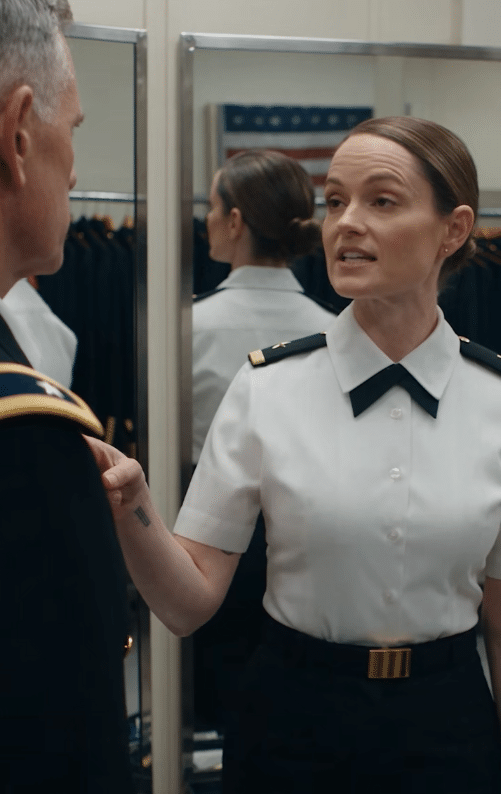
It was supposed to be a routine morning in the military uniform preparation room. Dress jackets hung in perfect rows. Polishing cloths lay folded beside metal insignia boxes. Soldiers moved between long mirrors, checking collars, ribbons, buttons, and every tiny detail before the formal review.
Then a quiet voice cut through the room.
“Your insignia is in the wrong place.”
The woman who said it did not raise her voice.
She was thirty-nine, composed, brown hair pulled into a low bun, white uniform shirt tucked neatly into black trousers. There was nothing confrontational in her posture. She had simply noticed the error and corrected it, the way someone experienced enough to care about standards would.
The officer she had corrected was fifty-five.
His gray hair was perfectly arranged. His dress uniform was covered with ribbons and polished insignia, and he had spent the previous ten minutes checking his reflection from three different angles.
He slowly turned toward her.
Several junior soldiers stopped moving.
The officer stared at her through the mirror.
Then his jaw tightened.
“You don’t correct what you could never earn.”
The words landed harder than the metal pieces scattered across the table.
He grabbed the fabric at her shoulder and jerked her around.
She stumbled.
His foot caught her movement, and she dropped to one knee beside the insignia table. Before anyone could react, he shoved the metal box off the table with his boot.
Clatter.
Pins, bars, and polished pieces scattered across the floor.
The woman steadied herself with one hand.
She did not cry.
She did not apologize.
She simply looked up at him.
Around them, soldiers froze.
One lowered his phone.
Another looked toward the door.
Nobody stepped forward.
The officer stood over her as if the entire room belonged to him.
But when she reached down to gather the scattered insignia, something slipped from beneath her sleeve.
A small tattoo appeared on the inside of her wrist.
Then something dark fell from her pocket.
She caught it before it hit the floor.
A badge.
Small.
Black.
Nothing like the bright ceremonial insignia scattered around her.
The young soldier standing beside the insignia table saw it first.
His expression changed instantly.
His face went pale.
He looked at the badge.
Then at the woman.
Then at the officer.
“Sir…” he whispered.
The officer barely glanced at him.
The young soldier swallowed.
“Look at what she’s holding.”
The officer sneered.
“She’s holding what I told her to pick up.”
The woman slowly stood.
Her eyes met his in the mirror.
And then she closed her fingers around the dark badge.
“No,” she said.
Her voice was quiet.
“I’m holding what decides who walks out there.”
For the first time that morning, the officer stopped looking at his reflection.
He looked at hers.
Then at the badge.
His confidence disappeared by degrees.
“Decides…?”
And suddenly, nobody in the room wanted to breathe.
Because whatever that badge was, the young soldier already knew one thing.
The man who had just humiliated her had no idea who he had put his hands on.
And the review had not even begun.
Act II
Ten minutes earlier, the room had been ordinary.
There had been the familiar rhythm of preparation: brushes moving across polished fabric, clasps snapping into place, shoes being checked beneath tables, and soldiers quietly helping one another fix details too small to notice from across a parade ground.
The woman had moved through all of it without drawing attention.
She wasn’t the loudest person in the room.
She wasn’t trying to command anyone.
In fact, most of the younger soldiers barely noticed her.
That was exactly how she preferred it.
She had a reputation for seeing things other people missed.
A crooked collar.
A loose button.
A ribbon mounted one fraction too high.
A clasp that might come loose under movement.
She understood that ceremonial discipline wasn’t about vanity. Every detail mattered because the people wearing those uniforms represented something larger than themselves.
That was why she had noticed the officer’s insignia.
It wasn’t dramatically wrong.
It was only slightly out of position.
But during the formal review, even a small mistake would be obvious.
So she had quietly pointed it out.
She expected him to fix it.
Instead, he took it personally.
The officer had spent years building an image around authority.
His uniform was not simply clothing to him.
It was armor.
Every ribbon was proof that he had accomplished something. Every polished surface reflected the person he believed himself to be.
And being corrected by a woman he considered beneath him had struck something much deeper than professional pride.
So he had responded with humiliation.
Publicly.
Deliberately.
He wanted the room to understand one thing:
He was important.
She was not.
But the woman never gave him the reaction he wanted.
Even after being thrown to one knee, she had remained controlled.
That was what unsettled the youngest soldier.
Because he’d seen people become angry when embarrassed.
He’d seen people cry.
He’d seen people panic when someone with rank turned against them.
She did none of those things.
She simply gathered the scattered insignia.
One piece.
Then another.
Until her sleeve shifted.
The young soldier saw the tattoo.
It was small, faded, and placed where most people would never notice.
But the tattoo wasn’t what frightened him.
It was the badge.
He had seen one before.
Not in this room.
Not on a parade uniform.
And certainly not in an insignia box.
He remembered seeing a photograph years earlier during an orientation briefing.
The image had lasted only a few seconds.
A dark badge.
A particular marking.
A warning that some people were never to be questioned about why they carried it.
He had never expected to see one in real life.
And now it was sitting in the hand of the woman everyone had just watched get shoved onto the floor.
His stomach tightened.
He wanted to tell the officer to stop.
But how could he?
The man was senior.
The room was watching.
And the badge’s meaning was not something he was authorized to explain.
So he whispered the only warning he could.
“Sir… look at what she’s holding.”
The officer ignored him.
That was his mistake.
The second mistake was worse.
He looked at the woman and saw someone he believed had lost.
She looked at him and saw someone who had already lost control.
The difference was enormous.
The officer simply hadn’t realized it yet.
But the woman knew something he didn’t.
And soon, everyone else would see it too.
Act III
The officer turned toward her.
“What exactly do you think you’re doing?”
The woman didn’t answer immediately.
She placed one final insignia piece on the table.
Then she looked down at the dark badge in her palm.
For a moment, the room saw almost nothing.
Just a small piece of black metal.
But the young soldier knew that wasn’t what it was.
There were symbols on it.
Subtle ones.
The kind that weren’t designed to impress crowds.
The kind that were designed to be recognized by the right people.
The officer stepped closer.
His arrogance was returning.
“You’ve caused enough disruption.”
The woman raised her eyes.
“I caused none of it.”
A few soldiers looked down.
The officer’s face tightened.
“You challenged me in front of my personnel.”
“No,” she said. “I corrected an error.”
That sentence made his expression darken again.
He stepped toward her.
“You don’t correct what you could never earn.”
She didn’t flinch.
Instead, she turned slightly toward the mirror.
The badge was now reflected clearly beside her face.
The officer’s eyes followed it.
Something flickered across his expression.
Not recognition.
Not yet.
More like uncertainty.
Then the young soldier spoke again.
“Sir…”
The officer snapped his head toward him.
“I told you to stay out of this.”
The young soldier immediately fell silent.
The officer turned back.
“She is holding what I told her to pick up.”
The woman looked at him.
“No.”
Her fingers closed around the badge.
“I’m holding what decides who walks out there.”
The room seemed to shrink.
The officer’s expression changed.
His eyes returned to the badge.
This time, he actually looked.
And something in his memory moved.
A briefing room.
A closed door.
A warning from someone senior to him.
A phrase he hadn’t heard in years.
Not a rank.
Not a decoration.
An authority that existed outside the normal ceremony of ribbons and medals.
The officer’s breathing slowed.
His eyes moved to the woman’s wrist.
The tattoo.
Then back to the badge.
Suddenly, her calmness made sense.
The way she had moved through the room.
The way she had spoken without hesitation.
The fact that she had never once behaved like someone impressed by his rank.
She hadn’t been challenging him.
She had been observing him.
And that possibility terrified him.
Because if she was who the badge suggested she might be, then everything that had happened in the room had been witnessed by someone whose authority did not depend on the number of ribbons on her chest.
The officer looked around.
The younger soldiers had stopped moving.
Nobody was whispering anymore.
Nobody was looking at him with admiration.
They were looking at the badge.
Then at her.
Then back at him.
His hand dropped slowly from the front of his uniform.
For the first time that morning, he seemed conscious of how ridiculous his obsession with appearance had become.
His insignia was crooked.
His temper was worse.
And the person he had tried to humiliate had just revealed something he couldn’t order away.
But there was still one question.
Why had she been carrying that badge here?
And why had she allowed him to believe she was nobody important?
The answer was about to make his earlier behavior look even more reckless.
Act IV
The woman stepped toward the mirror.
She didn’t need to raise her voice.
She didn’t need to threaten him.
She simply held the dark badge where its reflection could be seen.
The officer stared at it.
A younger soldier finally understood what was happening.
She had not been there merely to inspect uniforms.
She had been watching.
Not the uniforms.
The people.
How they behaved under pressure.
How senior personnel treated junior soldiers.
Whether standards existed only when important people were watching.
Whether rank was being used to maintain discipline or to protect someone’s ego.
The officer suddenly remembered every word he’d said.
Every movement.
Every witness.
Every second of the incident.
His face went pale.
The woman looked at him.
“You were worried about where your insignia was placed.”
He said nothing.
“You should have been more worried about how you used the authority beneath it.”
Nobody moved.
The words weren’t shouted.
That made them worse.
The officer glanced toward the young soldier.
The young soldier immediately straightened.
Then toward the others.
They were already standing differently.
Not because she had ordered them to.
Because the room had changed.
The woman crouched once more and picked up the final piece of insignia from the floor.
Her wrist tattoo showed again.
This time, nobody missed it.
She placed the piece beside the others.
Perfectly aligned.
Then she looked back at the officer.
“You wanted everyone to know what could be earned.”
A pause.
“So now everyone gets to see what can be lost.”
The officer swallowed.
His mouth opened.
Nothing came out.
There was no dramatic shouting.
No punishment announced.
No armed guards bursting through the door.
The reversal was quieter than that.
The man who had relied on his rank to make everyone else feel small had finally realized that rank was not immunity.
And the woman who had been forced to her knees was standing again.
Calm.
Steady.
Unbroken.
The young soldier looked at the badge one more time.
He finally understood why she had not been afraid.
She hadn’t needed to prove who she was.
The badge already did that for anyone who knew enough to recognize it.
The officer looked at her reflection.
His own reflection stared back beside hers.
For the first time, he seemed to understand that the mirror had never been his friend.
It had simply been showing him exactly what everyone else could see.
A man obsessed with appearing powerful.
And a woman who never needed to appear powerful at all.
But there was still one final thing he didn’t understand.
If she had been observing the room from the beginning…
Then she had also been observing him.
And that meant the incident hadn’t merely exposed his temper.
It had exposed his character.
Act V
The formal review began twenty minutes later.
The hallway outside filled with footsteps.
Uniforms were straightened.
Buttons checked.
Ribbons aligned.
The same ritual continued as though nothing had happened.
But inside the preparation room, nothing was the same.
The officer stood before the mirror.
His insignia had been corrected.
His jacket was immaculate.
Every ribbon was perfectly positioned.
From a distance, he looked exactly as he had intended to look that morning.
Important.
Decorated.
Untouchable.
But he no longer looked at himself with pride.
He looked at the woman standing several feet behind him.
She was finishing the final inspection.
No anger.
No satisfaction.
No need for revenge.
That almost frightened him more than the badge.
She wasn’t interested in humiliating him.
She was interested in the truth.
And the truth was already enough.
The young soldier approached the table carefully.
He glanced at her.
Then at the dark badge.
He still didn’t ask what it meant.
Some questions were better left unspoken.
The woman slipped the badge back into her pocket.
The movement was almost casual.
Then she adjusted her sleeve, covering the tattoo.
The officer watched every motion.
Finally, he spoke.
“I didn’t know.”
She looked at him through the mirror.
“I know.”
Two words.
No accusation.
No forgiveness either.
Just fact.
The officer looked down.
For years, he had believed respect came from making people afraid to challenge him.
That morning, he learned something different.
Fear could make a room silent.
It could make people obey.
But it couldn’t make them respect you.
The woman picked up the last polishing cloth.
She folded it once.
Then twice.
And placed it beside the insignia box.
“Your uniform is ready,” she said.
The officer nodded.
He started toward the door.
Then stopped.
For one brief moment, he looked back.
The woman was already working on another jacket.
She had moved on.
That was the final humiliation.
He had spent the morning trying to make himself unforgettable.
She had already forgotten him.
Outside, the sound of the formal review grew louder.
The officer stepped into the corridor.
Behind him, the young soldier remained frozen for another second.
Then he looked at the woman.
“Ma’am?”
She turned.
He hesitated.
“What was that badge?”
She studied him for a moment.
Then gave the smallest smile.
“Something you only notice when someone forgets what their uniform is supposed to mean.”
And she returned to work.
The young soldier looked toward the corridor where the officer had disappeared.
Then back at the long mirror.
The dark badge was gone.
The tattoo was hidden.
The insignia were back in their box.
But the lesson remained.
Because that morning, a man had believed the most powerful thing in the room was his rank.
He was wrong.
It was the woman who didn’t need to explain hers.