Act I
The static started before anyone noticed the wind.
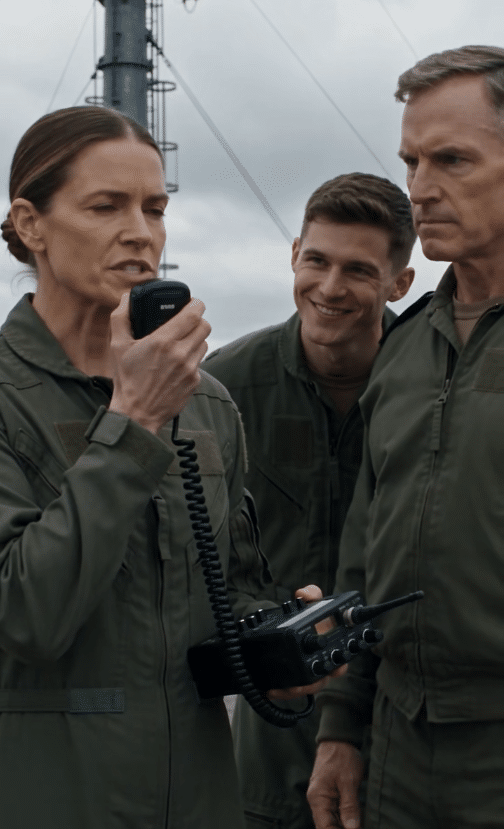
At the base of the military radio tower, cables trembled against steel supports while gray clouds dragged across the sky. A signal box hummed beside the equipment rack, and intermittent bursts of radio noise crackled through the handset in the woman’s grip.
She listened.
Not casually.
Carefully.
The forty-year-old communications specialist stood with her brown hair pulled into a low bun, an olive technical jacket zipped against the cold, and a signal meter glowing in her other hand.
A younger technician glanced at her and laughed.
“She always hears ghosts in the signal.”
The Colonel standing nearby didn’t laugh.
He was fifty-three, broad-shouldered, cold-eyed, and already irritated by the equipment readings. A communications problem meant paperwork. Paperwork meant questions. Questions meant someone eventually asking why the signal problem hadn’t been reported sooner.
The woman looked down at the meter again.
Then she lifted her eyes.
“That ghost is a distress channel.”
The younger technician’s smile widened.
The Colonel’s expression hardened.
“You’re certain?”
She nodded.
“I’ve isolated the frequency twice.”
That should have been enough.
A distress channel wasn’t something to dismiss because it was inconvenient.
But the Colonel wasn’t hearing a warning.
He was hearing a challenge.
He stepped toward her.
“Give me the radio.”
She didn’t move.
“Sir, the transmission is still active.”
His hand shot forward.
He ripped the radio from her grip and smashed it against the metal signal box.
The casing popped open.
Before she could react, he shoved her hard into the base of the tower.
Her shoulder and side struck metal.
She fell onto the gravel, catching herself with one hand.
A small scrape marked her palm.
Pain tightened her face.
But her eyes never left the signal meter.
The Colonel looked down at her.
“Signal girls panic over noise.”
The wind pushed dust across the gravel.
Then something dark slipped from the pocket of her jacket.
It landed beside the signal meter.
A small burned patch.
And the senior technician saw it.
Act II
The senior technician had spent decades around radios, field transmitters, emergency channels, and equipment that had been carried into places nobody wanted to remember.
He knew the difference between ordinary damage and the remains of something that had survived an event.
The patch looked insignificant.
Small.
Scorched around the edges.
Its original color was almost impossible to identify beneath the darkened fabric.
But there was a partial symbol on it.
The senior technician stopped breathing for a moment.
“Colonel… what is that patch?”
The younger technician looked over.
Whatever confidence he had carried seconds earlier disappeared.
The Colonel didn’t even bother turning around.
“Burnt cloth doesn’t outrank me.”
He stepped toward the broken radio.
“Get another handset.”
Nobody moved immediately.
The senior technician’s eyes remained on the patch.
The woman slowly pushed herself upright.
Her shoulder hurt.
Her palm stung.
She didn’t complain.
Instead, she picked up the signal meter and checked the reading.
The display was still active.
A faint transmission continued to pulse through the equipment.
The Colonel noticed.
“You’re still listening?”
“Yes.”
“After I told you the signal was noise?”
She looked at him.
“You didn’t tell me that.”
His eyes narrowed.
“You don’t get to correct me in front of my technicians.”
“I’m not correcting your rank.”
Her voice remained level.
“I’m reporting a distress channel.”
The difference was simple.
The Colonel refused to accept it.
He had spent years protecting his record from failures, delays, missed transmissions, and anything else that might suggest his communications section wasn’t under control.
A mysterious distress signal was precisely the kind of problem that could become a career problem.
So he had decided it didn’t exist.
The woman had decided otherwise.
The senior technician looked between them.
Then his eyes returned to the burned patch.
There was history in that fabric.
He knew it.
The Colonel didn’t.
Not yet.
The younger technician took a cautious step away from the tower.
The woman noticed.
She said nothing.
She simply held the signal meter steady as another burst of static emerged.
This time, it sounded less like interference.
And more like someone trying desperately to be heard.
Act III
The radio tower groaned softly in the wind.
The broken handset lay open beside the signal box.
Nobody touched it.
The Colonel stared at the equipment as though he could force the problem to disappear by refusing to acknowledge it.
“Kill the channel,” he ordered.
The woman didn’t move.
“Sir, I can’t.”
“You can, and you will.”
“The distress transmission is active.”
His face tightened.
“That channel isn’t supposed to be active.”
She looked at him.
“That’s why I’m investigating it.”
The senior technician lowered his gaze.
The Colonel caught the movement.
“You know something?”
“No, sir.”
The answer came too quickly.
The Colonel stepped toward him.
“Then look at me when you answer.”
The senior technician raised his eyes.
There was something in them that hadn’t been there before.
Not defiance.
Recognition.
The Colonel turned back toward the patch.
The woman had picked it up.
She held it between two fingers.
The burned fabric looked older now that he was actually studying it.
There was a tiny portion of a symbol near the edge.
Something about it tugged at his memory.
He couldn’t place it.
The woman slipped the patch onto the metal surface beside the signal meter.
The static returned.
One burst.
Then another.
The senior technician’s face went pale.
The Colonel noticed.
“What is wrong with you?”
The older man said nothing.
The woman looked at the signal meter.
Then at the Colonel.
He expected her to explain.
Instead, she gave him something far more unsettling.
“No. But the message behind it does.”
Silence.
The Colonel stared at her.
The words weren’t loud.
They didn’t need to be.
The younger technician looked away.
The senior technician stood completely still.
The Colonel’s eyes moved from the woman’s face to the burned patch.
Then to the equipment.
The distress signal was still there.
And suddenly, the two things seemed connected.
A burned patch.
An old symbol.
A transmission nobody wanted officially acknowledged.
The Colonel’s confidence began to crack.
Because he remembered something.
Not enough.
Just fragments.
An old communications incident.
A transmission that had once disappeared from a report.
A voice that had never made it into the official record.
And a field operation where someone had stayed on a channel long after everyone else had stopped listening.
His breathing changed.
He looked at the woman again.
For the first time, she didn’t look like a technician reporting a malfunction.
She looked like someone who had been waiting years for him to hear the right frequency.
Act IV
The Colonel stepped closer to the signal meter.
Static whispered through the speaker.
He stared at the numbers.
Then at the patch.
Something old was surfacing in his memory.
A night.
A damaged communications relay.
A transmission buried beneath interference.
He remembered being told that the channel had gone dead.
He remembered accepting that answer.
Maybe because accepting it had been easier.
The senior technician watched him carefully.
He still didn’t explain.
The woman didn’t ask him to.
Whatever the patch represented, she knew the Colonel had to recognize it himself.
The Colonel picked up the edge of the burned fabric without actually touching it.
“Where did you get this?”
She didn’t answer.
His voice hardened.
“Who gave it to you?”
Nothing.
The silence was becoming unbearable.
The wind pushed against the tower cables.
The equipment continued its faint electronic hum.
Then the signal broke through again.
A short burst.
A pause.
Another burst.
The Colonel stared at the speaker.
His expression changed.
He remembered that rhythm.
Or thought he did.
Years ago, there had been an emergency transmission with a similar pattern.
It had come from a channel that wasn’t supposed to be operating.
The official explanation had been simple.
Interference.
Faulty equipment.
Nothing actionable.
But someone had disagreed.
Someone had kept listening.
Someone had insisted the noise was a message.
The Colonel looked at the woman.
Her face was calm.
Her palm was still lightly scraped.
Her shoulder still hurt.
Yet none of that mattered to her now.
She was watching him realize that the past had not disappeared.
It had only been buried under static.
The younger technician backed away.
The senior technician remained silent.
The Colonel’s eyes stayed fixed on the burned patch.
The arrogance was gone.
In its place was a question he had spent years avoiding.
What if the message had never actually ended?
Act V
The tower seemed taller now.
The same cables that had looked ordinary minutes earlier suddenly felt like part of something much older.
The Colonel stood beneath them without speaking.
His damaged radio lay at his feet.
The signal meter remained active.
And the burned patch sat between them like a piece of evidence that had waited patiently for the right person to recognize it.
The woman didn’t threaten him.
She didn’t demand an apology.
She didn’t explain what the symbol meant.
She simply stood there.
Steady.
The senior technician knew better than to interrupt.
The younger technician had lost every trace of his earlier amusement.
The Colonel looked at the patch again.
He remembered the old transmission.
He remembered the missing report.
He remembered being told there was nothing there.
But now the signal was coming through again.
And the woman standing in front of him had known exactly what it was.
A distress channel.
Not a ghost.
Not noise.
A message.
The Colonel’s face tightened as another burst of static came from the equipment.
His eyes moved from the signal meter to the scorched patch.
Then slowly back toward the woman.
Something had connected.
Not completely.
But enough.
His breathing became shallow.
The confidence that had filled his voice earlier was gone.
He looked at the damaged radio.
Then at the patch.
His mouth opened.
And when he finally spoke, it was barely more than a whisper.
“What message…?”
The wind swept across the tower.
The static answered first.
And the Colonel stood there, suddenly afraid of what the next transmission might say.