Act I
The hearing-room door was only twenty feet away.
Yet to the former officer standing outside it, those twenty feet felt like the longest distance she had ever crossed.
The waiting hall was unusually quiet. Dress-uniform officers sat along a wooden bench, a registration table stood beneath harsh lights, and the large hearing-room door remained closed.
At forty-one, she looked nothing like someone arriving to surrender.
Her brown hair was tied neatly in a low bun. She wore a dark navy suit and carried a thick evidence folder against her side.
An aide standing near the door looked her up and down.
Then he smirked.
“She looks like she came to beg.”
She stopped.
Her expression didn’t change.
“I came to testify.”
The words traveled farther than they should have.
Several officers glanced toward the Colonel.
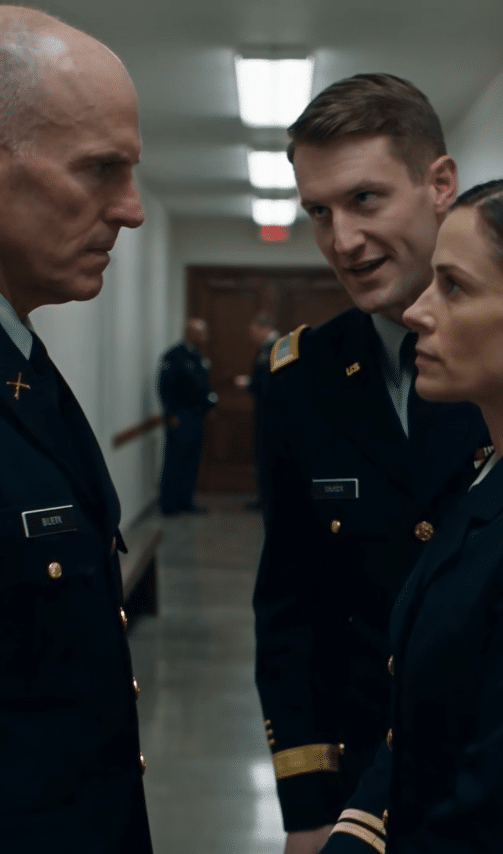
He stood near the hearing-room entrance, fifty-six years old, dressed in full uniform, with the controlled expression of a man who had spent years making other people uncomfortable simply by entering a room.
He was already under pressure.
The hearing was supposed to examine allegations surrounding decisions made under his command.
And now the woman who had once served beneath him had arrived carrying evidence.
The Colonel walked toward her.
“You should have thought carefully before coming here.”
She held the folder tighter.
“I did.”
His eyes dropped to it.
“Then you’re making a mistake.”
She didn’t answer.
The aide shifted closer.
The Colonel’s expression hardened.
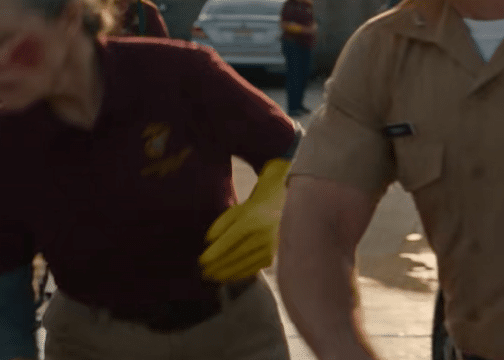
He kicked the evidence folder from her hand.
Papers scattered across the floor.
Old photographs slid beneath the bench.
The woman crouched to gather them.
The Colonel struck her across the face.
Her cheek reddened instantly.
A tiny trace appeared near the corner of her mouth.
The hall went silent.
She slowly lifted her face.
She didn’t step away from the hearing-room door.
The Colonel leaned toward her.
“Witnesses like you disappear before they speak.”
She looked directly at him.
And then one of the old photographs turned over on the floor.
A handwritten number appeared on its back.
Beside it was a tiny symbol.
The legal officer at the registration table saw it.
His hand froze above the sign-in sheet.
Then his face went pale.
Act II
The legal officer had been preparing registration packets all morning.
He knew which documents were supposed to be inside the hearing room.
He knew which witnesses had been cleared.
And he knew the difference between an ordinary photograph and something that had been preserved as evidence for a very specific reason.
The old photograph was face-down on the floor.
Its edges were worn.
The back carried a handwritten number and a small symbol.
The legal officer stared at it.
Then he stopped reaching for his pen.
“Colonel… don’t touch that photo.”
The Colonel looked down.
His expression barely changed.
“It’s a picture. Nothing more.”
He bent slightly as though he intended to pick it up anyway.
The legal officer stiffened.
The former officer reached the photograph first.
She picked it up carefully.
The Colonel watched her.
“What exactly are you trying to prove?”
She returned the photograph to the folder.
“Nothing.”
He frowned.
“I’m not here to prove anything.”
She looked toward the closed door.
“I’m here to tell the truth.”
The Colonel’s jaw tightened.
The hearing was only minutes away.
That door represented everything he had been trying to control: testimony, records, questions, and decisions that could no longer be settled with a commanding voice.
The aide who had mocked her earlier now stood several feet away.
He wouldn’t look at her.
The Colonel noticed.
“You were talking a lot a minute ago.”
The aide swallowed.
“Sir…”
“Say something.”
Nothing came.
The former officer remained calm.
She gathered the remaining papers one by one.
Then she noticed something.
The photograph had not been part of the ordinary evidence packet.
It had been tucked behind another document.
And the handwritten number on its back matched the number she had written on the outside of her folder.
The legal officer saw that connection.
His expression changed again.
But he said nothing.
The Colonel noticed both of them.
“What aren’t you telling me?”
Nobody answered.
The hearing-room door remained closed.
And suddenly the Colonel seemed less concerned about what was inside the folder than what had been written on the back of one old photograph.
Act III
The former officer stood.
Her cheek was still red.
She didn’t cover it.
She didn’t ask anyone to help her.
Instead, she straightened her jacket and held the evidence folder against her side.
The Colonel stared at her.
“You think walking into that hearing makes you powerful?”
“No.”
“Then why are you here?”
“Because they asked me to come.”
He laughed once.
A short, humorless sound.
“They asked you.”
She nodded.
“Yes.”
“Who?”
She looked toward the door.
“I think you already know.”
His smile disappeared.
The legal officer lowered his eyes.
The Colonel turned toward him.
“You seem unusually interested in that photograph.”
The younger man didn’t respond.
The Colonel stepped closer.
“Is there something I should know?”
The legal officer hesitated.
The former officer spoke first.
“Don’t touch it.”
The Colonel turned sharply.
“You’re giving me orders now?”
“No.”
She held his gaze.
“I’m giving you a warning.”
He looked at the photograph again.
The number.
The symbol.
Something about it bothered him.
He couldn’t explain why.
Then a memory surfaced.
A report from years earlier.
A case number.
A photograph that had been requested, copied, and eventually removed from an active file.
He remembered signing something.
He remembered being told the matter was closed.
He remembered believing that meant it was finished.
But the number on the photograph looked painfully familiar.
The Colonel’s breathing changed.
The former officer noticed.
She didn’t smile.
She didn’t celebrate.
She simply waited.
The legal officer remained silent.
The Colonel looked at the hearing-room door.
Then at the photograph.
Then at the folder.
The pieces weren’t complete.
But they were beginning to fit.
He took one step toward the photograph.
The legal officer immediately said again, quieter this time:
“Colonel… don’t.”
The Colonel stopped.
For the first time, the warning didn’t sound like protocol.
It sounded like fear.
And the woman finally gave him the one sentence that made him look at the closed door differently.
“It is the reason they opened that door.”
Act IV
The Colonel stared at the door.
It hadn’t changed.
The same dark wood.
The same brass handle.
The same narrow window showing nothing beyond the glass.
But now it looked different.
It no longer represented a room he controlled.
It represented a room that had been prepared for something.
For someone.
For evidence.
The Colonel looked back at the photograph.
The handwritten number seemed suddenly enormous.
He remembered the old case.
Not everything.
Just enough.
A missing record.
A disputed decision.
A witness who had refused to change her statement.
And a photograph that had been treated as inconvenient rather than important.
He had thought the matter disappeared years ago.
Apparently, it hadn’t.
The aide took another step backward.
The legal officer remained beside the registration table, his face tight.
No one spoke.
The former officer stood between them and the hearing-room door.
She wasn’t blocking it.
She didn’t need to.
The Colonel suddenly understood that she had never come there to ask for permission.
The hearing had been opened because someone wanted her testimony.
And the old photograph had been preserved because someone knew the story wasn’t finished.
His eyes returned to the number.
He knew that number.
Or at least he knew what it represented.
A file.
A decision.
A chain of events that could lead directly back to him.
The Colonel’s confidence began to fracture.
He looked at the former officer.
“You’ve had that all this time?”
She didn’t answer.
“How long?”
Silence.
He looked toward the legal officer.
The younger man wouldn’t meet his eyes.
The Colonel’s breathing became shallow.
The room seemed to contract around him.
He had spent years intimidating witnesses.
Now the witnesses weren’t the ones looking afraid.
He was.
The former officer turned slightly toward the hearing-room door.
The registration clock continued ticking.
Then footsteps sounded faintly from the other side.
The Colonel froze.
Someone inside was waiting.
And whatever waited beyond that door already knew about the photograph.
Act V
The footsteps stopped.
Silence returned.
The Colonel stared at the hearing-room door.
The woman stood nearby, holding the evidence folder against her chest.
She had been struck in front of everyone.
Humiliated.
Threatened.
And still, she had never moved away from that door.
Because she hadn’t come there to beg.
She had come to testify.
The old photograph remained inside her folder.
The handwritten number remained visible along its back.
And the tiny symbol beside it was enough to make the legal officer recognize something the Colonel had tried to forget.
The Colonel looked at the door again.
His entire posture had changed.
Minutes earlier, he had acted as though the hearing belonged to him.
Now he looked like a man wondering what had already been placed on the other side.
The former officer said nothing.
Neither did the legal officer.
No one explained the photograph.
No one revealed what the number meant.
That was what made the silence so powerful.
The Colonel finally looked at the woman.
There was no contempt left in his expression.
Only uncertainty.
He looked at the folder.
Then at the door.
His lips parted.
A single question escaped.
“That door…?”
Nobody answered.
The camera stayed on him.
His face tightened.
The certainty drained from his eyes.
And behind him, the hearing-room door remained closed.