Act I
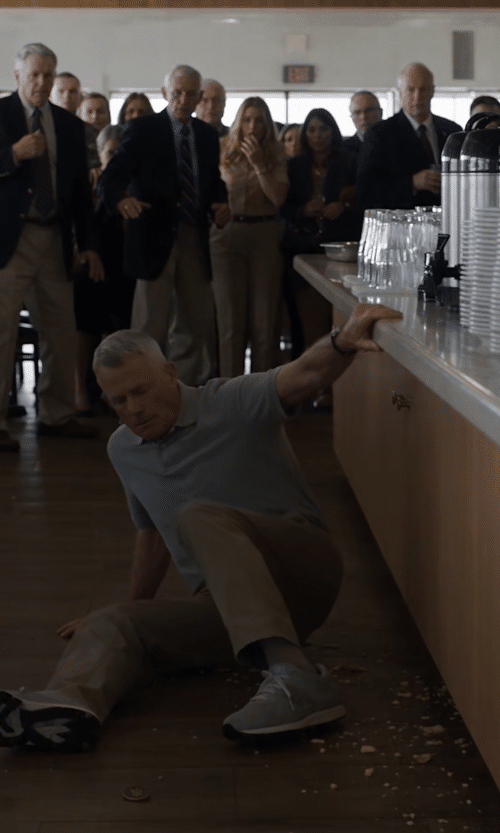
The old man hit the coffee station so hard that cups toppled from the counter and shattered against the tile.
For a split second, the crowded hotel breakfast hall seemed to freeze. Twenty conference attendees stood in line behind the buffet, their plates in their hands, watching a silver-haired man struggle to catch his breath on the floor.
Standing several feet away was Major General Richard Caldwell, a powerful officer accustomed to having people move before he even asked.
He looked down at the old man as if the incident had been an inconvenience.
“Old men don’t police generals.”
Nobody answered.
The man on the floor was seventy-one, dressed in a plain gray polo shirt, chinos, and comfortable walking shoes. He had no visible rank insignia, no medals, and no uniform. Before the incident, he had been holding a breakfast plate and waiting patiently for his turn.
His name was Arthur Bennett.
To most people attending the military leadership conference, he looked like an ordinary retired veteran who had come downstairs for coffee.
That was exactly how he wanted to be seen.
The trouble had started less than a minute earlier, when General Caldwell walked past the entire breakfast line and stepped directly in front of Arthur.
Caldwell was the conference’s guest of honor. His photograph appeared on the event program, and several senior officers had already congratulated him on his recent appointment. He was fifty-five, physically imposing, and confident that his position entitled him to certain conveniences.
His young aide, Captain Matthew Ross, followed close behind him.
When Arthur noticed the general cutting the line, he spoke without raising his voice.
“Excuse me, sir. The line starts back there.”
Ross laughed.
“Sir, he actually told you to get back in line.”
The captain’s amusement encouraged Caldwell to treat the situation as a joke.
Then he noticed that Arthur was not laughing.
“You skipped twenty people,” Arthur said.
The general’s smile disappeared.
For a man accustomed to hearing agreement, a simple correction in front of witnesses felt like a public challenge. Caldwell glanced at the people behind Arthur, several of whom had stopped talking to see what would happen.
He could have apologized.
He could have stepped back.
He could even have ignored the remark and ordered his aide to bring him breakfast somewhere else.
Instead, he knocked Arthur’s plate onto the buffet counter.
When Arthur repeated that he should return to the end of the line, Caldwell stepped back and drove a hard kick into the older man’s torso.
Arthur was thrown backward into the coffee station. The impact sent cups rattling, napkins scattering, and a metal serving tray crashing against the counter before he fell heavily to the floor.
Someone gasped.
A hotel employee took one instinctive step forward, then stopped when the general turned his head.
Caldwell seemed almost satisfied by the silence.
He had made his point, or so he believed.
Arthur lay still for a moment, fighting to recover his breath. His face tightened with pain, and one hand pressed against the floor as he gathered himself.
But he did not beg.
He did not apologize.
And when he finally stood, he did so without accepting the help nobody had yet offered.
He straightened his gray polo, looked at the general, and remained near his original place in line.
That was when something fell from his trouser pocket.
A small black coin struck the tile, spun beneath the buffet lights, and rolled toward the shoes of a retired sergeant major serving as the conference’s military liaison.
The liaison bent to retrieve it.
Then he saw the symbol on its face.
His fingers stopped moving.
The color drained from his face so quickly that the captain noticed it from across the room.
The retired sergeant major slowly straightened, holding the coin between both hands as though it were something far more important than an ordinary piece of metal.
He looked at Arthur.
Then at the general.
And when he finally spoke, his voice had lost every trace of casual professionalism.
“General… you might want to stop talking.”
Because he recognized the coin.
And he knew that the old man Caldwell had just kicked was not someone the general could afford to dismiss.
Act II
Arthur Bennett had learned a long time ago that the most revealing thing about a person was how they behaved when they believed nobody important was watching.
He had seen kindness from people who had very little to give. He had also seen cruelty from people who possessed every advantage imaginable.
Rank, in his experience, could magnify either quality.
It could make a good leader more capable of protecting others, or give a selfish person a convenient excuse to demand obedience.
Arthur had spent much of his life trying to understand that difference.
He had entered military service when he was young, back when his uniform felt too stiff, his boots seemed impossibly heavy, and the officers around him appeared to know everything. Over the decades, he had served alongside people who inspired extraordinary loyalty and others who could turn a simple mistake into a career-ending humiliation.
He learned from both.
The good leaders had something in common. They never needed to remind everyone in the room that they were in charge.
They listened.
They took responsibility.
And they understood that the people standing behind them were not props in a story about their own importance.
Arthur had eventually reached the highest levels of command himself.
He had worn four stars.
He had commanded at the level where decisions affected entire organizations and where the consequences of a single bad judgment could extend far beyond the person who made it.
Yet he had never developed an appetite for the attention that came with the position.
After retiring, he declined invitations to become a familiar face on conference stages. He rarely attended ceremonies unless there was a compelling reason, and he disliked the way ordinary conversations changed when people recognized his former rank.
Someone who had spoken to him naturally would suddenly stand straighter. A person who had disagreed with him a moment earlier would begin apologizing for opinions that had not offended him in the first place.
Arthur found it exhausting.
He preferred quiet breakfasts, long walks, and conversations in which people did not constantly calculate what his approval might be worth.
That was why he had attended the leadership conference without medals or a uniform.
He had been invited to participate in a small discussion about the responsibilities of senior leadership. He intended to listen more than speak, meet a few old acquaintances, and return home without becoming the center of attention.
The black coin in his pocket was the one exception to his otherwise unremarkable appearance.
It was worn at the edges, darkened with age, and marked with a symbol unfamiliar to most people. There was no polished gold border, no elaborate display case, and no inscription advertising the achievements of the person who carried it.
Arthur had kept it for decades.
He had received it during a period when trust had mattered more than titles, when a person’s word could determine whether a dangerous decision was carried out correctly, and when the people involved knew that the public would never understand the full cost of what they had done.
The coin was not a decoration.
It was a reminder.
Of duty.
Of loyalty.
Of the difference between being given authority and being worthy of it.
Arthur rarely showed it to anyone. Most of the younger officers he encountered had never seen one like it, and he preferred to keep the story attached to it private.
The retired sergeant major who had just picked it up, however, was old enough to recognize its significance.
His name was Samuel Brooks.
At sixty-three, Brooks had spent a lifetime around soldiers, commanders, and the traditions that held military organizations together. Retirement had not removed him from that world. He now served as a liaison between the conference organizers and the military attendees, helping with schedules, credentials, and the small problems that inevitably appeared when hundreds of people gathered under one roof.
He was good at his job because he knew how to recognize trouble before it became a crisis.
But the black coin in his hand was not a problem he could solve with a phone call.
He had seen its symbol only once before, years earlier, when a senior officer had explained why certain objects were kept out of ordinary circulation.
The coin belonged to a very small circle of people connected to an extraordinary chapter of military history.
And the man who carried it had been one of them.
Brooks looked again at Arthur.
The gray polo shirt.
The ordinary shoes.
The quiet expression.
Then he remembered a name he had heard in stories long before he had ever met the man himself.
General Arthur Bennett.
The retired four-star commander who had disappeared from public life without seeking applause.
Brooks tightened his grip on the coin.
He now understood why the symbol had looked familiar.
What he did not understand was why a man with that history had been standing quietly in a breakfast line while a younger general treated him like an inconvenience.
And he was about to find out.
Act III
Major General Caldwell watched the retired sergeant major holding the coin.
At first, he seemed irritated by the interruption.
“What’s the problem?” he demanded.
Brooks did not answer immediately.
He turned the coin carefully, examining the worn symbol on its face. His expression had become rigid, and his posture had changed in a way that made several officers nearby notice.
Caldwell gave a short laugh.
“It’s a challenge coin.”
He said it as if that settled everything.
In his world, challenge coins were common enough. Officers exchanged them at ceremonies, conferences, and visits between units. They were handed out as tokens of appreciation and collected by people who enjoyed displaying their military connections.
Caldwell had several himself.
He had given them to guests, accepted them from senior officials, and posed for photographs while presenting them to younger officers.
To him, the black object in Brooks’s hands was simply another piece of military memorabilia.
Brooks looked up slowly.
“No, sir.”
The answer was quiet, but it carried a weight that made Caldwell’s expression tighten.
“No?”
Brooks looked at Arthur again.
The older man had recovered his breath. He stood beside the coffee station, one hand resting lightly against the counter, his face still showing the pain of the fall.
He was not asking for the coin.
He was not demanding that Brooks announce his identity.
He was simply waiting.
Brooks had spent enough years in uniform to understand that this was not an ordinary moment. The coin’s meaning was not something to be tossed around in a crowded breakfast hall, especially when the person who carried it had chosen not to reveal himself.
He looked back at Caldwell.
“General, I strongly suggest you stop talking.”
Caldwell’s amusement vanished.
“Are you giving me an order, Sergeant Major?”
“No, sir.”
“Then tell me what this is about.”
Brooks’s jaw tightened.
“I think you should ask the gentleman you just kicked.”
The captain had stopped smiling completely.
He glanced at Arthur, then at the coin, then at his commanding officer. The entire sequence of events had begun to look different in retrospect.
At first, Ross had believed he was watching a harmless disagreement between a senior general and an elderly attendee. He had encouraged Caldwell’s arrogance because he assumed that supporting his superior was the safest way to navigate the morning.
Now he was beginning to realize that his laughter had helped turn an ordinary act of fairness into an opportunity for violence.
Caldwell, meanwhile, had begun to feel something unfamiliar.
Uncertainty.
He had expected Brooks to return the coin and step aside. Instead, the retired sergeant major continued holding it carefully, as if handing it back casually would be an act of disrespect.
That small gesture bothered Caldwell more than he wanted to admit.
“What’s so special about it?” he asked.
Arthur finally looked at Brooks.
“Then ask him why he won’t hand it back.”
The sentence was delivered without anger.
Arthur did not reach for the coin. He did not explain the symbol or offer a single detail about his past.
He simply pointed out what everyone could see.
Brooks was holding an object that belonged to him, yet he was treating it with the kind of care usually reserved for something entrusted to his protection.
Caldwell looked at the sergeant major’s hands.
Then at his face.
Brooks was not showing curiosity anymore.
He was showing recognition.
And underneath that recognition was a kind of reverence that Caldwell had never expected to witness over an old piece of metal.
“Sergeant Major,” Caldwell said more carefully, “who is this man?”
Brooks drew a slow breath.
For a moment, he looked as though he might answer.
Then he glanced toward Arthur, who gave the slightest shake of his head.
Brooks understood.
The coin could be recognized without the man’s history being turned into a public spectacle.
He lowered his voice.
“Sir, there are some people whose authority doesn’t disappear when they retire.”
Caldwell stared at him.
“That’s not an answer.”
“No, sir. It isn’t.”
Brooks kept the coin in his hands.
“And I think you already know why.”
The words settled over the breakfast line.
A few attendees looked at Arthur more closely. Others glanced toward the conference program, as though trying to remember whether his name had appeared anywhere on it.
Arthur said nothing.
His silence was not an attempt to create suspense.
It was a refusal to turn his identity into an excuse for what had happened.
He had been right about the line before anyone knew who he was.
He had been right when he pointed out that Caldwell had skipped twenty people.
And he had been right when he expected the general to follow the same rules as everyone else.
The black coin had not made those things true.
It had merely forced the room to consider why a retired sergeant major was suddenly afraid to return it.
Caldwell looked at the coin again.
Then he looked at Arthur.
For the first time, he began to suspect that the man he had kicked might have once occupied a position far beyond his own.
But the worst part was not that the old man might outrank him in military history.
It was that Arthur had never needed to mention his rank to expose the general’s character.
Act IV
The breakfast line remained frozen.
Behind the buffet, a hotel employee quietly moved the fallen cups away from the coffee station. Another staff member approached Arthur, but he raised a hand to indicate that he could stand on his own.
He was still in pain.
He did not pretend otherwise.
But he had recovered enough to straighten his shoulders and take a steady breath.
Then he stepped back toward the line.
Not to challenge Caldwell.
Not to prove that he was unafraid.
Simply because he had been waiting for breakfast, and he saw no reason to surrender his place because another man had chosen violence.
That movement unsettled the room more than any speech could have.
Caldwell watched him.
The general had built his career around the idea that people responded to strength. If someone challenged him, he pushed harder. If someone refused to move, he made the refusal costly enough that the next person would think twice.
The tactic had often worked.
People rarely wanted trouble with a senior officer. They had jobs to protect, evaluations to pass, and careers that depended on the goodwill of those above them.
Arthur had none of those reasons to be afraid.
He was retired.
He was unadorned.
And he had already demonstrated that he was willing to stand by an ordinary principle even when the consequences became physical.
Caldwell turned toward Brooks.
“Are you telling me this man is some kind of senior official?”
Brooks looked at him for a long moment.
“I am telling you that you should have treated him with respect before you ever saw that coin.”
Caldwell’s face reddened.
“That doesn’t answer my question.”
“No, sir. It answers a more important one.”
Several officers shifted uncomfortably.
Caldwell looked around, searching for someone who would help him reclaim control of the conversation. Captain Ross kept his eyes lowered. The conference attendees no longer seemed eager to offer their approval.
The general had been the guest of honor when he entered the breakfast hall.
Now he was the man who had kicked an elderly attendee in front of twenty witnesses.
No explanation of the coin could erase that.
Brooks finally spoke again.
“General Bennett has been retired for years. But some of the people who served with him still remember what he stood for.”
The name landed across the room.
Bennett.
A few older officers reacted immediately.
One man at the back of the line slowly lowered his coffee cup. A retired colonel near the entrance turned toward Arthur with an expression of disbelief. Someone whispered the name to the person standing beside him.
Caldwell heard the murmurs.
His eyes widened slightly.
He had heard of Arthur Bennett, of course. Every senior officer knew the name, even if they had never met the man personally.
Bennett had once been a four-star general whose leadership was studied in professional military circles. He had developed a reputation for demanding accountability from people above and below him, refusing to let personal loyalty override duty, and taking responsibility when decisions went wrong.
He was also known for disliking ceremony.
After retirement, he had largely vanished from the public stage.
Caldwell had never expected to encounter him in a hotel breakfast line wearing a gray polo shirt.
He looked at Arthur again, this time searching for confirmation.
“General Bennett?”
Arthur met his eyes.
“Retired,” he said.
Two syllables.
No flourish.
No accusation.
Caldwell’s mouth opened slightly before closing again.
He looked toward Brooks, who still held the black coin. The retired sergeant major had not relaxed his grip. His expression remained grave, and he seemed reluctant to move until Arthur gave him some indication that the moment had passed.
Caldwell suddenly understood that he had been wrong about far more than a breakfast queue.
He had assumed the absence of insignia meant the absence of importance.
He had mistaken a quiet manner for weakness.
And he had treated an ordinary rule as if it were an insult simply because following it would require him to wait like everyone else.
But Brooks’s recognition of the coin suggested something else, too.
There was a chapter of military history attached to Arthur Bennett that Caldwell knew only from fragments. Whatever the black coin represented, it carried a significance that could not be reduced to the souvenirs exchanged at conferences.
Caldwell’s voice softened.
“What exactly is that coin?”
Arthur glanced at it.
“Something I was trusted to keep.”
“Trusted by whom?”
Arthur did not answer.
Brooks looked down at the symbol, then back at the retired general.
He understood why Arthur had remained silent.
The coin was not a shortcut to status. It was a reminder of responsibility, and responsibility meant very little if it only mattered when the people watching could recognize it.
Caldwell had spent the morning demanding respect because of his rank.
Arthur had earned respect without mentioning his.
The difference was now visible to everyone.
And for the first time, Caldwell seemed afraid to ask what else he had failed to understand.
Act V
Caldwell stood in the middle of the breakfast hall, surrounded by people who had witnessed his behavior.
The silence was no longer the silence of fear.
It was the silence that comes when excuses have nowhere left to hide.
Captain Ross stepped forward.
“General, I think we need to report what happened.”
Caldwell turned toward him sharply.
For a moment, the captain looked as though he might retreat into the familiar habit of obedience. Then he glanced at Arthur, whose expression remained calm despite the pain he was clearly enduring.
Ross swallowed.
“I saw what happened, sir.”
The statement was simple.
It was also the first time he had spoken without trying to protect his commanding officer.
Caldwell stared at him, then looked away.
Brooks carefully turned the black coin in his hands and extended it toward Arthur.
The retired general accepted it with a small nod.
For an instant, his fingers rested against the worn metal.
Then he slipped it back into his pocket.
No one applauded.
No one announced his former rank over the hotel’s speakers.
No one asked him to stand before the conference attendees and explain the history of the coin.
Arthur would not have wanted any of those things.
He had not corrected Caldwell because he wanted recognition. He had corrected him because twenty people were waiting in line, and the general had decided that their time mattered less than his own.
That was the entire issue.
The coin had revealed a hidden chapter of Arthur’s life, but it had not changed the nature of the wrongdoing.
A retired four-star general deserved no more basic courtesy than any other person in that line.
And an elderly man wearing an ordinary polo shirt deserved no less.
Arthur looked at Caldwell.
“You could have simply waited your turn.”
The general’s face tightened.
“I know.”
It was the first honest answer he had given all morning.
Arthur nodded toward the coffee station, where staff members were cleaning the floor.
“You should help them make this right.”
Caldwell followed his gaze.
The fallen cups, the spilled coffee, and the abandoned breakfast plates were ordinary things. They were not symbols of military tradition or fragments of a hidden history.
They were the immediate consequences of his decision.
For a moment, Caldwell appeared ready to object. Then he noticed that Brooks was watching him, that Ross was no longer looking away, and that the officers who had witnessed the attack were waiting to see what he would do next.
He stepped toward the counter.
He began helping the hotel staff clear the mess.
It did not erase the kick.
It did not excuse the abuse of authority.
And it did not settle what would happen when the incident was formally reported.
But it was the first action he had taken that morning that did not demand someone else pay for his pride.
Arthur returned to the breakfast line.
A man near the front quietly offered him his place. Arthur declined and stepped back behind the people who had been waiting before him.
He would take his turn.
Just like everyone else.
Brooks watched him for a moment, then approached.
“General, may I ask you something?”
Arthur glanced at him.
“Go ahead.”
“After all these years, why do you still carry it?”
Arthur’s hand rested briefly against his pocket, where the black coin had disappeared.
“Because people forget what authority is for.”
Brooks said nothing.
Arthur looked down the long line of officers, veterans, hotel employees, and ordinary conference guests.
“Sometimes they need a reminder.”
He stepped forward when the line moved.
Behind him, Caldwell stood beside the coffee station, no longer surrounded by admirers. The captain remained nearby, and the retired sergeant major watched with the grave expression of someone who knew that rank could open doors but could never guarantee respect.
The general had entered the breakfast hall believing his title placed him above twenty people.
He left that illusion behind in the silence that followed his own actions.
Arthur Bennett had not needed his uniform, his medals, or four stars on his shoulders to know that the line should be fair.
He had not needed the black coin to make the general’s behavior wrong.
And he had not needed to reveal his identity to prove that dignity belonged to everyone.
The coin had simply reminded the room of something that should never have been forgotten.
The measure of a general is not how quickly a room obeys him. It is what he does when someone without rank tells him he is wrong.