Act I — The Water Wasn’t for Him
The disaster-relief warehouse was packed with pallets of bottled water, folded blankets, and emergency supplies destined for neighborhoods devastated by a major storm. National Guard personnel moved between forklifts while volunteers checked supply tags and prepared deliveries for families who had gone days without clean water.
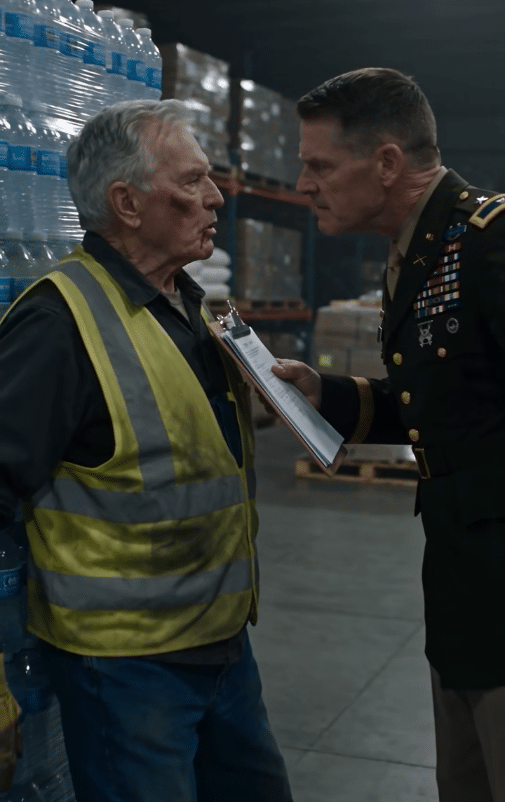
Beside a towering pallet of bottled water, a seventy-two-year-old man in a worn volunteer vest checked a clipboard. His silver hair was damp with sweat, his gloves were stained from handling boxes, and his work clothes looked nothing like the uniforms surrounding him.
A thirty-one-year-old aide approached, accompanied by a fifty-year-old Brigadier General.
“Sir, he refuses to reroute the pallet.”
The General glanced toward a marked delivery area reserved for visiting officials and VIP personnel.
“Move that water over there,” he ordered. “Now.”
The old volunteer kept one hand on the pallet tag.
“It goes where people need it.”
The General stared at him, apparently stunned that someone wearing a volunteer vest would contradict an officer of his rank.
“I gave you an order.”
“And those neighborhoods are still waiting for water.”
The aide shifted uneasily. The General stepped closer, his face tightening with anger.
Act II — An Order Enforced by Violence
The General swatted the clipboard from the volunteer’s hand. It struck the concrete, scattering paperwork beneath the pallet.
Before the old man could bend down, the General punched him hard across the face.
The volunteer fell beside the stack of water. His cheek reddened and began to swell, and a faint trace of blood appeared at the corner of his mouth.
Several National Guard personnel stopped moving. A forklift operator released the controls, while nearby volunteers stared in disbelief.
The General stepped forward and delivered two forceful kicks to the fallen man’s torso. Then he grabbed at the pallet tag, attempting to tear it away.
“Do you understand who gives the orders here?” he demanded.
The volunteer winced and drew a painful breath. His fingers tightened around the tag as the General pulled at it.
“Let go of that!”
The old man refused.
He remained conscious, his expression tightened by pain but his gaze unwavering. Even as he struggled to push himself upright, he kept the tag secured in his hand.
The General looked down at him with open contempt.
“Warehouse hands don’t redirect generals’ orders.”
The volunteer braced himself against the pallet and slowly raised his head.
“Then give an order that keeps people alive.”
The aide’s expression changed. Around them, the warehouse fell silent.
Act III — The Man Who Knew the Name
The old volunteer pulled himself into a sitting position beside the pallet. His breathing was uneven, and the swelling across his cheek was becoming more pronounced.
Yet his attention never left the supply tag.
He checked its destination, straightened its bent corner, and held it against the pallet as though the delivery mattered more than the pain running through his body.
The General watched him with growing irritation.
Then a seventy-year-old man in a weathered field jacket entered the warehouse aisle.
The retired Colonel had gray hair, a lined face, and the steady expression of someone accustomed to seeing trouble before it arrived. He had come to inspect the relief operation, but he stopped the instant he noticed the elderly volunteer on the floor.
His eyes narrowed.
He took another step.
Then his expression changed completely.
“Old Bear…?”
The words came out quietly, almost as if he couldn’t believe what he was seeing.
The injured man turned his head.
For a brief moment, the two men simply looked at one another. The retired Colonel’s face carried a recognition that seemed to reach far beyond the warehouse and its stacks of supplies.
Near a forklift, a fifty-eight-year-old National Guard Command Sergeant Major heard the nickname.
He turned sharply.
His eyes landed on the old volunteer, and the color drained from his face. His posture stiffened, and he stared as though the name had awakened a memory he had never expected to encounter in this place.
The General noticed both reactions.
He didn’t yet understand them.
Act IV — The Warning
The Command Sergeant Major moved closer, his expression suddenly grave.
“General… stop. Please stop now.”
The Brigadier General turned toward him with disbelief.
“What’s wrong with you?”
The senior enlisted leader didn’t answer immediately. His gaze remained fixed on the volunteer, and his voice lowered when he spoke again.
“Sir, I’m asking you. Stop.”
The retired Colonel stood a few feet away, watching the injured man with unmistakable respect. Neither military witness appeared interested in explaining what the nickname meant.
The General forced a contemptuous laugh.
“Another stupid nickname?”
His aide gave a nervous half-smile, but it disappeared when he saw the Command Sergeant Major’s face.
Nobody else laughed.
The General looked around the warehouse, expecting someone to restore the sense of authority he had enjoyed only moments earlier. Instead, personnel stood frozen beside their equipment, and the retired Colonel remained motionless.
The old volunteer slowly pushed himself upright against the pallet.
Pain tightened his face as he found his footing. He brushed dust from his vest, then checked that the water remained marked for its original destination.
Finally, he met the General’s eyes.
“He survived long enough to remember why it mattered.”
The retired Colonel’s expression hardened.
The Command Sergeant Major lowered his gaze for a fraction of a second, as though the sentence had confirmed something he had already feared.
The General’s smile began to fade.
Act V — Old Bear
The warehouse seemed suddenly quieter than it had been before the confrontation.
The General looked from the retired Colonel to the Command Sergeant Major. Both men were watching the elderly volunteer with a seriousness that rank alone could not explain.
He turned back toward the man in the worn vest.
The swollen cheek, the work gloves, and the dusty clothes were still there. Nothing about the volunteer’s appearance seemed to justify the sudden change in the room.
And yet the two military men who had recognized him looked as though the General had crossed a line he could never uncross.
The aide took a small step away from his superior.
The General noticed but said nothing. His eyes returned to the pallet tag still held in the volunteer’s hand.
The water had never been intended for a VIP area. It was meant for people whose homes had been damaged, whose taps had stopped running, and whose families were waiting for basic supplies.
The old man had refused to let that delivery be diverted.
Even after being struck down, he had protected the destination tag.
The General’s jaw tightened as he tried to make sense of the reactions around him. The retired Colonel’s expression remained grave, while the Command Sergeant Major stood rigid, his earlier warning hanging unanswered in the air.
Then the nickname seemed to register differently.
The General’s face lost color. His mocking expression vanished, replaced by a growing, unmistakable fear.
The camera closes in until only the General’s face remains, the warehouse blurred behind him.
His eyes widen. His breath catches.
“Old Bear…?”