Act I
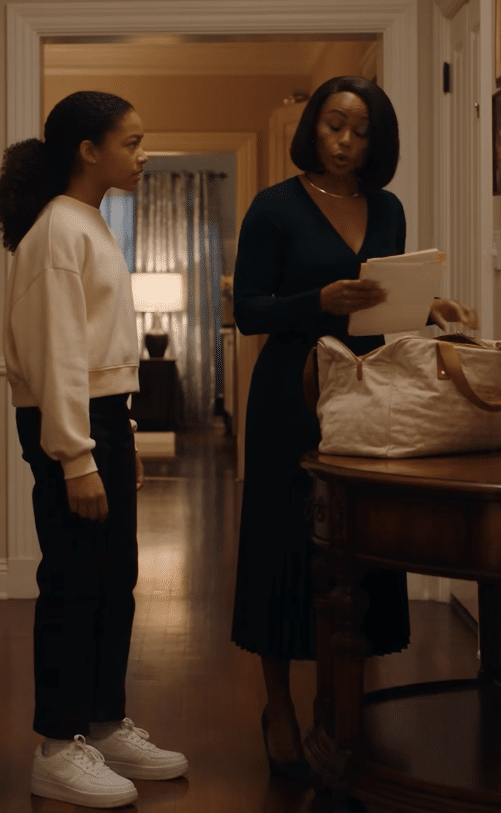
Nia stopped in the hallway when she saw her mother’s photographs disappearing into a bag.
For a moment, she couldn’t understand what she was looking at. The framed pictures, the handwritten letters, the little keepsakes she had spent years protecting—all the pieces of Sarah that remained in the house were being gathered together by her stepmother as if they were nothing more than unwanted clutter.
The wooden keepsake box sat open on the polished console table. Beside it, a large bag was already half-filled with memories Nia couldn’t replace.
“Those were my mother’s things.”
Her stepmother didn’t turn around immediately. Dressed in black, with a delicate gold necklace resting against her collarbone, she continued arranging the items with the calm efficiency of someone cleaning out a storage closet.
“They’re old, faded, and worthless.”
The words hurt more than Nia expected.
Sarah had been gone for years, but Nia still remembered the little things about her mother: the warmth of her hands, the way she smiled when taking photographs, and the handwritten notes she sometimes tucked away for her daughter to discover later.
Those letters were precious because they were Sarah’s words. The photographs mattered because they preserved moments Nia could no longer experience again.
Her stepmother knew how much they meant to her.
That was what made the scene so difficult to watch.
Nia stepped forward and carefully retrieved a photograph from the open bag. It showed her with Sarah, both of them smiling, their faces close together. Nia brushed her fingertips along the photograph’s edge, checking that it hadn’t been damaged.
“They’re all I have left of her.”
Her stepmother finally looked at her.
There was no sympathy in her expression, only irritation that Nia had interrupted what she apparently considered a necessary task.
“Then learn to let go. This house isn’t a storage room for your past.”
Nia drew the photograph against her chest.
She had never asked anyone to replace her mother. She had never demanded that the family live according to Sarah’s memory. All she wanted was permission to keep the few things that made her feel connected to the woman she had lost.
But her stepmother seemed determined to make even that feel like an offense.
The hallway, with its warm lamps and carefully arranged family photographs, suddenly felt unfamiliar.
Nia looked at the bag again.
Her mother’s life was being reduced to a collection of objects someone else had decided were no longer worth keeping.
And when Ava appeared at the end of the hallway, she immediately understood that something was terribly wrong.
Act II
Ava approached slowly, her long curls falling over the shoulders of her striped top.
She had heard enough of the conversation to understand why Nia was holding the photograph so tightly. The two girls had never been especially close, but Ava had seen Nia’s keepsake box before. She knew it contained things Nia rarely allowed anyone else to handle.
They weren’t ordinary possessions.
They were reminders of a person who should have been there to watch Nia grow up.
Ava looked at the bag, then at her mother.
“Mom, they belong to Nia.”
Her mother’s expression hardened.
“Stay out of it. Nia’s clutter lowers the whole house.”
Ava stared at her in disbelief.
She was used to her mother being particular about the house. Everything had a place, and anything that disrupted the carefully maintained appearance of the rooms could become a source of criticism.
But this wasn’t about furniture or decorations.
It was about Nia’s mother.
Ava glanced at the photograph in Nia’s hands. The girl’s expression was controlled, almost unnervingly calm. She wasn’t shouting or demanding an apology. She was simply trying to protect the one thing her stepmother couldn’t replace.
That quietness made Ava feel worse.
Nia had learned not to expect kindness from someone who repeatedly treated her grief as an inconvenience. She had learned to ask for less, to keep her feelings private, and to hold on to her memories without expecting anyone else to understand.
Her stepmother turned back toward the bag.
Ava remained where she was, visibly struggling with what she had just witnessed.
Then the front door opened.
Marcus entered the hallway, dressed in his dark-brown suit, his tie neatly arranged beneath the collar of his beige shirt. He had returned home expecting an ordinary evening.
Instead, he found a large bag filled with photographs and letters, his daughter standing beside an open keepsake box, and a picture of his late wife pressed against Nia’s chest.
He stopped.
For a second, he seemed unable to connect the objects in front of him with the scene he had walked into.
Then recognition crossed his face.
He knew those photographs.
He remembered the woman in them. He remembered Sarah’s handwriting and the little belongings she had kept over the years. He knew that the wooden box had been important to Nia long before his second marriage.
“Why are Sarah’s things in that bag?”
His wife turned toward him.
The coldness vanished from her expression so quickly that the change was almost startling.
“Nia asked me to help clear them out.”
Marcus looked at his daughter.
Nia lowered the photograph slightly.
For a moment, she seemed to be deciding whether telling the truth would make things worse. Her stepmother had already dismissed her mother’s belongings as worthless, and now she was telling Marcus that the decision had been Nia’s.
But Nia had not asked for any of this.
And she wasn’t going to let another lie turn her mother’s memory into something she had willingly abandoned.
Act III
“I asked her not to touch them.”
Nia’s voice was quiet, but it carried clearly through the hallway.
Marcus looked from his daughter to the bag.
He had heard disagreements in the household before. He had listened to competing explanations, tried to keep the peace, and occasionally assumed that a problem was smaller than it appeared.
But he knew Sarah’s belongings mattered to Nia.
He remembered the day they had gone through the keepsake box together. Nia had carefully shown him photographs and letters, explaining which memories she could still recall and which ones she had learned about through the things her mother left behind.
He had promised that she could keep them.
Now those same possessions were sitting in a bag, and his wife was claiming that Nia had requested their removal.
Marcus didn’t immediately respond.
His wife shifted her weight, seemingly expecting him to accept her explanation and move on. After all, she had presented herself as the person trying to organize the house, while Nia had been made to look like the emotional obstacle.
But something about the scene didn’t add up.
The belongings had not been neatly stored or carefully packed for safekeeping. They had been gathered together while Nia stood nearby, watching helplessly as her stepmother decided what was worth keeping.
Marcus looked at the open wooden box.
Then he noticed Caleb standing a short distance away.
The boy had been watching the confrontation in silence, his eyes moving between his mother and the bag. He seemed reluctant to interrupt, but there was something he clearly wanted his father to see.
Caleb had noticed his mother’s purse sitting open earlier.
Inside it, he had seen a small velvet box.
He recognized it because it had once belonged to Sarah.
He didn’t understand why his mother would have it, especially while she was gathering Sarah’s other possessions into a bag. But he remembered the brooch inside, an antique piece Nia had mentioned before.
Now, with Marcus home and the truth about the bag beginning to emerge, Caleb stepped forward.
He picked up the small velvet box and brought it to his father.
“She kept this one.”
Marcus accepted it.
His expression changed as he opened the lid.
Inside lay Sarah’s antique brooch.
For a moment, the hallway seemed to grow completely still.
Marcus recognized the piece immediately. He remembered seeing Sarah wear it, and he knew it was not an ordinary trinket that had been forgotten among old household belongings.
If his wife considered Sarah’s possessions worthless, why had she kept this one separate?
He looked at the brooch again, then at the bag filled with photographs and letters.
The contrast was difficult to ignore.
The items his daughter treasured were being treated as disposable. Yet one of Sarah’s more valuable possessions had been removed from the collection and placed inside his wife’s purse.
Marcus lifted the brooch carefully.
Something was tucked beneath it.
A folded piece of paper.
He drew it out and began to unfold it.
His wife took a small step forward.
It was the first movement she had made since Caleb handed over the box that seemed to betray genuine alarm rather than irritation.
And when Marcus opened the paper completely, he found a detail that changed the meaning of everything he had just witnessed.
Act IV
The paper was a store appraisal receipt.
Marcus read it carefully, his eyes moving across the printed details until he reached the information identifying the item.
It concerned the same antique brooch he was holding.
He looked from the receipt to the velvet box, then toward the large bag containing Sarah’s photographs, letters, and other belongings.
The evidence was simple, but the implications were impossible to ignore.
His wife had been gathering Sarah’s possessions and describing them as worthless. At the same time, she had kept the brooch separate, concealed inside her purse, with an appraisal receipt folded beneath it.
This was no longer merely a disagreement about household organization.
Ava saw the receipt in Marcus’s hand.
She looked at the bag, then at the brooch, and her expression changed as the pieces came together.
“She wasn’t throwing everything away. She was selling the valuable pieces.”
The words were not spoken triumphantly.
Ava sounded disturbed.
She had watched her mother dismiss Nia’s attachment to Sarah’s belongings as sentimentality. She had heard her describe the photographs and letters as clutter, as though their only significance was the space they occupied.
Now she was looking at a valuable object that had been kept apart from the rest.
The distinction was difficult to explain innocently.
Marcus didn’t answer immediately.
He remembered Sarah as more than a collection of objects. He remembered her place in their lives, the years they had shared, and the memories Nia was still trying to preserve.
He also remembered trusting his wife to respect his daughter’s needs.
The bag on the console table made that trust feel painfully misplaced.
Every photograph inside represented a moment that could never be recreated. Every letter carried words Sarah had chosen to leave behind. For Nia, those possessions were not valuable because of what a store might pay for them.
They were valuable because they belonged to her mother.
Marcus looked at his daughter.
Nia was holding the photograph close to her chest, with the wooden keepsake box beside her. She had not reached for the brooch or the receipt. She wasn’t concerned with the financial value of the piece.
She wanted her mother’s things to remain hers.
The simplicity of that wish made the scene even more difficult to bear.
His wife had tried to present the cleanup as something Nia wanted. She had dismissed the belongings as worthless, then kept the brooch in her purse. Now the appraisal receipt sat openly in Marcus’s hand.
The explanations that might once have sounded plausible no longer fit together.
He turned the receipt over, then looked again at the brooch.
He did not need to invent a larger story to understand the question before him. The evidence in the hallway was enough to show that something deeply wrong had happened to the boundaries Nia should have been able to trust.
Marcus slowly lowered the receipt.
His wife stood opposite him, her carefully composed expression beginning to crack.
For the first time since he had entered the house, she seemed to understand that she could not simply redirect the conversation toward Nia’s behavior or dismiss the incident as an argument about clutter.
The truth was sitting in front of them.
And Marcus was ready to ask the question she had no easy way to answer.
Act V
Marcus held the appraisal receipt in one hand and the velvet box in the other.
The brooch rested inside, catching a faint glimmer from the hallway lamp. Beyond him, the large bag remained open, filled with the photographs and letters his wife had been preparing to remove.
The contrast was unmistakable.
Sarah’s memories had been treated as unwanted possessions, while the valuable piece had been kept apart from them.
Nia stood beside the wooden keepsake box, still holding her photograph.
She looked at the brooch for a moment, recognizing it as something her mother had once treasured. But she did not reach out to take it. Her attention remained on the bag and the letters inside, as if she was afraid that even now, someone might decide those things no longer belonged to her.
Ava stood close by, silent.
Caleb watched his father, waiting to see what he would do.
Marcus looked at his wife.
He thought about the explanation she had given when he first walked through the door. She had said Nia wanted the belongings cleared out, even though Nia had just told him she had asked her not to touch them.
He thought about the photographs and letters gathered into the bag.
And he thought about the brooch hidden in the purse, accompanied by a receipt that concerned the same piece.
The more he looked at the scene, the less it resembled an innocent attempt to tidy the house.
His wife’s earlier contempt for Sarah’s belongings had taken on a different meaning. The photographs and letters had been described as worthless, but the valuable piece had been kept separate. Nia’s grief had been dismissed as an attachment to the past, while her mother’s possessions had been handled without her permission.
Marcus had entered the hallway expecting to find a household task in progress.
Instead, he had found his daughter’s memories treated as though they were hers only until someone else decided otherwise.
He raised his eyes to his wife.
She seemed to search his face for some indication that he would accept an explanation, any explanation, that allowed the evening to return to normal.
But the receipt remained in his hand.
The velvet box remained open.
And the bag of Sarah’s belongings remained between them.
Marcus’s voice was controlled when he finally spoke.
“How many of Nia’s memories have you sold?”
His wife stared at him.
Her lips parted, but no answer followed. The composure she had maintained throughout the confrontation began to fall away as she looked at the receipt, the brooch, and the open bag.
For once, she had no immediate accusation to redirect toward Nia.
No explanation could change the fact that the belongings had been packed without Nia’s consent. No dismissive remark could make the appraisal receipt disappear.
She stood frozen beneath the warm hallway light, unable to answer the question.
Nia held her photograph and wooden keepsake box close.
The letters and photographs remained in the open bag.
Nobody spoke.
Hard cut.