Act I
“No vehicles inside during evacuation.”
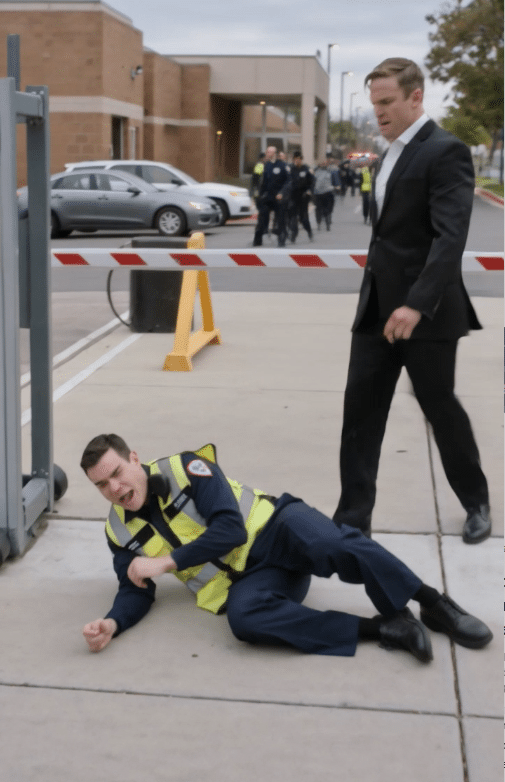
Samuel Brooks stood at the sealed school gate, his yellow reflective vest catching the pulsing emergency lights. Students were being directed along a side path while parents waited beside cars lined along the curb. Beyond the temporary barriers, the school grounds were still under emergency protocol.
Victor Lang stepped out of his expensive sedan and pointed toward the gate.
He wanted to drive inside.
Samuel raised his stop sign and held his position. The instruction was simple: no vehicles could enter while students were evacuating. Cars needed to remain clear of the route, and staff had to keep the entrance unobstructed.
Victor didn’t care.
He rushed forward and drove a forceful kick into Samuel’s chest, throwing the older guard backward against the gate barrier. Samuel dropped hard onto the concrete. His shoulder radio fell away, and the stop sign skidded across the pavement.
His forearm struck the metal foot of the barrier, leaving a thin trace of blood.
Parents gasped. One woman covered her mouth. Another stepped backward toward her car, staring in disbelief as Victor stood over the man who had been trying to keep the entrance safe.
Samuel struggled to breathe.
Even as pain tightened his face, he reached toward the gate control. He was still trying to keep the entrance closed while students were being moved away from the danger area.
“No vehicles inside during evacuation.”
His voice shook, but the instruction remained the same.
Victor looked down at him with contempt.
“Trash. Open the gate for my car.”
Samuel had been doing his job. Victor had responded by attacking him in front of parents and students.
The guard tried to curl away from the pain, but Victor stepped over the fallen stop sign and delivered two more forceful kicks into his back and side while he lay on the concrete.
The parents recoiled. Nobody rushed forward. The shock of the attack had left them frozen, and the emergency operation continued around them as staff guided students along the side route.
Victor straightened his black suit.
“Rules don’t apply to me.”
He spoke as if the words explained everything.
In his mind, the school gate was an obstacle, Samuel was an employee who had forgotten his place, and the emergency procedure was something that should bend when a sufficiently important person demanded it.
But the gate stayed closed.
Then a school police vehicle and a district SUV braked sharply at the curb.
Their doors opened.
A man in a dark suit and gray overcoat stepped out, accompanied by school police and the principal. He looked toward the sealed entrance, the injured guard, and the parent standing beyond the barrier.
Superintendent Alan Reed had arrived.
And the first words he spoke made Victor realize that the gate would not open just because he demanded it.
Act II
Victor Lang was accustomed to getting his way.
At forty-six, he carried himself like someone who expected other people to make room for him. His expensive sedan, polished shoes, and black suit were part of an image he carefully maintained. He believed that being successful meant he shouldn’t have to wait in the same way as everyone else.
He rarely considered how his behavior affected the people standing in his path.
When a receptionist asked him to follow a procedure, he saw needless bureaucracy. When a worker told him something couldn’t be done, he assumed the person lacked the authority to make that decision. And when someone refused to yield, he took it as a challenge.
That afternoon, the closed school gate had become his latest obstacle.
The evacuation alert had triggered a coordinated response. Students were being directed away from the main entrance, temporary barriers restricted vehicle access, and staff were using the designated side route to move people safely.
Samuel Brooks had been assigned to help keep the entrance clear.
At fifty-two, Samuel understood that a school emergency was not the time to make exceptions for impatient parents. Vehicles could obstruct the evacuation route, interfere with responding personnel, or place students in danger as they moved between buildings and the street.
He had no personal reason to refuse Victor.
He was simply following the procedure that applied to everyone.
Victor, however, believed his own circumstances deserved special treatment. His car was waiting. He wanted access, and he regarded the closed gate as a needless inconvenience rather than a safety measure.
When Samuel refused to open it, Victor’s frustration became aggression.
The attack happened so quickly that the nearby parents barely had time to react. One moment, Samuel was standing at the entrance with his stop sign raised. The next, he was on the concrete, his radio and sign scattered nearby.
Yet even after being struck, Samuel reached toward the gate control.
He understood what Victor seemed unwilling to acknowledge: the students still needed the route to remain clear.
The emergency did not pause because an adult had lost his temper.
Parents continued watching from beside their cars. Their expressions showed shock and fear, but none approached Victor. They had seen him attack a school employee in the middle of an evacuation, and they were afraid of what he might do next.
Then the district SUV arrived.
Superintendent Alan Reed stepped out alongside school police and the principal. His attention moved quickly across the scene, taking in the sealed gate, the students being guided along the side path, and Samuel lying injured beside the barrier.
He didn’t rush into an argument with Victor.
He didn’t begin by asking whether the parent had an important appointment or whether he believed he deserved access.
The evacuation was still underway.
The immediate priorities were to protect Samuel, maintain the gate restriction, and keep the student route clear.
School police moved between Victor and the injured guard. The principal signaled staff to continue guiding students along the designated path.
Then Alan turned toward the entrance.
His next instruction would settle the question Victor had been trying to force everyone to answer.
Act III
“Keep the gate sealed.”
Superintendent Alan Reed’s order was calm, direct, and unmistakable.
School police positioned themselves between Victor and Samuel, creating a barrier that prevented the parent from approaching the injured guard again. The principal turned back toward the school and signaled staff to continue the evacuation.
Nobody opened the gate.
Nobody asked Victor whether he approved.
For several seconds, he appeared unable to process what had happened. He had expected the arrival of district leadership to give him someone more important to pressure. Instead, the superintendent had reinforced the very order Victor had attacked Samuel for enforcing.
The gate remained shut.
The students continued along the side path, guided away from the main entrance. Emergency lights flashed against the temporary barriers, and the school police vehicle remained near the curb.
Samuel lay beside the gate, breathing hard and grimacing from the pain. His radio was on the pavement, and the stop sign had slid away from his reach.
Even in that condition, he had been trying to keep the entrance closed.
Alan noticed.
The guard had not been defending his pride. He had been trying to maintain the safety boundary while students were being evacuated. Victor had attacked him because he wanted his car inside, but Samuel’s responsibility had not changed when he fell.
The superintendent’s first action was to support that responsibility, not undermine it.
School police held their position between Victor and Samuel. The principal continued coordinating the movement of students, making sure the emergency route remained clear.
Victor looked toward his sedan.
It was still waiting outside the gate, exactly where he had left it. He glanced at the temporary barriers, then at the school police officers who were now controlling the entrance.
The car had not moved.
Neither had the rule.
Victor had treated the gate as if it were a personal inconvenience that Samuel had invented. Now the superintendent had arrived and confirmed that the restriction was staying in place.
The parent turned toward Alan, waiting for an explanation.
He received no invitation to argue about his status.
The order was already clear.
“Keep the gate sealed.”
The superintendent’s attention returned to the emergency operation. Students were still being guided away from the main entrance, and the injured guard needed assistance. The district’s leadership had taken control of the situation without allowing Victor’s anger to disrupt the evacuation any further.
For the first time, Victor was no longer the person dictating what happened next.
He stood outside the barrier, staring at a gate that refused to yield to his demands.
And he was beginning to realize that the superintendent had not come to help him get inside.
Act IV
Victor had expected the district SUV to change everything.
He had imagined that someone from the school system would arrive, recognize his importance, and tell Samuel to stop making a problem out of a simple request. In Victor’s mind, the guard had been unreasonable, and the arrival of a superintendent should have settled the dispute in his favor.
Instead, Alan Reed had made the restriction explicit.
“Keep the gate sealed.”
The words carried more weight than a heated argument ever could.
School police stood between Victor and Samuel. The principal continued directing staff as students moved along the side path. The entrance remained closed, and the temporary barriers were still in place.
Victor looked at the officers.
They were not there to help him reach his sedan. They were there to protect the scene and keep the gate secured.
He glanced toward Samuel, who remained on the ground near the barrier. The guard was still in pain, and his equipment lay scattered on the concrete.
The sight should have made the situation clear.
Samuel had been enforcing a safety rule. Victor had attacked him, then demanded that the same rule be ignored.
Yet Victor still seemed more troubled by the closed gate than by what he had done.
He shifted his weight and looked back at the superintendent.
Alan did not raise his voice or turn the encounter into a public contest. He remained focused on the evacuation, the injured guard, and the need to keep vehicles away from the entrance.
That steady response left Victor with no opening to exploit.
The parents who had witnessed the attack kept their distance. Earlier, they had stepped backward in fear as Victor stood over Samuel. Now they watched in silence as school police secured the area.
The emergency operation continued around them.
The alarm lights pulsed. Radios crackled. Staff moved students along the side path, keeping them away from the restricted entrance. The school was still responding to an emergency, and the adults responsible for maintaining order had to keep that work moving.
Victor’s demand could not take priority over any of it.
He had told Samuel that rules did not apply to him.
But the superintendent’s order made the opposite clear: the rule remained in place, regardless of how loudly Victor protested or how expensive his car was.
The gate was not a symbol of Samuel’s personal authority.
It was a safety boundary.
And Alan was backing the person who had been enforcing it.
Victor looked toward the sedan again. The vehicle was close enough to see through the restricted entrance, but he had no permission to drive it onto the campus.
He had wanted the gate opened for his car.
Now he was watching the superintendent ensure that it stayed closed.
His face tightened as the contradiction became impossible to ignore.
For the first time since stepping out of his sedan, Victor seemed to understand that his demands had not made him more powerful.
They had only made his refusal to accept the emergency protocol more obvious.
Act V
“Sealed?”
Victor stared at the gate.
His anger had begun to give way to disbelief. The superintendent had arrived, school police had taken control of the space around Samuel, and the principal was continuing the evacuation.
Yet the gate remained closed.
The expensive sedan was still outside the barrier, unable to enter the campus. The stop sign lay on the concrete, and Samuel’s radio remained near the gate while the injured guard struggled through the pain.
The rule had not changed.
No vehicles inside during evacuation.
Samuel had said it before the attack. He had repeated it afterward, even while trying to reach the gate control from the ground.
Victor had treated that instruction as an insult. He had assumed his impatience mattered more than the responsibility entrusted to the guard.
But the superintendent had backed Samuel’s decision without hesitation.
“Keep the gate sealed.”
There was no ambiguity in the order.
School police maintained the barrier between Victor and the injured guard. The principal continued guiding staff as students moved away from the main entrance. Parents stood silently beside their cars, watching the scene beneath the pulsing emergency lights.
The school could not abandon its evacuation plan because one parent wanted to drive through a closed gate.
And the person responsible for the district had made that clear.
Victor looked toward Alan, searching for some sign that the order might be reconsidered. The superintendent remained focused on the emergency and the people who needed protection.
He had not arrived to negotiate special access for Victor.
He had arrived to help control a serious situation.
Samuel had been trying to keep the gate closed when Victor attacked him. Even after being knocked down, the guard had reached toward the control rather than abandoning his post.
That was what the superintendent had supported.
The contrast between the two men could not have been clearer. One had been trying to protect the evacuation route; the other had used violence because he believed his car deserved priority.
Now the gate stood between Victor and the thing he wanted, and the entire official response reinforced the same boundary.
He could not simply demand his way inside.
He could not make the emergency procedure disappear.
And he could not turn Samuel’s refusal into a personal insult that justified an attack.
Victor stared at the sealed entrance, his expression tightening as the reality settled over him.
The superintendent was backing the guard’s order.
The gate was staying closed.
And for once, Victor Lang’s insistence that the rules did not apply to him had changed nothing.
“Sealed?”
His voice was smaller now, edged with stunned disbelief.
Behind him, the emergency lights continued to flash as students moved safely away from the entrance.
Hard cut.