Act I
“Eat from the floor, soldier.”
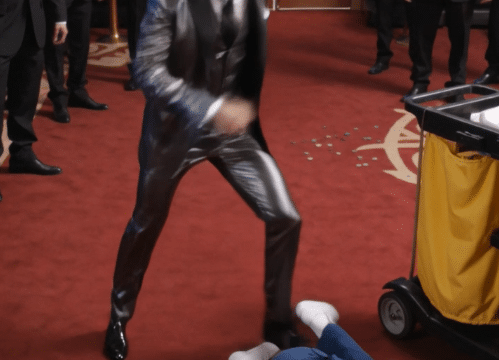
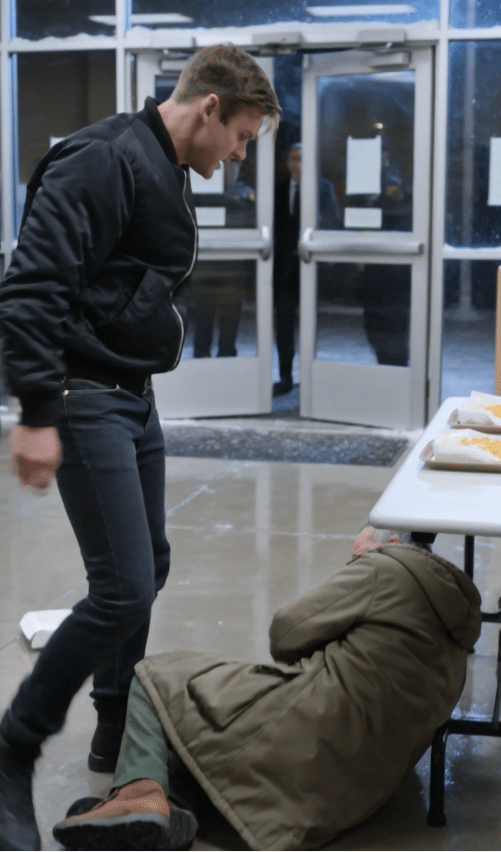
The words echoed through the community meal hall just as the thirty-five-year-old man in the black bomber jacket delivered another vicious kick to the veteran lying beside the food table.
Paper plates rattled. A metal serving tray clattered against the floor. Somewhere near the entrance, a woman gasped so sharply that several people turned toward her.
But the seventy-year-old veteran barely seemed to hear any of it.
He was staring at the food scattered across the wet floor.
Mashed potatoes had spilled beneath the table. A piece of bread lay near someone’s shoe. The paper meal box that had been his only food for the day was crushed against a table leg, its contents spread across the dirty concrete.
The old man tried to push himself upright with his remaining hand, but pain twisted through his chest. His worn army coat caught against the table, and his elbow scraped the metal leg, leaving a thin trace of blood.
He grimaced, drew a ragged breath, and reached toward the overturned container.
“Please,” he whispered. “It’s my only meal today.”
The man in the black jacket looked down at him.
“Trash. You held up the line.”
For a moment, the entire room seemed to stop breathing.
The veteran’s name was Frank Miller. He was seventy, had served in the United States Army, and had spent the past several years trying to rebuild a life that had become smaller with every passing hardship.
He had lost his left arm years earlier. His old military coat had been repaired more times than he could count, and his gray scarf was beginning to fray at the edges. Yet every evening, he made the same difficult journey to the community meal hall, hoping to receive something warm enough to last through the night.
That evening, he had waited patiently in a long line while snow gathered against the glass doors.
When he reached the serving table, the volunteer had placed a paper meal box in his remaining hand. Frank had thanked her, stepped aside as carefully as his stiff joints allowed, and started toward an empty chair.
He had barely taken three steps when the man behind him snapped.
“Can you move any slower?”
Frank turned slightly.
“Sorry. I’m trying.”
“Trying?” the man repeated. “You’ve got a hundred people waiting.”
The line was long, the room was crowded, and the cold had made everyone’s patience thinner. But the other people in line had been waiting, too. Some were elderly. Some had children with them. Others stood silently in worn coats, staring at the food as though they were calculating how much longer they could go without it.
No one had demanded that Frank move faster.
Only the man in the black jacket seemed to regard the veteran’s disability as a personal insult.
Frank attempted to move toward the table’s edge.
The man grabbed the meal box from his hand and threw it down.
Before Frank could react, the attacker kicked him hard in the chest, knocking him backward into the table leg. The box burst open, and the food spilled across the floor.
Frank cried out and fell onto his side.
His remaining hand instinctively reached for the meal, as though he might somehow gather it back into the container before anyone noticed what had happened.
Then the attacker stepped closer and kicked him twice more.
Frank curled inward, trying to shield himself. His face tightened with pain, and his breathing became shallow and uneven.
Several volunteers stood frozen behind the serving table.
A young man near the food line raised his hands to his mouth. An elderly woman looked away, unable to bear the sight. Someone whispered, “Oh, my God,” but nobody moved quickly enough to stop what was happening.
The attacker looked around at the crowd.
“What?” he demanded. “You want to waste everyone’s time over this?”
Frank lifted his head.
He looked humiliated, frightened, and utterly exhausted.
“Please,” he said again. “I just need something to eat.”
The man leaned toward him.
“Then eat from the floor, soldier.”
Those words hurt in a way the attacker could not have understood.
Frank had never expected special treatment because he had worn a uniform. He had never asked anyone to admire him, and he had spent years avoiding conversations about the circumstances that had cost him his arm.
But he had believed that there were still places where a person could ask for a meal without having to defend his right to receive it.
Apparently, this was no longer one of them.
Outside, snow blew against the glass doors.
Inside, the veteran lay beside the table, looking at the food he had waited nearly an hour to receive.
Then the front doors burst open.
A gust of freezing air swept through the hall, scattering napkins across the floor. Several people turned toward the entrance as a tall man in a black suit and long charcoal coat strode inside, followed by two security guards and a camera crew.
The newcomer took one look at the scene.
His expression changed.
He crossed the room without hesitation, stopped beside Frank, and lowered himself toward the injured veteran before addressing anyone else.
Then he looked toward the serving table.
“Serve him first. Every night.”
The order was quiet, unmistakable, and so unexpected that nobody immediately understood what it meant.
The man in the black jacket stared at him.
“Every night?”
For the first time since the assault began, the bully seemed to realize that the room no longer belonged to him.
And he had absolutely no idea who had just walked through those doors.
Act II
Frank Miller had never imagined that a free meal could become the center of his life.
When he was young, he had worked long hours, paid his bills, and believed that hard work offered a reasonably reliable path toward security. He had grown up in a small town where people helped neighbors shovel snow, repaired broken fences without sending invoices, and brought casseroles to families dealing with illness.
His father had taught him to stand on his own feet.
His mother had taught him never to let pride prevent him from showing kindness.
Frank tried to live by both lessons.
He enlisted in the Army as a young man, believing that service meant accepting responsibility even when the work was difficult. He did not talk much about his military years afterward. When people asked, he offered a few harmless stories and changed the subject.
The memories he kept to himself were harder to explain.
He remembered the men who had shared their food with him, the letters that arrived from home, and the strange intimacy of trusting another person with your life. He remembered how quickly an ordinary day could become a permanent dividing line between the person you had been and the person you were forced to become.
He also remembered the moment his life changed.
The loss of his left arm had not only altered what he could do physically. It had forced him to reconsider almost every ordinary task he had once performed without thinking.
Buttoning a shirt became a challenge. Carrying groceries required planning. Opening a jar could leave him frustrated enough to set it aside for hours.
At first, Frank fought every limitation.
He learned new techniques, practiced until his remaining hand ached, and refused assistance whenever he could manage without it. He returned to civilian life determined that his injury would not define him.
For years, it did not.
He worked in building maintenance, married a woman named Ellen, and helped raise her daughter from a previous relationship. Their home was modest but warm, and Friday nights meant cheap pizza, old television shows, and arguments about which team would win on Sunday.
Ellen never treated his disability as something that made him less of a man.
When he struggled with a task, she simply found another way for them to do it together.
“You don’t have to prove you’re indestructible,” she once told him.
Frank had laughed.
“I’ll let you know when I figure out how.”
Then Ellen became ill.
The years that followed were a blur of appointments, medication schedules, unpaid leave, and bills that arrived whether he was ready for them or not. Frank spent his savings trying to keep her comfortable, and after she died, he discovered that grief could make even a familiar room feel like a place he no longer belonged.
He stayed in their apartment for as long as he could.
Eventually, the rent increased, his health deteriorated, and his income proved insufficient to cover everything. He moved into temporary accommodation, then into a small rented room, and finally into a situation where the money left after basic expenses rarely stretched far enough.
He hated explaining this to anyone.
When people asked how he was doing, he said he was managing.
When someone offered help, he thanked them but tried to make the favor seem smaller than it was.
And when food became difficult to afford, he found the community meal hall.
The hall was operated by a nonprofit organization that served hundreds of meals each week. Its volunteers worked long shifts, washed endless trays, and tried to make sure nobody left hungry.
For Frank, the place became a quiet anchor.
He learned which nights served soup, which volunteers remembered his preference for softer bread, and which table was easiest to reach without bumping into people.
He never pushed to the front of the line.
He never demanded an extra portion.
If the hall ran short of food, he sometimes stepped aside so that someone with children could eat first.
The volunteers noticed his manners, his patience, and the way he always thanked them.
They did not know everything about his life. Frank had never told them much.
But they knew he was a veteran, that he had lost an arm, and that he sometimes arrived looking so tired he could barely keep his eyes open.
On the night of the assault, Frank had skipped lunch.
He had planned to eat at the hall, take the bus back to his room, and save the small amount of money in his pocket for breakfast the next morning.
The meal box had not been a convenience.
It had been his plan for surviving the night.
The man who destroyed it was named Derek Walsh.
Derek was thirty-five, physically fit, and accustomed to expressing his frustration as though everyone around him were responsible for it. He had arrived at the hall after a long day, irritated by the snow, the traffic, and the fact that he had to wait for a meal.
He had a job, a rented apartment, and enough money to buy food when he chose to prioritize it. But he had grown resentful of the people he encountered in the charity line, convinced that anyone who needed assistance was somehow taking something from him.
Frank’s slow movement gave Derek an excuse to turn that resentment into cruelty.
He did not know the veteran’s history.
He did not know that Frank had gone without lunch.
He did not know that the crushed meal box represented everything Frank had expected to eat that day.
He had not asked.
He had simply decided that the old man was taking too long.
And now, as the charity founder stood beside Frank and ordered that he be served first, Derek was about to discover that the meal hall was not the helpless place he had assumed it to be.
The man in the black suit had spent years building something that depended on one simple principle.
Nobody who came through those doors should have to prove they deserved to eat.
Derek had just violated that principle in front of the very person who had made it the foundation of his life’s work.
Act III
The man who had entered through the snowy doors was named Charles Whitaker.
At sixty-two, Charles was the founder of the Whitaker Community Foundation, an organization that operated meal programs, emergency shelters, and support services for people facing financial hardship.
His name appeared on the organization’s paperwork, but he rarely used it to command attention. He preferred to visit kitchens, speak with volunteers, and observe how the programs worked when no formal event was taking place.
He had not built the foundation because he believed himself to be unusually generous.
He had built it because he remembered what it felt like to need help.
When Charles was seventeen, his father lost his job at a manufacturing plant. The family had been living comfortably enough, but the sudden loss of income turned ordinary expenses into painful decisions.
His mother began stretching meals. His father took temporary work wherever he could find it. Charles learned to recognize the small signs of financial distress that adults tried to hide from their children.
The family eventually recovered.
But Charles never forgot the humiliation of standing in a food line while pretending not to notice who was looking at him.
Years later, after building a successful business, he began funding local meal programs. At first, the foundation served one neighborhood. Then it expanded, eventually operating facilities in several cities.
Charles insisted on a rule that sometimes frustrated his administrators.
The first priority was not publicity.
It was the person standing in front of them.
He disliked staged photographs of volunteers handing food to grateful recipients. He disliked speeches that turned hunger into an abstract problem while ignoring the people waiting outside in freezing weather.
Most of all, he disliked systems that made people feel they had to apologize for being poor.
“If someone has to choose between dignity and dinner,” he once told his board, “we’ve designed the wrong system.”
That belief shaped the meal hall’s daily operations.
The staff were instructed to serve people respectfully, accommodate disabilities, and avoid making assumptions about anyone’s circumstances. When possible, meals were provided without intrusive questions. If someone needed extra time, the line was supposed to make room.
Charles had come that evening to review the program’s winter response.
A media team was accompanying him because the foundation had recently launched a campaign to expand emergency food services during severe weather. The visit was meant to document the work of volunteers and the demand for meals during the coldest months.
He had expected to find a busy kitchen.
Instead, he found Frank on the floor.
At first, Charles noticed the spilled food and the overturned chair. Then he saw the veteran’s missing arm, his worn coat, and the expression on his face.
Charles had seen that expression before.
It was not simply pain.
It was the shame of being hurt in public and worrying that everyone would remember the humiliation more clearly than the injury.
He crouched beside Frank.
“Sir, my name is Charles. Can you hear me?”
Frank nodded.
“I’m sorry,” he whispered.
Charles frowned gently.
“What are you apologizing for?”
Frank looked toward the food on the floor.
“The mess.”
For a moment, Charles said nothing.
He looked at the crushed container, then at the veteran’s trembling hand.
“You don’t need to apologize for any of this.”
He turned toward a volunteer.
“Please call for medical assistance. And bring him a fresh meal as soon as it’s safe to do so.”
Then he looked toward the serving counter.
“Serve him first. Every night.”
The volunteers exchanged stunned glances.
Charles continued, his voice firm.
“Starting now, anyone who needs additional time or assistance gets it. Nobody is rushed out of this line because their disability makes someone impatient. And no one is made to feel they have to earn the right to eat.”
Derek stared at him.
“You can’t be serious.”
Charles finally turned.
“I’m entirely serious.”
“He held up the line,” Derek protested. “Everyone was waiting.”
Charles glanced toward the people standing behind him.
“Was anyone here complaining about him?”
Nobody answered.
A woman near the back of the line shook her head.
“He was trying his best,” she said.
Another volunteer spoke from behind the counter.
“He thanked me for his meal before this man took it from him.”
Derek looked around, searching for someone who might agree with him.
His friends were gone. The other people in the hall were watching him with expressions that ranged from disgust to disbelief.
Charles remained calm.
“You saw a disabled veteran struggling to move, and your response was to take his food, knock him down, and kick him while he was on the floor.”
Derek’s face reddened.
“I didn’t know he was a veteran.”
Charles’s expression hardened.
“Would that have made it acceptable if he weren’t?”
Derek had no answer.
The camera crew had stopped filming the general scene and turned their attention toward Charles, waiting for direction. He raised one hand.
“Don’t make him a spectacle,” he said.
Then he turned back toward Frank.
That small decision mattered.
Charles could have used the incident to create a dramatic public statement. He could have demanded that the cameras capture every reaction, every angry word, and every tear.
Instead, he made sure the veteran received attention without turning his suffering into entertainment.
One of the security guards moved between Derek and Frank while the volunteers cleared space for the medical responders.
Frank was helped into a safer position, and a staff member retrieved a clean blanket. Charles stayed nearby, asking short questions and listening carefully to the answers.
When Frank mentioned that he had not eaten since the previous morning, the founder’s face changed again.
“Yesterday morning?” he repeated.
Frank nodded.
“I thought this would be enough until tomorrow.”
Charles looked toward the kitchen.
“Please prepare a full meal for him. Something warm, and whatever else he needs to take with him.”
Then he addressed the program director.
“I want us to review how we identify guests who may need additional food or transportation assistance. Quietly. Respectfully. No one should have to explain their entire life just to receive help.”
Derek shifted uneasily.
He had expected an argument.
He had expected someone to tell him to calm down, perhaps to ask Frank to forgive him so that the line could keep moving.
He had not expected the man who ran the entire organization to focus so completely on the veteran.
And he certainly had not expected the next instruction.
Charles looked toward the security guards.
“Please make sure Mr. Walsh leaves the serving area. We will review this incident with the appropriate people before deciding whether he can return.”
Derek’s mouth fell open.
“You’re throwing me out over a meal?”
Charles met his eyes.
“No. Your behavior has consequences because you chose to hurt someone who was already vulnerable.”
The room went silent.
Then Charles added, “And the meal he lost will not be the last meal he receives here.”
Derek stared at him.
“Every night?”
The question escaped before he could stop himself.
Charles did not answer.
Not yet.
Because the decision he was about to make would affect far more than Frank’s dinner.
Act IV
The medical responders arrived within minutes.
Frank was still conscious, but his chest hurt, and his movements were guarded. They assessed him carefully and recommended further evaluation to rule out serious injury.
Before he left, Charles crouched beside him once more.
“Mr. Miller, we’re going to make sure you’re looked after.”
Frank looked embarrassed.
“I don’t want to cause trouble for your people.”
Charles shook his head.
“You haven’t caused trouble. Someone hurt you. That’s not the same thing.”
Frank swallowed, his remaining hand resting against the blanket.
“I just wanted something to eat.”
“I know.”
Charles stayed until the responders had everything they needed. A volunteer packed a fresh meal for Frank to take with him when he was cleared to leave, and another gathered his belongings so nothing would be misplaced.
Only after Frank was on his way to receive medical care did Charles turn his attention back to the hall.
Derek was standing near the entrance with one security guard beside him.
His anger had begun to turn into panic.
“Look,” he said, “I was frustrated. It was a long line. I shouldn’t have done that, but you’re acting like I’m some kind of monster.”
Charles regarded him for several seconds.
“I’m not interested in deciding what kind of person you are based on one sentence. I’m interested in what you chose to do when another person needed patience.”
Derek shook his head.
“You don’t know anything about me.”
“That’s true,” Charles replied. “And you knew nothing about Mr. Miller. You didn’t know what he had been through, what he could afford, or whether he had another meal waiting for him at home.”
He gestured toward the serving table.
“You didn’t need to know any of those things to leave him alone.”
Derek glanced at the people watching from the line.
He looked particularly unsettled by the volunteers. He had treated them as background figures in his own frustration, but they had witnessed his actions and were now being asked to record what they saw.
The program director had already secured the relevant security footage. Several guests had offered to provide statements, and the incident was being documented for review.
Charles made it clear that any further action would be based on the evidence and the foundation’s policies, not on a public confrontation.
Derek was asked to leave the serving area while the organization reviewed whether he could return. If he wanted to challenge that decision, there was a formal process for doing so.
There would be no shouting match.
No public humiliation designed to mirror his own.
Just accountability.
Derek stepped toward the doors, then stopped.
“Are you really going to change the whole program because one guy couldn’t move fast enough?”
Charles looked toward the long food line.
“I’m changing the program because your actions exposed a weakness we need to address.”
He turned to the volunteers.
“Starting tonight, we are establishing a priority service procedure for guests who need extra time or assistance. The line will accommodate them. We will also create a take-home meal option for people who cannot safely carry food through a crowded room.”
The program director nodded and began making notes.
Charles continued.
“We’ll expand the winter meal reserve so that no one who loses a meal because of an incident like this has to wait until the next scheduled service. And we’ll arrange additional support for guests who have difficulty getting to and from the hall.”
He paused.
“This isn’t about giving Mr. Miller special treatment. It’s about making sure our rules work for people who actually need our services.”
The volunteers listened in silence.
For years, they had done their best with limited staff, crowded rooms, and long lines. They had seen guests struggle with mobility issues and had often improvised solutions as they went.
Now they had permission—and resources—to make those solutions part of the system.
The foundation would review the staffing plan, improve accessibility, and create a clearer way for guests to request help without having to explain their circumstances in front of everyone.
It would take time and money.
Charles committed both.
But there was another decision he made that evening.
He asked the program director to contact Frank once he had recovered enough to discuss it, and to offer him a choice of ongoing support. If Frank wanted regular meals, transportation assistance, or help navigating veteran services, the foundation would coordinate those resources with him.
The offer would not be conditional on appearing in a campaign video.
It would not require a photograph, a testimonial, or a public expression of gratitude.
Frank could accept the help privately.
That distinction was important to Charles.
He had seen too many charitable programs treat a recipient’s gratitude as part of the transaction, as though a meal came with an obligation to smile for the donor.
He refused to build another system like that.
Meanwhile, the camera crew had begun packing away its equipment.
One of the reporters asked whether Charles wanted to make a statement about what had happened.
“Yes,” he replied. “But not while Mr. Miller is being treated. His recovery comes first.”
The reporter nodded.
Charles looked toward the snowy glass doors.
“Later, we can talk about what this incident tells us about the work we still need to do.”
Derek heard him from across the room.
He had spent the evening believing that the only issue was whether a disabled man had slowed down a line.
Now he was watching the consequences spread through an entire organization.
The meal program was changing its procedures. The witnesses were documenting what they had seen. The foundation was reviewing the incident, and the man Derek had tried to dismiss as worthless was receiving the attention he had needed from the beginning.
Derek had asked whether Charles was changing everything because of one meal.
He was beginning to understand the answer.
It was not the meal alone.
It was the belief that some people deserved patience and others did not.
And Charles intended to challenge that belief wherever it appeared inside his organization.
Act V
Frank returned to the community meal hall several days later.
The bruising and pain had required medical attention, but he was recovering. His elbow had been cleaned and dressed, and the staff had given him instructions about when to seek further care.
He arrived wearing the same old army coat and gray scarf.
For a moment, he hesitated outside the glass doors.
The memory of the assault remained vivid. He could still hear the meal box hitting the floor, Derek’s contemptuous voice, and the terrible silence of people who had not known what to do.
He wondered whether anyone inside would look at him differently.
Then one of the volunteers spotted him through the glass.
She opened the door and smiled.
“Mr. Miller. We’re glad you’re back.”
Frank nodded, unsure what to say.
She guided him toward a quiet table near the serving area. There was no need to navigate the entire line, and nobody rushed him as he settled into his seat.
A few minutes later, another volunteer brought him a warm meal in a sturdy container with a secure lid.
There was bread, soup, vegetables, and a small dessert.
Frank stared at the tray.
“That’s a lot of food.”
“You can take whatever you don’t finish with you,” the volunteer said. “We have containers ready.”
He looked down at the meal.
“I don’t want to take more than I need.”
“You’re allowed to eat, Mr. Miller.”
She said it so naturally that he almost missed the significance of the words.
He had spent years trying to make himself smaller in every place where he needed assistance. He moved carefully, apologized often, and tried to take up as little room as possible.
He had learned to treat his own needs as an inconvenience.
Now someone was telling him that he did not have to.
Frank took the first spoonful of soup.
It was warm, simple, and exactly what he needed.
He ate slowly, savoring the food without looking around to see whether anyone was judging him. For the first time in several days, his shoulders began to relax.
When he finished, the volunteer asked whether he would like a take-home meal for the following morning.
Frank hesitated.
Then he nodded.
“Yes, please. If that’s all right.”
“Of course.”
The foundation followed through on its promises.
The meal hall introduced a more flexible serving procedure, improved the way staff accommodated guests with disabilities, and expanded its reserve of take-home meals during severe weather. The changes benefited people whose needs had often gone unnoticed: older adults who struggled to carry containers, guests who needed extra time to move through the room, and people who could not safely wait in a crowded line.
The organization also strengthened its referral network for veterans and other guests who needed help beyond food assistance.
Charles insisted that the improvements be measured by their usefulness, not by the attention they attracted.
He did not want a campaign built around Frank’s suffering.
He wanted a program that worked better for the next person who walked through the doors.
As for Derek, the foundation reviewed the incident and its policies. He was not permitted to return to the meal service while the review was underway, and the organization documented the assault for the appropriate authorities.
There was no dramatic courtroom speech that instantly transformed his character. There was no magical punishment that erased what he had done.
There was simply evidence, a formal process, and the loss of the privilege he had treated as though it belonged to him.
He had believed that the people in the meal hall were too powerless to hold him accountable.
He had been wrong.
Weeks later, Charles visited the hall without a camera crew.
He found Frank sitting near the window, eating soup and talking with two regular guests. The old veteran looked tired, but there was a little more color in his face.
Charles approached the table.
“May I join you?”
Frank immediately began shifting his container to make room.
“You don’t have to do that,” Charles said, pulling out a chair.
“I know,” Frank replied, then gave a small, embarrassed smile. “Old habits.”
They sat together for a few minutes, discussing the weather and the new meal containers. Charles asked whether the revised system was working for him.
Frank told him that it was.
He could collect food without worrying about carrying an open box through a crowded room, and the volunteers had helped him arrange transportation for appointments when the weather made travel difficult.
Most importantly, he no longer felt that he had to apologize every time he needed an extra moment.
Before Charles left, Frank asked him a question.
“Why did you make such a big deal out of what happened?”
Charles leaned back in his chair.
“Because it shouldn’t have happened in the first place.”
Frank looked down at his remaining hand.
“People get impatient.”
“They do,” Charles agreed. “But impatience doesn’t give anyone the right to hurt you.”
Frank was quiet.
Charles continued.
“And I didn’t change the program because you were the person who got hurt. I changed it because I want the next person who comes here to be safer than you were that night.”
Frank considered that.
Then he nodded slowly.
“That makes sense.”
He did not thank Charles with a grand speech. He did not promise to tell everyone about the foundation or offer to appear in a campaign.
He simply returned to his soup.
And Charles, who had spent much of his adult life trying to understand the difference between charity and dignity, recognized that this was exactly how the moment should end.
Not with the founder receiving praise.
Not with the veteran being asked to perform gratitude.
But with an old man being allowed to finish his meal in peace.
Outside, snow continued to gather along the pavement. Inside, the line moved steadily, volunteers carried fresh trays from the kitchen, and guests found places to sit.
The meal hall had not solved every hardship its visitors faced.
It could not restore Frank’s lost arm, bring back his wife, or erase the years of financial uncertainty that had brought him there.
But it could offer him a warm meal without humiliation.
It could give him time to move at his own pace.
And it could make sure that the next person who entered those doors would not have to wonder whether needing help made them less deserving of kindness.
The night Derek destroyed Frank’s meal, he had believed the old veteran was the problem because he was moving too slowly.
Charles Whitaker saw the truth.
The problem was a world in which someone could stand beside a hungry man, watch him struggle, and decide that his suffering mattered less than a few seconds of inconvenience.
The solution was not to make Frank move faster.
It was to make room for him.
And every night after that, when the doors opened to people coming in from the cold, the first question was no longer how quickly the line could move.
It was whether everyone who needed a meal could receive one with dignity.
For Frank Miller, that change meant more than a full container of food.
It meant he could walk—or move, at his own pace—through those doors without feeling that he had to earn the right to be there.
And for everyone who had witnessed what happened, it left behind a lesson far more lasting than the spilled meal that started it all:
A person’s worth is not measured by how quickly they move, how much they can carry, or how little help they need. Sometimes, the truest measure of a community is whether it makes room for the person who cannot keep up.