Act I
“Trash. Slow men miss trains.”
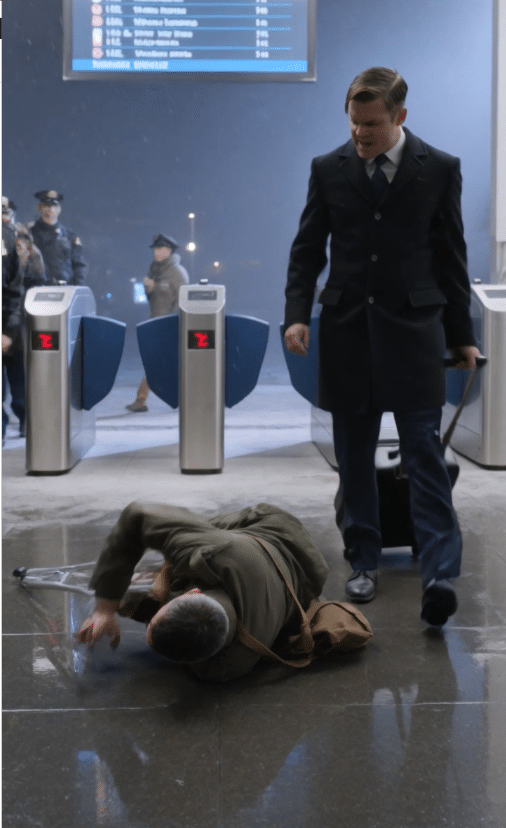
The words echoed across the station as seventy-three-year-old Walter Hayes lay face-down on the wet floor, reaching desperately for a single train ticket beneath the shoes of rushing commuters.
Outside, a blizzard swallowed the parking lot and buried the station entrance beneath swirling white snow. Every time the doors opened, freezing wind swept across the ticket gates, rattling signs and sending loose paper skittering over the tiles. The departure board blinked with warnings of delays, cancellations, and one final service that might still make it through the storm.
Walter had been trying to reach that train.
He wore an old army jacket with frayed cuffs, and a shoulder bag hung against his side. Two crutches supported his injured leg, forcing him to move carefully through the crowded station. In his coat pocket, folded inside a plastic sleeve, was a photograph of his daughter, Emily.
He had not seen her in nearly three years.
The man who had attacked him wore a premium black coat, polished shoes, and the irritated expression of someone who believed the world existed to keep him moving. A luxury suitcase rolled behind him as he approached the ticket gate, checking his expensive watch while Walter struggled to pass through.
The wealthy traveler shoved his shoulder into the old veteran.
Walter stumbled.
His train ticket slipped from his fingers and fluttered onto the wet floor.
“No,” Walter whispered.
He turned awkwardly, balancing on one crutch while reaching for the small rectangle of paper. The ticket had cost him money he could barely spare. More importantly, it was his only chance to reach Emily before the storm made travel impossible.
He bent lower.
The businessman looked down at him, then deliberately kicked him hard in the back.
Walter pitched forward, striking the floor face-first. His crutches clattered away in opposite directions, and his elbow scraped against the tile, leaving a thin trace of blood. The ticket slid beneath the shoes of nearby passengers.
A woman gasped.
A young man froze with his suitcase halfway over the gate. Several commuters stepped back, their faces tightening with shock, but no one moved toward Walter.
The businessman stood over him.
Walter tried to lift himself, his arms trembling as pain tightened his expression. He looked toward the ticket, then toward his scattered crutches. His breath came in short, uneven bursts.
“That ticket is for my daughter,” he said.
For a moment, the words seemed to hang in the air between them.
The businessman glanced at the paper beneath a stranger’s shoe.
“So?”
Walter swallowed hard. “Please. I just need to get home.”
“Home?” The man gave a contemptuous laugh. “You should have planned better.”
Then he stepped closer and delivered two more forceful kicks into Walter’s back and side.
Walter curled inward, trying to protect himself. His face tightened with pain and humiliation, and one hand stretched toward the ticket as if he could somehow keep it from disappearing. His crutches lay several feet away, useless against the wet floor.
The crowd watched.
The businessman adjusted his coat and leaned over him.
“Stay down and let real passengers move.”
Walter closed his eyes.
He had spent years enduring pain without asking strangers for sympathy. He had learned to move slowly, to accept assistance when it was offered, and to keep his struggles private. But nothing had prepared him for the shame of lying on a station floor while people stepped around him as if he were an abandoned bag.
Then the platform shook.
A special inspection train car rolled to a sudden stop beyond the glass doors. Its brakes released a sharp metallic hiss that cut through the storm noise.
The door opened.
A man in a navy suit beneath a long dark coat stepped down into the blowing snow, accompanied by two station security officers. He was sixty years old, silver-haired, and carried himself with the calm authority of someone accustomed to making decisions that affected thousands of people.
He took one look at Walter.
Then at the scattered crutches.
Then at the ticket lying beneath the crowd.
The man’s expression changed.
He moved toward the fallen veteran while security immediately closed around the scene.
“Hold this train for him,” he ordered.
The station seemed to stop breathing.
The departure board continued blinking. Snow swept through the open doors. The businessman stared at the newcomer, his mouth parting in outrage.
“For him?”
He had no idea who had just stepped off that train.
And he had even less idea why the entire railway system was about to turn its attention toward the old man he had tried to leave behind.
Act II
The railway director did not answer the businessman.
Instead, he knelt beside Walter, careful not to crowd him, and motioned for a security officer to summon medical assistance. Another officer moved between Walter and the man in the black coat, creating a barrier that made it clear the assault was over.
“Sir, can you hear me?” the director asked.
Walter opened his eyes.
“Yes.”
“What’s your name?”
“Walter Hayes.”
“Mr. Hayes, stay where you are for a moment. We’re going to help you.”
Walter tried to push himself upright.
“My crutches—my ticket—”
“We’ll secure both.”
The director’s voice carried no impatience, no suggestion that Walter was holding anyone up. He spoke as if the old man’s safety were the only thing that mattered on the platform.
A security officer retrieved the crutches and placed them within sight but out of the way of the medical team. Another carefully recovered the ticket after documenting where it had been found.
Walter watched every movement.
“Please don’t lose it,” he said. “It’s the last train I can take tonight.”
The director looked at the ticket, then at Walter.
“We won’t lose it.”
Behind them, the wealthy traveler began to protest.
“This is ridiculous. You’re holding an entire train for one man?”
The director rose slowly.
“Yes.”
“You can’t be serious. There are people waiting to get home. People with reservations. People who actually paid for their travel.”
The director’s eyes narrowed slightly.
“Mr. Hayes paid for his ticket too.”
“That isn’t the point.”
“Then explain the point.”
The businessman glanced around, searching for an audience that might share his outrage. A few commuters looked away, embarrassed by their earlier silence. Others now watched openly, their phones raised as station staff began securing the area.
The man straightened his shoulders.
“I have a first-class reservation. I’m traveling on business, and I’ve already lost an hour because of this weather. I don’t intend to lose another one because someone can’t get through a gate.”
The director looked toward Walter, who was still lying on the floor while a medical responder examined him.
“You believe his disability is an inconvenience to you?”
“I believe people should know how to move through a station.”
Walter lowered his gaze.
The director noticed.
That small movement seemed to trouble him more than the businessman’s shouting. Walter had already been struck three times. Yet even now, he appeared more ashamed of taking up space than the man who had attacked him.
“Mr. Hayes,” the director said gently, “you have nothing to apologize for.”
Walter’s throat tightened.
He could not remember the last time someone had said that to him without adding a qualification afterward.
The businessman scoffed. “Are you going to give him a medal next?”
The director turned his head.
“No. Someone already did.”
The words were quiet, but the businessman had no answer.
A security officer asked him to step aside while the assault was investigated. He refused, demanding to know who had authorized the train hold and whether the director understood how much money a delayed service could cost.
The director did not engage with the threats.
“My name is Thomas Reed,” he said. “I am the director of this railway system. The train will remain here until Mr. Hayes is safe, and the incident will be documented.”
The businessman’s face changed.
He had heard the name before. Thomas Reed oversaw the regional network, including the premium services the businessman used for frequent corporate travel. Reed was known for inspecting stations without advance notice, meeting frontline employees, and personally reviewing serious passenger complaints.
But the businessman still assumed the director’s decision was a temporary gesture.
“Fine,” he said sharply. “You’ve made your point. Now get him off the floor and let the rest of us continue.”
A medical responder looked up.
“Sir, he needs to be assessed before we move him.”
The businessman rolled his eyes.
Thomas Reed did not.
“Make sure he receives whatever care he needs. Contact his destination station and confirm that someone can meet him if he still wishes to travel.”
Walter stared at the director.
“Someone?” he whispered.
“If you’d like,” Reed replied. “You shouldn’t have to manage everything alone tonight.”
Walter’s expression crumpled for a second before he managed to steady himself.
He had not told anyone how frightened he was of arriving at Emily’s home without warning. He had not explained why he had waited so long to make the trip, or why the thought of missing this particular train hurt more than the bruises forming beneath his coat.
But the ticket in the security officer’s hand told a story of its own.
It was a one-way journey to a small town several hours away, printed with a departure time that was only minutes from passing.
Thomas Reed looked at the destination.
Then he looked at Walter.
“Is your daughter expecting you?”
Walter hesitated.
“No,” he admitted. “Not exactly.”
The director waited.
Walter swallowed and glanced at the photograph peeking from his coat pocket.
“I promised her I’d come.”
For the first time, the director’s expression softened completely.
He had seen thousands of passengers pass through his stations. He had witnessed missed connections, family reunions, arguments, farewells, and the private tragedies that unfolded beneath public clocks.
But he recognized something in Walter’s voice.
The old man was not merely trying to catch a train.
He was trying to reach someone before he lost the courage to try again.
And the reason that journey mattered would soon become impossible to ignore.
Act III
Three years earlier, Walter Hayes had been a different kind of lonely.
He lived in a small house on the edge of town, where the porch steps creaked beneath his boots and a faded flag hung beside the front door. His wife, Margaret, had died after a long illness, leaving him with a quiet home and a routine that no longer seemed to have a purpose.
His daughter, Emily, called every Sunday.
At first, the conversations were ordinary. She talked about work, the weather, and the small repairs she wanted to make to her house. Walter asked whether she was eating properly and reminded her that the world had not ended just because her car needed new tires.
Then the calls grew shorter.
Emily had been struggling with her own life. A relationship had ended badly, her job had become uncertain, and she was trying to raise her young son, Noah, while keeping the household together. Walter wanted to help, but he had never learned how to speak comfortably about fear or grief.
He offered practical advice when she needed reassurance.
He went silent when she needed him to listen.
One evening, during an argument over money and a decision Emily had made without telling him, Walter said something he regretted almost immediately.
“You’re old enough to solve your own problems.”
Emily went quiet.
“I thought I could talk to you,” she replied.
“You can. But I can’t keep fixing everything.”
“I never asked you to fix everything, Dad.”
He had no answer.
The call ended badly, and neither of them knew how to repair it. A week passed, then a month. Their messages became polite and cautious, as though they were acquaintances trying not to offend each other.
Walter told himself that Emily needed space.
In truth, he was afraid she would discover how little control he had over his own life.
After an accident left him with a serious leg injury, walking became difficult. Rehabilitation helped, but the pain never entirely disappeared. He began relying on crutches, and the simplest errands required planning. His old army jacket became his favorite coat because it was warm, familiar, and roomy enough to accommodate the medical supports he sometimes needed beneath it.
Then his finances deteriorated.
The cost of treatment, the loss of steady work, and several unexpected household expenses consumed what savings remained. Walter tried to keep up with everything himself. He sold tools from his garage, postponed repairs, and stopped driving when he could no longer afford the upkeep.
Eventually, he lost the house.
He did not tell Emily.
He told her he was staying with an old friend. When she offered to visit, he claimed he was too busy with appointments. He convinced himself that he was protecting her from worry, though every unanswered call made the distance between them wider.
By the time he admitted that he had nowhere permanent to live, shame had become its own kind of prison.
He stayed in temporary accommodation when he could afford it and accepted help from a local veterans’ charity when a place was available. His life became a series of short-term arrangements, each one ending just as he began to feel safe.
Still, he kept one promise to himself.
He would visit Emily.
He had written the promise on a scrap of paper and tucked it behind her photograph. He did not know what he would say when he arrived. He did not know whether she would open the door, whether she was still angry, or whether enough time had passed that she no longer wanted him in her life.
But he could not keep waiting for a perfect moment.
Then, three days before the blizzard, Emily called.
Her voice was unsteady.
“Dad, Noah keeps asking about you.”
Walter sat down on the edge of his bed.
“He does?”
“He found an old picture of you in your army jacket. He wants to know why you never visit.”
Walter looked at the photograph in his hand.
“What did you tell him?”
“That you love him.”
The answer broke something open inside him.
He had not realized how much he needed to hear that Emily still believed it.
“I do,” he said. “I love you both.”
There was a long silence.
Then Emily said, “If you want to come, Dad, you can. We don’t have to figure everything out in one day.”
Walter pressed the phone to his ear.
“I’d like that.”
“Then come.”
They agreed that he would take the train during the next available clear window. Emily sent him the address and told him not to worry about bringing anything. She would pick him up from the station, and Noah had already started counting the days.
Walter bought the cheapest ticket he could find.
He packed a spare shirt, his medication, the photograph, and a small wrapped gift for his grandson. It was a wooden train he had bought at a charity shop months earlier, before he knew whether he would ever be able to make the trip.
The night before departure, the weather service announced that a major blizzard was moving across the region.
Walter nearly canceled.
He sat on his narrow bed, watching snow accumulate outside the window, and told himself that Emily would understand if he waited another week. Another month. Another season.
Then he looked at the photograph.
Noah’s small face smiled up at him from beside his daughter.
Walter folded the photograph carefully and slipped it into his coat.
He would go.
At the station, he reached the ticket gate just as the wealthy traveler swept past him. The collision sent his ticket to the floor. The kicks followed before Walter could even retrieve it.
And when he lay there, hearing the stranger tell him that real passengers deserved to move, the old fear returned: perhaps he had waited too long, perhaps Emily had only invited him out of kindness, perhaps the world had already decided that he was no longer worth the trouble.
Thomas Reed had no way of knowing all of this when he stepped down from the inspection train.
But he saw the destination printed on Walter’s ticket.
He saw the photograph in the old man’s pocket.
And he recognized the expression of someone who was terrified that one more disappointment might finally convince him to stop trying.
Reed knew that holding a train would not repair a broken family. It would not erase years of silence or make Walter’s injuries disappear.
But it could give him a chance to reach the door.
And sometimes, a chance was the only thing standing between a person and giving up.
Act IV
The blizzard intensified as station staff began making arrangements.
Wind pressed snow against the glass entrance, and the departure board continued to flash warnings across the platform. Several services had already been canceled. Others were running behind schedule, their crews waiting for updated instructions from the regional control center.
Thomas Reed stood beside the security team while an operations manager spoke to him over a radio.
The special inspection train had been scheduled to continue to the central depot. It was carrying senior railway personnel and technical staff who had spent the evening checking storm-related damage along the line.
Reed had authority to request an operational review, but keeping a train stopped during severe weather was not a casual decision. It required coordination with the control center, the crew, and the stations along the route.
He knew that.
He also knew the difference between delaying a train for convenience and making a decision because a passenger had been assaulted and needed assistance.
“Contact control,” he instructed. “Confirm the safest available departure window. If the service can proceed without compromising safety, we will hold it long enough for Mr. Hayes to be assessed and boarded with assistance.”
The operations manager relayed the request.
A few minutes later, the radio crackled with a response.
The train could remain at the station while the medical assessment was completed. The crew would receive updated instructions before departure, and the destination station would be notified that a passenger requiring assistance was traveling in the storm.
Reed turned to Walter.
“If the medical team clears you to travel, the train will wait for you. If they advise against it, we’ll arrange safe accommodation and help you contact your daughter.”
Walter stared at him.
“You’d really do that?”
“Of course.”
“But there are all those people.”
Reed glanced toward the commuters gathered behind the barriers.
“They have places to be. So do you.”
The simplicity of the answer left Walter speechless.
Nearby, the wealthy traveler had begun pacing. His suitcase wheels clicked sharply against the floor as he repeatedly checked his watch. His anger had turned from impatience to resentment, and every minute of delay seemed to confirm his belief that the railway had betrayed him personally.
He approached Reed again.
“This is absurd. You can’t stop a premium service for someone who can’t even walk properly.”
Reed turned slowly.
“His ability to walk has nothing to do with his right to travel.”
“I’m paying for a premium ticket.”
“So is every other passenger who purchased a ticket for this service. None of them purchased the right to assault another person.”
The businessman flushed.
“I didn’t assault anyone.”
Several witnesses looked toward the security officers.
Reed did not argue with him. The police would investigate the incident, and the available recordings and statements would establish what happened. Instead, he instructed station security to keep the businessman separated from Walter and ensure that no further confrontation occurred.
The man attempted to object, but the officers directed him away from the medical area.
His luxury suitcase stood beside him, immaculate and expensive, while snow melted from the hem of his coat. He looked toward the stopped train as if he could force it to move by sheer anger.
For the first time, his money and status seemed useless.
Walter, meanwhile, was sitting on a bench while a medical professional examined him. He winced when asked to shift his weight, but he answered every question as clearly as he could. His elbow required cleaning and dressing, and the responder advised that he receive further assessment because of the blows to his back and side.
Walter’s first question was whether he could still travel.
The responder explained that his condition would need to be considered carefully before he boarded. Reed made sure that Walter understood he would not be pressured to travel if it was unsafe.
“I don’t want anyone risking themselves for me,” Walter said.
“No one is doing that,” Reed replied. “We’re making a plan.”
The words sounded almost foreign to Walter.
He was accustomed to being told what could not be done. He was accustomed to the sigh before someone explained that a ramp was unavailable, a room was full, a service had ended, or an appointment could not be moved.
He was not accustomed to hearing someone describe his needs as a problem that deserved a solution.
The destination station called back. Staff there confirmed that they could arrange assistance on arrival and help Walter connect with his daughter if necessary. A station employee offered to contact Emily with his permission, but Walter shook his head.
“I want to tell her myself.”
The employee handed him his phone.
His fingers trembled as he opened their conversation. He had already sent a message from the station, but he had not explained what happened. He did not want her to worry, and he was still struggling to believe that he might actually make it.
He typed slowly.
I’m at the station. There’s been a delay, but I’m trying to get there.
A reply appeared almost immediately.
Dad, are you okay? The weather is getting worse. Please tell me where you are.
Walter looked at the screen until the letters blurred.
Then he pressed the call button.
Emily answered before the first ring had finished.
“Dad?”
“I’m here,” he said.
“What’s happening? I’ve been watching the weather alerts. I thought you might have changed your mind.”
Walter closed his eyes.
“I almost did.”
“Why?”
He looked toward his crutches, then toward the train waiting beyond the glass.
“Because I was scared.”
The silence on the line was gentle this time, not angry.
“So was I,” Emily said. “I’ve been scared you wouldn’t come.”
Walter’s mouth trembled.
“I want to see you, sweetheart.”
“I want to see you too.”
He had imagined their reunion countless times. In some versions, he apologized perfectly. In others, Emily ran toward him, and all the years between them disappeared in a single embrace.
The real conversation was quieter.
It contained pauses, unfinished sentences, and the small sounds of two people trying not to cry.
But it was real.
When Walter ended the call, Thomas Reed was standing nearby. He did not ask what they had said. He simply nodded toward the medical team, who had finished their assessment and were explaining the safest options.
The train’s doors remained open.
The station board blinked again, updating the service information.
Walter looked at the carriage and then at the ticket in his hand.
For the first time that night, the journey seemed possible.
Yet as he prepared to board, the wealthy traveler made one final attempt to reclaim the situation.
He stepped toward the barrier, staring at Reed in disbelief.
“You’re really holding the train for him?”
Reed did not raise his voice.
“I’m making sure a passenger who was assaulted can travel safely, if medically cleared, and reach the person waiting for him.”
The businessman looked as though he wanted to argue.
But the words would not come.
He had spent the evening believing that Walter’s slow movements made him less deserving of a place in the world. Now an entire railway operation had adjusted around the old man’s safety, while the man who had attacked him stood outside the circle of people making decisions.
And the next announcement would make that reversal impossible to ignore.
Act V
The final decision came from the medical team.
Walter was advised to receive further evaluation before making the journey. Given the force of the assault and the pain in his back and side, the responders did not want him boarding until they were satisfied it was safe.
For a moment, Walter’s face fell.
He looked at the train, then at the ticket he had fought so desperately to recover. He had imagined the trip as a straight line between the station and Emily’s front door. Now the journey had become another uncertainty, another delay he could not control.
Thomas Reed stepped closer.
“Your daughter knows what’s happening,” he said. “The destination station has been notified. We’ll help arrange the next safe option, and we’ll make sure you don’t have to navigate it alone.”
Walter looked down.
“I promised her.”
“And you kept the promise that mattered most tonight,” Reed replied. “You tried to go.”
Walter shook his head, fighting back tears.
“That doesn’t get me to her.”
“No,” Reed said honestly. “But it means we know what we’re working toward.”
He arranged for the station team to help Walter reach a nearby medical facility safely, while the railway’s passenger assistance staff coordinated with Emily and the destination station. The ticket was preserved, and the railway confirmed that Walter would not be financially penalized for the disruption caused by the assault and medical assessment.
Reed did not pretend that these measures could make the night disappear.
He could not give Walter back the moment before the first kick. He could not erase the humiliation of lying on the floor while strangers looked away. And he could not guarantee that the storm would clear by morning.
But he could make sure Walter was no longer left to face those things alone.
Before the medical transport arrived, Reed returned to the old veteran with a small envelope. Inside was the contact information for the passenger assistance team, along with confirmation that a staff member would coordinate his onward journey once he had been medically cleared.
“Keep this with your ticket,” Reed said.
Walter accepted it carefully.
“Why are you doing all this for me?”
Reed glanced at the stopped train.
“Because you needed help.”
Walter seemed to search for a more complicated explanation. He had spent so long believing that assistance came with a hidden price that a simple answer was difficult to accept.
“You don’t even know me,” he said.
“I know what happened here. That’s enough.”
Walter lowered his head.
The first tear fell before he could stop it.
Reed did not try to turn the moment into a speech. He stood beside him until the medical team was ready, then stepped back to give Walter room to move safely.
Across the platform, station security continued documenting the assault. The witnesses who had frozen at the beginning were now providing statements. One woman approached an officer and admitted that she had been afraid to intervene, then asked whether her recording would help.
The officer explained how to submit it.
The young man who had stepped backward with his suitcase stayed long enough to give his account. He looked ashamed when he passed Walter’s bench.
“I’m sorry,” he said quietly.
Walter studied him.
The young man looked as if he expected to be condemned.
“I should have done something.”
Walter was tired. His back hurt, his elbow was bandaged, and he had no strength left for anger.
“Yes,” he said. “You should have.”
The young man nodded, accepting the answer without trying to excuse himself.
Walter looked toward the station entrance, where the blizzard continued to rage. Then he added, “Next time, don’t wait for someone important to come through the door.”
The words stayed with the young man long after Walter had left.
The investigation into the assault proceeded through the appropriate authorities. The railway preserved the relevant footage, cooperated with the inquiry, and reviewed the station’s response procedures to determine how staff could identify and report violent incidents more quickly.
Thomas Reed also ordered a review of the passenger assistance process. He wanted to know why so many people with mobility difficulties were forced to negotiate crowded gates without clear support, and why witnesses often believed they had no role in reporting violence unless someone with authority arrived.
He did not describe the review as a favor to Walter.
It was a responsibility the railway should have taken seriously all along.
As for the businessman, his expensive coat and luxury suitcase offered no protection from the evidence gathered that night. The investigation would determine the legal consequences of his actions, while the railway reviewed the incident under its passenger conduct policies.
His outrage did not change the record.
His money did not change what the witnesses had seen.
And the fact that he had expected Walter to disappear quietly did not make the old man any less deserving of justice.
Later that night, after the medical team had taken Walter for further evaluation, Emily arrived at the station.
She came through the doors wearing a thick winter coat, snow caught in her hair, and fear written across her face. She had driven as far as conditions allowed before station staff helped her coordinate the safest route to meet her father.
When she saw the empty bench where he had been sitting, she stopped.
A station employee approached and explained that Walter was receiving medical care. He was safe, and the team had arranged for her to be taken to him as soon as possible.
Emily pressed a hand over her mouth.
For years, she had imagined seeing her father again. Sometimes she pictured a warm, ordinary afternoon. Sometimes she imagined a difficult conversation in which every old hurt would finally be named.
She had never imagined being told that a stranger had kicked him to the floor because he was moving too slowly.
When she reached the medical facility, Walter was sitting upright, his crutches resting beside the chair. He looked older than she remembered. The gray in his hair seemed brighter beneath the clinical lights, and the familiar army jacket hung loosely around his shoulders.
But when he saw her, he smiled.
It was a small, uncertain smile, the kind he used to give when she came home late as a teenager and he wanted to show relief without admitting how worried he had been.
“Hi, sweetheart,” he said.
Emily crossed the room and wrapped her arms around him.
For several seconds, neither spoke.
Then she pulled back, her eyes wet.
“Why didn’t you tell me how hard things had gotten?”
Walter looked down at his hands.
“I didn’t want you to think I was a burden.”
“Dad, you are my father.”
“I know.”
“No,” she said, her voice breaking. “I don’t think you do.”
He looked at her.
She took his hand carefully, avoiding the bandage on his elbow.
“You don’t have to earn a place in my life by being strong all the time. You don’t have to wait until everything is fixed before you call me.”
Walter’s eyes filled.
“I was afraid you’d stopped needing me.”
Emily shook her head.
“I needed you to let me love you.”
Those words reached a place the assault had not touched.
Walter bowed his head, and his daughter held him while years of silence finally gave way to grief. There were apologies, but they were not perfect. There were promises, but neither pretended that a single night could erase every mistake.
They began again with something smaller and more honest.
A visit.
A phone call.
A willingness to tell the truth before shame made it impossible.
The next morning, after doctors determined that he could travel with appropriate assistance, railway staff helped Walter complete the journey. The storm had eased enough for the service to resume under revised operating conditions, and the station team confirmed that his arrival would be coordinated with Emily.
Before he boarded, Thomas Reed met him near the carriage door.
Walter held out the ticket.
“I almost lost this.”
Reed looked at the small piece of paper.
“But you didn’t.”
Walter smiled faintly.
“No. I suppose I didn’t.”
Reed offered his hand, and Walter shook it.
There was no grand ceremony, no announcement over the station speakers, and no crowd applauding. Most passengers would never know what had happened that night. They would remember the blizzard, the delays, and the inconvenience of waiting.
But Walter would remember something else.
He would remember the moment a stranger stopped treating him like a problem to be moved aside. He would remember the railway director who held the train long enough to make sure he was safe, and the daughter who waited for him because she still wanted him in her life.
And he would remember the words that had been spoken over him on the wet station floor.
“Stay down and let real passengers move.”
For a long time, those words might have followed him. They might have become one more reason to keep his head lowered, to apologize for taking up space, to believe that the world had no room left for him.
Instead, he carried a different truth onto the train.
He was not an obstacle.
He was a father going home.
The train doors closed only after the staff had confirmed that he was safely aboard. Through the window, Walter saw Thomas Reed standing on the platform, speaking with a station officer as snow drifted around their shoes.
Walter lifted his hand.
Reed lifted his in return.
Then the train began to move.
For the first time in years, Walter did not feel as though he were traveling toward a place where he had to prove he still mattered. He was going to see his daughter. He was going to meet his grandson again. He was going to sit at a kitchen table and tell the truth about the life he had been too ashamed to describe.
The storm had delayed him.
A cruel stranger had tried to stop him.
But neither had the final word.
Because the worth of a man is not measured by how quickly he walks, how much money he carries, or how easily he moves through a crowded gate.
And sometimes, when an entire world seems to be rushing past someone who has fallen, the most powerful thing anyone can do is stop the train—and make room for him to get home.