Act I
“Trash. Rust isn’t worth respect.”
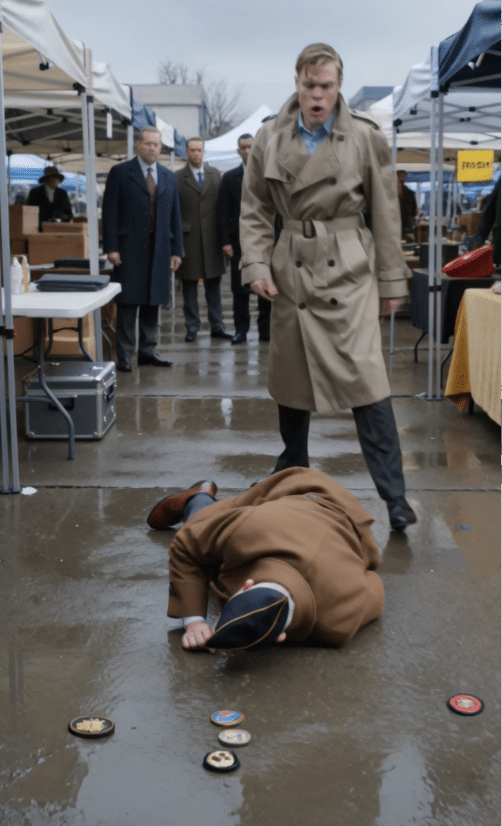
The words struck harder than the rain as eighty-year-old Arthur Mitchell lay crumpled against a flea market stall, staring at the military badges scattered in the mud.
“Please,” he whispered, reaching for one of them. “Those are mine.”
The man standing over him wore an expensive trench coat, polished leather shoes, and the effortless arrogance of someone who had never worried about the price of his next meal. A luxury watch gleamed beneath his sleeve as he looked down at Arthur with open disgust.
Arthur wore a faded brown coat and an old veteran cap pulled low over his forehead. His prosthetic leg had begun to ache in the cold, and the damp weather made every movement slower. On the narrow table beside him lay a few old military badges, arranged on a piece of worn cloth that had once belonged to his late wife.
They were all he had left to sell.
He had spent the morning hoping to earn enough money to refill his prescriptions. The pharmacy had given him until the end of the day to settle the remaining balance, and his pension would not arrive for several more days. He had counted his coins twice before coming to the market, then decided he could no longer afford to keep pretending the problem would solve itself.
The man in the trench coat had arrived shortly before closing.
He examined the badges, offered Arthur a handful of bills, and demanded that he accept the price immediately. Arthur refused. The offer was insulting, barely enough to cover a fraction of what the badges were worth, and he knew it.
“I can’t sell them for that,” Arthur said.
The buyer’s expression hardened.
“You’re an old man selling rusty junk in the rain. What makes you think you get to negotiate?”
Arthur lowered his eyes, but he did not change his answer.
The man picked up one of the badges and held it between two fingers.
“Look at this. Tarnished. Scratched. Nobody wants something like this.”
“I earned those before I lost my leg,” Arthur replied.
For a moment, the man’s expression sharpened with amusement. He looked at Arthur’s prosthetic leg, then back at the badge.
“Then you should’ve learned when to let things go.”
He threw the badge into the mud.
It landed beside the stall with a wet slap.
Arthur immediately bent to retrieve it, bracing one hand against the table as he shifted his weight. His prosthetic leg made the movement awkward, but he kept his eyes fixed on the badge. He could not bear to leave it in the mud, not even for a moment.
Before his fingers reached it, the man kicked him hard in the back.
Arthur pitched forward against the stall, sending the remaining badges flying from the table. Metal clattered across the wet walkway. His prosthetic leg struck the ground, and his forearm scraped against the rough edge of the stall, leaving a thin trace of blood.
A vendor gasped.
A woman near the neighboring table covered her mouth. Several people froze beneath the market awnings, watching as Arthur struggled to breathe and tried to gather his scattered belongings.
The man stepped closer.
Two more forceful kicks landed against Arthur’s back and side.
Arthur curled inward, his face tightening with pain. He tried to shield the badges with one arm, even as his body trembled from the impacts. The rain soaked his coat, and mud smeared across the sleeve he had carefully brushed clean that morning.
“I earned those before I lost my leg,” he repeated, his voice breaking.
The man looked down at him.
“Sell your pride cheaper.”
Arthur’s hand closed around one badge.
He had once carried wounded men through smoke and debris. He had once believed that a person’s worst moment was precisely when others were supposed to help. Now he lay beside a flea market stall, unable to stand, while strangers watched him struggle to protect the last physical reminders of a life he had given everything to live.
Then a voice rang out from the end of the market.
“Move away from him.”
A tall man in a long black coat was striding through the rain, followed by an assistant carrying a hard-sided protective case. His silver hair was slicked back, and his expression was so controlled that even the vendors seemed to fall silent.
He reached Arthur first.
Without looking at the attacker, he crouched beside the old veteran and asked whether he could hear him. His assistant immediately moved to shield the scattered badges from the mud while the newcomer signaled for someone to call emergency services.
Only after Arthur was protected did the man stand.
He looked directly at the bully.
“Do not touch those badges again.”
The buyer scoffed, though his eyes flickered toward the protective case.
“Those badges?”
He had no idea what lay in the mud.
And he had no idea who had just arrived to recover them.
Act II
The newcomer was not merely another collector with money to spend.
His name was Charles Whitmore, and among military historians, auction houses, and private museums, it carried extraordinary weight. For more than thirty years, he had assembled one of the most respected private collections of American military history in the country. He had purchased letters from fallen soldiers, restored damaged unit records, and helped families recover artifacts that had disappeared into private collections after the deaths of veterans.
He had also become famous for refusing to buy an object when he suspected its owner did not understand what they possessed.
Charles believed that history was not valuable simply because something was old. It was valuable because people had lived through it.
That belief was why he had come to the flea market in the first place.
A small dealer had contacted his office about several military badges that appeared to match a collection Charles had been researching for years. The photographs were poor, and the seller had provided almost no provenance. Charles had decided to inspect the objects himself before making an offer.
He had expected a routine appointment.
Instead, he found an elderly veteran lying in the mud while a wealthy stranger mocked his service.
Charles’s assistant, Naomi Price, knelt near the stall and carefully gathered the badges that had not been submerged. She wore gloves and carried archival sleeves inside the protective case. Every movement was deliberate, not because the objects were more important than Arthur, but because they deserved to be preserved until their owner could decide what happened next.
Arthur watched her with visible distress.
“Please,” he said. “Don’t let anyone take them.”
Naomi looked up.
“They’re staying with you, sir. We’re only keeping them safe.”
The words seemed to reach him slowly.
Charles turned toward a nearby vendor.
“Call for medical assistance. Tell them an elderly man has been assaulted and has an existing mobility impairment.”
Then he addressed the security staff who had arrived from the market entrance.
“Keep that man away from Mr. Mitchell. Preserve any available camera footage, and make sure the witnesses have an opportunity to give statements.”
The bully laughed sharply.
“You’re acting like I robbed a museum.”
Charles looked at him.
“No. I’m acting like you assaulted a man.”
“He was trying to rip me off.”
Arthur stared at the ground.
“I told you the price wasn’t enough,” he said quietly. “That’s all.”
“And then you made a scene,” the bully snapped.
Charles stepped between them.
“You threw his property into the mud. You kicked him while he was bent over trying to retrieve it. And you kicked him again after he fell.”
The man’s face tightened.
“You saw nothing before you arrived.”
“Correct,” Charles replied. “That’s why the witnesses and any available recordings will matter.”
The answer was not the dramatic threat the bully had expected. Charles did not claim to know every detail, and he did not promise a punishment before the facts had been established. He simply made it clear that the assault would not be dismissed because the victim was old, poor, or inconvenient.
The bully looked toward the surrounding stalls.
“This is a flea market. People bargain. People argue. If he can’t handle that, he shouldn’t be here.”
An older vendor finally spoke.
“He didn’t argue with you. He said no.”
The bully glared at him.
Another vendor stepped forward, keeping a respectful distance from Arthur.
“I saw you throw the badge. Then I saw you kick him.”
The crowd that had frozen in silence was beginning to find its voice.
Not everyone spoke. Some witnesses still looked frightened, and a few hurriedly closed their stalls. But the bully could no longer pretend that nobody had seen what he had done.
Charles turned back to Arthur.
“Mr. Mitchell, do you have someone we can contact for you?”
Arthur hesitated.
“No one who needs to be bothered.”
“That’s not what I asked.”
The old veteran looked down at his muddy hands.
“I have a daughter. We haven’t spoken much lately.”
Charles waited, giving him room to continue.
“Her name is Laura. She’s got her own family. I don’t want to drag her into this.”
Naomi’s expression softened.
“You’ve been hurt, sir. Letting someone know doesn’t make you a burden.”
Arthur attempted a small smile, but it quickly faded.
He had spent years trying to protect his daughter from the consequences of his decline. He had told her he was managing. He had assured her that his medication was covered and his housing was stable, even when neither statement was entirely true.
He could not bear the thought of her discovering how desperate things had become.
Charles glanced toward the badges arranged inside the protective case.
One of them bore a distinctive insignia. Another had an engraving along its reverse side, partially obscured by corrosion. He had seen a similar combination only once, in a collection of photographs preserved by a military archive.
He crouched beside the table.
“Mr. Mitchell, may I ask where these came from?”
Arthur looked at the badges.
“They were mine. Some belonged to men in my unit. Their families gave them to me over the years, or asked me to keep them when they couldn’t bear to look at them anymore.”
Charles’s eyes narrowed with interest.
“Were you assigned to the 17th Field Evacuation Company?”
Arthur looked up sharply.
“How do you know that?”
Charles did not answer immediately.
He turned one of the badges gently, examining the worn marking beneath the clasp. Then he looked at Arthur’s face, searching for a confirmation he was almost afraid to ask for.
“Because I’ve spent twelve years trying to identify the men who served with that company during the winter evacuation at Bellford Ridge.”
Arthur stopped breathing for a moment.
The name had not been spoken in his presence for decades.
And suddenly, the man with the protective case seemed less interested in purchasing the badges than in discovering how they had survived.
Act III
Bellford Ridge was a name that rarely appeared in popular histories of the war.
There had been no famous general’s speech, no widely circulated photograph of a flag being raised, and no triumphant parade afterward. The operation had taken place during a brutal winter campaign, when roads were damaged, communications unreliable, and wounded soldiers often had to be carried across terrain that vehicles could not reach.
Arthur Mitchell had been twenty-seven.
He was a field evacuation specialist, responsible for getting injured men away from danger and into the hands of medical teams. His work rarely appeared in official reports beyond a few lines noting that casualties had been transferred. The names of the people who carried them were often forgotten as soon as the next crisis began.
Arthur never considered that unfair.
He had not joined the military to become famous. He had joined because he believed that when someone was hurt, the people around them had a responsibility to act.
During the Bellford Ridge operation, that belief was tested repeatedly.
A convoy carrying wounded soldiers became stranded after a bridge was damaged. Enemy fire forced the medical teams to withdraw from their initial position, leaving several men trapped beyond a stretch of exposed ground. Arthur volunteered to help retrieve them.
He made multiple trips with a small evacuation team, carrying stretchers and supporting soldiers who could barely stand. During one return journey, an explosion struck near the route. Arthur was thrown against broken equipment, badly injuring his leg.
The damage was severe enough that doctors eventually had to amputate below the knee.
He remembered waking in a hospital and asking whether the men had made it out.
The nurse had told him that the last of them had been evacuated.
Arthur had closed his eyes and thanked God.
The badges came later.
Some were official service decorations. Others were unit insignia, small pieces of metal that would never command high prices in an auction catalog. But over the years, several surviving members of the evacuation company had entrusted Arthur with objects belonging to friends who had died.
One soldier’s mother sent him her son’s badge with a handwritten letter. Another veteran asked Arthur to keep his insignia after his memory began to fail. A third had given him a badge shortly before entering hospice, saying he wanted it to remain with someone who remembered what the unit had done.
Arthur kept them together.
He did not display them in a glass cabinet. He stored them in a small wooden box at home, wrapped in cloth and protected from moisture. When his wife, Helen, was alive, she sometimes sat with him while he cleaned the badges. She never pushed him to explain every memory attached to them.
She understood that he was keeping more than metal.
After Helen died, Arthur began to lose his grip on the life they had built. Medical expenses mounted, and the limitations imposed by his injury made it difficult to find reliable work. A small pension covered the essentials until unexpected costs forced him to choose between household bills and medication.
He tried to sell a few belongings.
Then he sold his tools.
Finally, he began taking some of the badges to local markets, telling himself that he could part with the less important ones and preserve the rest.
But he could never quite decide which were less important.
Every object had a story. Every story belonged to someone who had trusted him to remember.
The badge the bully had thrown into the mud had belonged to Sergeant Daniel Price, a medic who had helped carry wounded men from Bellford Ridge. Daniel had died years after the war, but before his death he had written Arthur a letter asking him to keep the insignia until Daniel’s grandson was old enough to understand its meaning.
Arthur had never found the grandson.
He had kept the badge anyway.
Now, as Charles Whitmore examined the engraving, Arthur realized that the collector might know more about the history of those men than he did.
“Where did you find the records?” Arthur asked.
Charles opened his case and removed a folder sealed inside a protective sleeve.
“For years, the evacuation company appeared in the archive under an incorrect designation. Some of the paperwork was damaged, and several names were transcribed incorrectly. I began looking for the original roster after I acquired a set of letters from a retired military clerk.”
He showed Arthur a photocopy of a handwritten list.
Arthur leaned forward.
There, in faded ink, were the names of men he had not heard mentioned in decades.
Daniel Price.
Thomas Ellery.
Robert Hayes.
And beside several names, short notations recording injuries, transfers, or deaths.
Arthur’s fingers trembled.
“I remember all of them.”
Charles nodded.
“I thought you might.”
The collector explained that he had been working with a military archive and several families to reconstruct the company’s history. He was not interested in proving that the badges were rare simply to drive up their market value. He wanted to establish their origins, preserve the surviving records, and return personal artifacts to families when possible.
One of the badges in Arthur’s collection matched an insignia mentioned in a missing inventory. Another appeared to correspond to a decoration awarded to a medic whose name had been omitted from the final published record.
Charles looked directly at Arthur.
“Your collection may help us correct a historical record that has been wrong for decades.”
Arthur stared at the folder.
For most of his life, he had believed the men he remembered belonged to a chapter that the world had already closed. Their families had moved on. Their children had grown older. The war had become a subject in textbooks and documentaries, while the people who had carried its burdens quietly disappeared into ordinary life.
He had never imagined that the small objects in his wooden box might help restore their names to history.
Then he remembered the medicine waiting at the pharmacy.
The reality of his situation returned with painful clarity.
“It’s good that they might matter,” he said. “But I still need to sell some of them.”
Charles closed the folder.
He did not tell Arthur to forget about the money. He did not offer empty praise about sacrifice, as though gratitude could pay for prescriptions.
Instead, he asked a practical question.
“How much do you need for your medicine and immediate expenses?”
Arthur looked embarrassed.
“It’s not your responsibility.”
“No,” Charles said. “But I’m asking because I want to understand what would help.”
Arthur finally named the amount.
Charles listened without interruption.
Then he turned toward Naomi.
“Let’s have the badges evaluated properly, and let’s make sure Mr. Mitchell has access to the money he needs without being pressured to sell anything tonight.”
Arthur looked startled.
“You haven’t even told me what they’re worth.”
“That’s precisely why we’re going to have them evaluated.”
Across the stall, the bully let out an incredulous laugh.
“You’re going to pay him because he got kicked?”
Charles turned toward him.
“No. I’m going to ensure that an elderly veteran is not forced to accept an insulting offer because he needs medicine. The assault is a separate matter.”
The distinction was important.
Charles was not rewarding Arthur for being hurt. He was refusing to let the injury become another opportunity for someone to take advantage of him.
And the first official valuation would reveal that the bully had made a far more expensive mistake than he could possibly imagine.
Act IV
By the time the rain began to ease, most of the market had gone quiet.
The closing vendors had pulled tarps over their tables, stacked crates beneath awnings, and started packing away the day’s unsold goods. Yet a small crowd remained around Arthur’s stall, drawn by the unusual sight of a famous collector protecting a collection that had just been scattered in the mud.
Naomi had placed the recovered badges inside individual archival sleeves. The pieces that had been exposed to mud were kept separate so they could be cleaned and examined without causing further damage. Nothing was polished or altered before its condition could be documented.
Charles explained that the first step was to establish authenticity, provenance, and condition. Some badges might have modest market values. Others could have historical significance beyond what their appearance suggested.
He made no extravagant promises.
But he did not hide his excitement when the examination confirmed that several pieces corresponded to the records he had been researching.
One badge, in particular, carried a rare unit marking associated with the evacuation company at Bellford Ridge. Its reverse engraving matched a name in the archival roster, and the accompanying documentation Arthur had preserved provided a link that had been missing from the historical record.
The collector’s assistant looked up from her notes.
“This could be the missing piece.”
Charles studied the badge for another moment.
“Yes,” he said. “It could.”
Arthur watched them, still seated because of his injured back. His forearm had been cleaned and bandaged, and a vendor had brought him a dry blanket. He kept asking whether the badges were safe, as though the rain might somehow reach through the case and take them away.
Naomi reassured him each time.
The bully, meanwhile, had refused to leave the area while security personnel gathered information about the assault. He had spent the last several minutes making calls, complaining that he was being treated unfairly and insisting that Charles was exaggerating the value of the collection.
When he learned that the badges were being evaluated by a specialist, he approached again.
“Let’s be realistic,” he said. “These things are old. They have sentimental value, perhaps. But nobody is going to pay a fortune for rusty military junk.”
Charles looked at him calmly.
“You offered Mr. Mitchell a price without establishing what the objects were.”
“I know what I saw.”
“You saw a man who needed money and assumed that made him easy to exploit.”
The bully’s face reddened.
“I made an offer. He refused. That should have been the end of it.”
“It could have been.”
Charles paused.
“You chose to throw his property into the mud. You chose to assault him. You chose to keep attacking him after he fell.”
The bully looked around for someone who might support him.
No one did.
A vendor who had witnessed the attack gave a statement to the security team. Another offered to provide a copy of the footage from a camera overlooking the walkway. The market manager confirmed that the incident would be documented and that the relevant recordings would be preserved for the authorities.
The bully’s confidence began to unravel.
He turned back toward Charles.
“You’re making a spectacle out of this because you’re famous. You want everyone to think you’re some kind of hero.”
Charles’s expression hardened.
“No. I came here to examine historical objects. I found a man being attacked, and I stopped to make sure he was safe.”
“Convenient.”
“What would have been convenient,” Charles replied, “is if you had walked away when he refused your offer.”
For once, the bully had no quick answer.
Charles then explained what the preliminary assessment suggested. The badges would need further examination before a final valuation could be established, and the archival connection required confirmation. If the findings held, however, the collection could be of considerable importance to a museum or research institution.
That did not mean every piece would sell for an extraordinary sum.
It meant that the objects deserved careful treatment, transparent valuation, and a decision made by their owner without intimidation.
Charles offered to arrange an independent appraisal at no cost to Arthur. If Arthur chose to sell any pieces, the transaction would be documented and conducted through a reputable institution. If he preferred to keep them together, Charles would help him explore options for preserving the collection while still addressing his immediate needs.
Arthur listened in silence.
For the first time that day, he could imagine a future in which he did not have to choose between medicine and memory.
He could get his prescriptions filled without selling every badge. He could learn what the objects were worth before making a decision. He could even discover the family of Daniel Price’s grandson and fulfill the promise he had carried for years.
The thought brought tears to his eyes.
“I never wanted to make money from what happened to those men,” he said.
Charles nodded.
“Then we won’t treat their service as merchandise. We’ll treat the objects honestly and respect your right to decide what happens to them.”
The words reached Arthur more deeply than praise would have.
He had been afraid that accepting money meant betraying the people whose memories he carried. Charles helped him understand that keeping himself alive and healthy was not a betrayal of the dead.
The badges could preserve history.
But Arthur was still part of that history, and his life mattered too.
A market security officer approached Charles to confirm that the incident report was complete. The bully would be dealt with through the appropriate process, based on the evidence and applicable rules. No one promised a particular legal outcome, but the witnesses and recordings would make it difficult for the attack to be dismissed as a simple disagreement over price.
Charles turned toward the man one final time.
“You saw an old veteran who needed money,” he said. “You decided that meant his memories had no value and his dignity had no price.”
The bully’s jaw tightened.
“You think a few badges make him important?”
Charles glanced toward Arthur, who was holding the photograph of his late wife while Naomi explained the next steps.
“No,” he said. “He was important before you arrived.”
The bully looked away.
But the most powerful revelation of the night was still waiting inside the collector’s folder.
Because the rare badge was not simply valuable.
It was connected to a name that had been missing from the official record for more than half a century—and Arthur Mitchell was the only surviving person who could explain why.
Act V
The final appraisal took several weeks.
Charles Whitmore’s team worked with military historians and archival specialists to verify the badges, compare their markings with surviving records, and determine which pieces could be connected to individual soldiers. The process was careful and sometimes frustrating. Some documents had been lost. Other names appeared under inconsistent spellings. Several objects required additional research before their origins could be confirmed.
But one discovery changed everything.
The badge that had been thrown into the mud belonged to Sergeant Daniel Price, the medic whose evacuation work had been mentioned in an incomplete wartime report. The report credited an unnamed member of the company with repeatedly returning to a dangerous route to recover wounded soldiers.
Arthur had been that man.
He remembered the day clearly.
Daniel had been among the first people to reach Arthur after his leg was injured. He had helped secure the evacuation team, checked the wounded, and refused to leave until the last stretcher had been moved. Years later, Daniel had given Arthur his badge and asked him to keep it with the others.
The archival record had never connected those two facts.
Now it could.
Arthur’s testimony, the badge’s engraving, and the surviving documentation allowed the historians to reconstruct a missing portion of the company’s history. The account would not turn the men into legends or pretend that one person had carried the entire burden. It would simply restore names and actions that had been left out.
For Charles, that was the real value of the collection.
He offered to purchase several pieces at independently appraised prices, with the agreement documented and the funds paid directly to Arthur. Other badges would remain with Arthur while the team worked to identify the families to whom they belonged. The rare insignia connected to Daniel Price would be loaned for a temporary museum exhibition, with Arthur’s permission and clear terms governing its care and return.
Arthur accepted the offer for a portion of the collection.
The payment covered his overdue prescriptions, his immediate living expenses, and a reserve that gave him breathing room for the first time in months. A veterans’ support organization also helped him review his benefits and connect with services he had been too embarrassed to ask about.
Charles did not pretend that the money solved everything.
Arthur still had medical appointments. He still needed assistance with some daily tasks, and the grief of losing Helen had not vanished. But he no longer had to stand in the rain, hoping that a stranger would pay enough for a piece of his past to keep him supplied with medicine.
He could make decisions without desperation making them for him.
A few weeks after the flea market incident, Charles invited Arthur to visit his research office. Inside were shelves of military histories, archival boxes, and carefully labeled cases containing objects from many different eras. Arthur moved slowly through the room, leaning on his crutches, stopping when he recognized a unit insignia in a display.
Charles showed him the draft of the historical report.
Arthur’s name appeared beside the account of the evacuation at Bellford Ridge. So did the names of the men who had worked with him. Daniel Price was listed not merely as a casualty or a medic, but as a person whose actions had helped save lives.
Arthur read the page twice.
“I never thought anyone would write it down,” he said.
Charles stood beside him.
“Someone should have done it years ago.”
Arthur touched the edge of the paper with one finger.
“I wasn’t trying to be remembered.”
“I know,” Charles said. “That’s why the record should be accurate.”
The museum exhibition opened later that year.
It was not an extravagant ceremony. There were no military parades or grand speeches. Veterans, families, historians, and a handful of local visitors moved quietly through the gallery, reading the restored accounts and looking at the objects preserved behind glass.
Arthur attended wearing his brown coat, freshly cleaned, and his veteran cap.
The badge that had landed in the mud was displayed in a protective case beside a photograph of Daniel Price. A small panel explained how the artifact had helped researchers connect the incomplete record to the men who served with the evacuation company.
Arthur stood before it for a long time.
Then a young man approached him.
He introduced himself as Michael Price, Daniel’s grandson. He had been searching for information about his grandfather for years, but family stories had offered only fragments. He knew Daniel had served overseas. He knew he had been a medic. He had never known about the evacuation company or the men whose lives Daniel had helped save.
Arthur took Michael’s hand.
“I knew your grandfather,” he said.
Michael’s eyes filled with tears.
“Tell me about him.”
So Arthur did.
He spoke about Daniel’s dry humor, his steady hands, and the way he could calm frightened men simply by talking to them as if they were already going to survive. He described the night Daniel helped evacuate the wounded and the years afterward, when the men tried to build ordinary lives around memories that did not always leave them in peace.
Michael listened to every word.
When Arthur finished, the younger man thanked him.
“You kept him alive for us,” Michael said.
Arthur shook his head.
“No. Your grandfather did that himself. I just kept a promise.”
Across the gallery, Charles watched them quietly.
He thought about the flea market and the man who had thrown a badge into the mud because he believed rust erased value. He thought about the way Arthur had reached for the object even while he was hurt, protecting a memory that no stranger had the right to dismiss.
The bully had seen an old man with a prosthetic leg and a few tarnished badges.
He had assumed poverty meant weakness, age meant irrelevance, and desperation meant permission to humiliate someone.
But the truth was never contained in the shine of the metal.
It lived in the hands that had carried wounded soldiers, in the families who had entrusted Arthur with their memories, and in the quiet promise he had kept long after the world stopped asking about the war.
The man who had attacked him faced the consequences of the incident through the appropriate channels. The witness statements and available footage were preserved, and the market’s management reviewed how it responded to violent behavior on its grounds.
There was no magical punishment that repaired the harm in an instant.
There was something more lasting: a record of what happened, a community that could no longer claim it had seen nothing, and an elderly veteran whose dignity was no longer left at the mercy of a stranger’s opinion.
Arthur continued to wear his old veteran cap.
He kept some badges in a small display at home, each one labeled with the name of the person who had entrusted it to him. The others were preserved through the museum project or returned to families when their origins could be established.
And every month, when he went to collect his medication, he no longer counted his coins with the same fear.
One rainy afternoon, he visited the museum again. The gallery was quiet, and water tapped against the windows. He stood before Daniel Price’s badge and remembered the moment it had struck the mud.
For a few terrible seconds, he had believed that everything those men had done could be reduced to something worthless in the eyes of the world.
He understood now that the badge had never been the whole story.
It was only a reminder.
A reminder that a person could lose a leg, a home, a partner, and years of comfort without losing the meaning of what they had done. A reminder that needing medicine did not make him weak, and accepting help did not diminish his service.
Arthur placed his hand lightly against the glass.
“I kept it safe, Daniel,” he whispered.
Outside, the rain continued to fall.
But this time, Arthur was warm. His medicine was paid for. His story had been recorded, and the names of his friends had been restored to the history they helped make.
The bully had looked at those badges and seen rust.
Charles Whitmore had looked at them and seen evidence.
Arthur had looked at them and seen the men who never came home.
And in the end, that was the truth no insulting offer, no expensive coat, and no cruel kick could ever change.
The badges had value because of the lives behind them. But Arthur Mitchell had value long before anyone discovered what they were worth.