Act I
The coat hit the dirty water before fourteen-year-old Emily Brooks could stop it.
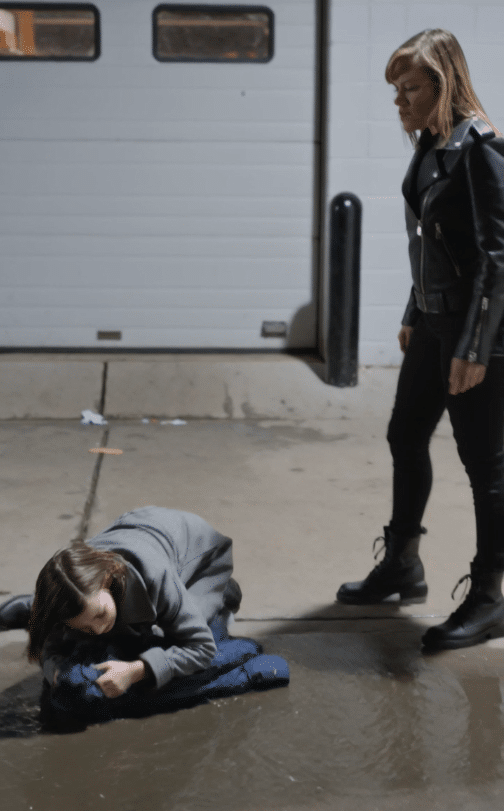
One second, she was clutching the faded blue children’s coat against her chest. The next, a young woman in a black leather jacket ripped it from her hands and flung it into a puddle behind the supermarket.
The coat landed beside a recycling bin, soaking up rainwater and grime. A gust of wind swept a paper receipt across the wet concrete, and somewhere behind Emily, a group of young people burst into laughter.
Emily stared at the coat.
“No,” she whispered.
She dropped her recycling bag and hurried toward it, her thin gray coat doing almost nothing to protect her from the freezing night air. The blue coat was too small for her, with a missing button and a patch sewn crookedly over one elbow. But to Emily, it was more precious than anything else she owned.
It was for her little sister.
She bent down and reached into the dirty water.
That’s when the woman kicked her hard in the back.
Emily fell face-first onto the wet concrete, her hands striking the ground as the impact knocked the breath from her lungs. Her recycling bag burst open beside her, sending plastic bottles rolling beneath the bins and across the service alley.
For a moment, she could only gasp.
Her forearm scraped against the rough pavement, leaving a thin trace of blood. She tried to push herself up, but pain forced her to curl onto her side.
The woman stepped closer.
She was twenty-three, dressed in a black leather jacket, fitted jeans, and expensive boots that seemed absurdly out of place beside the overflowing recycling bins. Her friends stood behind her, watching with the eager expressions of people who had mistaken cruelty for entertainment.
Emily reached for the blue coat.
The woman kicked her again, then delivered another forceful kick into her side.
Emily curled inward, shielding the coat with one arm while struggling to catch her breath.
“Please,” she managed.
The woman looked down at her.
“What’s wrong? You don’t like playing in the trash?”
Emily shook her head, tears mixing with the rain on her cheeks.
“It’s for my little sister.”
For a fraction of a second, one of the young men behind the woman stopped smiling.
But the woman only laughed harder.
“Trash. That coat belongs in the trash.”
Emily pulled the wet fabric against her chest.
Her little sister, Sophie, was six years old. She had spent the previous night shivering beneath two thin blankets because the heating in their apartment had stopped working. Emily had promised that she would find something warm for her before the next cold spell arrived.
A local charity had donated the coat that afternoon.
It wasn’t new. It wasn’t fashionable. But it was warm, and it was the first thing Emily had held in weeks that made her believe she might actually keep her promise.
The woman knew none of that.
She saw a poor teenager collecting bottles behind a supermarket and decided that humiliating her would make the evening more amusing.
“Let her freeze prettier,” she announced.
Her friends laughed again.
Nearby, a delivery worker froze beside a loading trolley. Two employees stood near the warehouse door, exchanging alarmed glances. An older woman waiting for a ride covered her mouth, horrified by what she had just witnessed.
Still, nobody touched Emily.
The girl struggled to her knees, wincing as she pulled the coat from the puddle. Muddy water streamed from its sleeves.
She tried to wipe it clean with the edge of her own coat.
The woman watched her with open contempt.
Then a heavy warehouse door slammed open behind them.
The laughter died instantly.
A tall man in a long black coat stepped into the alley, accompanied by two security guards. Wind whipped loose papers around his legs as he surveyed the scene: the scattered bottles, the soaked children’s coat, the injured girl on the ground, and the young woman standing over her.
His eyes settled on Emily first.
He crossed the alley without saying a word, removed his own coat, and draped it around her shoulders.
Then he turned to the guards.
“Lock the back gate.”
The guards immediately moved toward the exit.
The young woman’s smile disappeared.
Because the man standing in front of her was not another employee she could intimidate.
He was the director of the entire supermarket.
And he had just ordered the only exit from the service alley secured.
Act II
Emily Brooks had never expected anyone to notice her.
At fourteen, she had already learned how to move through the world without attracting attention. She kept her eyes down in crowded places, spoke softly to adults, and apologized even when someone else bumped into her.
She had discovered that people were often kinder when they believed you wouldn’t ask them for anything.
Her mother, Rachel, had worked as a cleaner until an illness forced her to stop. After her death the previous winter, Emily and Sophie had moved between temporary arrangements with relatives before finally settling into a small apartment on the outskirts of town.
Their aunt had initially promised to help them.
But money was tight, and the arrangement deteriorated. Eventually, Emily found herself managing most of the household responsibilities while trying to keep Sophie in school and their lives from unraveling.
There were days when she hated how much she had to think about things other children never noticed.
The price of bread.
The cost of electricity.
Whether the water would stay warm long enough for Sophie to take a bath.
Whether a neighbor might lend them an extra blanket.
And, whenever the weather turned cold, whether she could find another coat before her little sister began shivering again.
Emily had started collecting recyclable bottles because a nearby recycling center paid by weight. It wasn’t much, but a little money could make a difference when every dollar had already been promised to something else.
She usually went out after school and worked until the center closed.
The supermarket had become one of her regular stops because employees occasionally left cardboard and plastic in a designated collection area. Emily never entered restricted areas, never took anything from customers, and never caused trouble.
She simply gathered what had been discarded.
Some employees knew her by sight. A few offered her leftover fruit or a sandwich when they could. Others ignored her entirely.
Emily never blamed them.
She knew everyone had their own worries.
That afternoon, a volunteer from a neighborhood charity had given her the blue coat. It had belonged to a child who had outgrown it, and the volunteer had apologized because one button was missing.
Emily had thanked her three times.
Then she had held the coat against her chest all the way home.
Sophie was going to love it.
That was the thought that kept Emily moving through the cold. She imagined her sister’s face when she saw the warm lining, the soft collar, and the little pockets on the front.
Sophie would probably insist on wearing it indoors.
She might even ask to sleep in it.
Emily could already hear her laughing.
But when she reached home that evening, Sophie was still shivering beneath the blankets. The apartment’s heating had failed again, and the maintenance request Emily had submitted two days earlier had received no response.
Emily had looked at the little girl and made another promise.
“I’ll fix it, Soph. I promise.”
Then she had gone back out to collect bottles, carrying the blue coat in a plastic bag to keep it dry.
She never imagined that someone would deliberately destroy it for fun.
Now she sat on the wet concrete behind the supermarket, trembling beneath the director’s heavy coat.
The director crouched a short distance away, careful not to crowd her.
“My name is Daniel Mercer,” he said. “I’m the store director. Can you tell me if you’re badly hurt?”
Emily shook her head automatically.
“I’m okay.”
Daniel glanced at the way she was holding her side.
“You don’t have to say you’re okay just because someone asks.”
That made her eyes fill with tears again.
She looked down at the blue coat, still stained with dirty water.
“Can I take it home?”
Daniel followed her gaze.
“Of course.”
“Even if it’s dirty?”
“It’s yours.”
Emily pressed her lips together, trying desperately not to cry.
The words seemed too simple to be true.
Around them, the security guards had positioned themselves near the back gate. They had not touched the young woman or her friends, but they were preventing anyone from casually leaving before the incident could be properly addressed.
Daniel stood.
He turned toward the woman in the leather jacket.
“What’s your name?”
“Madison,” she replied sharply.
“Madison what?”
“Madison Reed. Why?”
“Because I want your full account of what happened.”
Madison gave a short laugh.
“You can’t be serious. She was digging through our trash.”
“She was collecting recyclables in the designated area.”
“Whatever. She was making a mess.”
Daniel glanced at the scattered bottles.
“Those bottles came out of her bag after you knocked her down.”
Madison’s jaw tightened.
Her friends had begun moving away from her, creating just enough distance to suggest they had never been involved.
Daniel noticed.
So did Madison.
“Don’t look at me like I’m some criminal,” she snapped. “It was a joke.”
Daniel looked at Emily’s trembling hands.
“Which part was supposed to be funny? Throwing away a child’s coat? Kicking a girl who was trying to retrieve it? Or laughing when she told you it was for her little sister?”
Madison’s expression hardened.
“She was being dramatic.”
Daniel said nothing.
He had spent more than twenty years working in retail. He had dealt with angry customers, shoplifters, dishonest contractors, and employees who believed a uniform gave them permission to mistreat people.
He had learned that the most revealing moment often came after someone was confronted with the harm they had caused.
Some people showed remorse.
Others searched for a more convenient victim.
Madison was searching for one now.
“You’re making this into something it isn’t,” she said. “You should be thanking us for giving you something to do.”
Daniel’s face went still.
He turned to the security supervisor.
“Preserve the camera footage. Get statements from every witness, and call the police. I want the incident documented properly.”
Madison stopped smiling.
She had expected a lecture.
She had expected the director to ask everyone to calm down and move on.
She had not expected the police to be called.
And she had no idea that the security footage would reveal something far more damaging than the assault itself.
Act III
Madison Reed had grown up believing that consequences were things that happened to other people.
Her parents were successful business owners, and she had spent much of her life surrounded by people who knew how to make problems disappear. If she missed a deadline, someone could negotiate an extension. If she argued with a teacher, her parents could arrange a meeting.
If she embarrassed herself in public, a carefully worded apology could usually make the story go away.
Over time, Madison had confused being protected with being right.
Her friends knew it, too.
They had watched her insult waiters, mock strangers, and turn ordinary inconveniences into personal attacks. Most of them laughed along because challenging her meant becoming the next target.
Tonight had started as another outing with no particular purpose.
Madison had suggested stopping behind the supermarket because she wanted to smoke away from the crowded entrance. When she saw Emily sorting bottles near the recycling bins, she made a joke about the girl’s old clothes.
Emily ignored her.
That should have been the end of it.
Instead, Madison noticed the plastic bag containing the blue coat.
She asked what was inside.
Emily tried to explain that it was for her little sister.
Madison laughed and demanded to see it.
When Emily refused to hand it over, Madison snatched the coat and threw it into the puddle.
The rest followed because Madison expected the world to reward her cruelty with laughter.
Now, standing beside the locked back gate, she realized that the director was not interested in her version of the story.
He was interested in the evidence.
A security supervisor returned from the warehouse office with a tablet. The cameras had recorded the incident from two angles, including the moment Madison seized the coat and deliberately threw it into the dirty water.
The footage also showed the assault.
Daniel watched only long enough to confirm that the sequence was clear.
Then he turned the screen away from Emily.
She had already experienced enough humiliation. There was no reason to make her relive it in front of a crowd.
“Save a copy,” he instructed. “Make sure it cannot be overwritten.”
The supervisor nodded.
Madison’s friends began speaking over one another.
“We didn’t touch her.”
“We thought Madison was just messing around.”
“She was the one who kicked her.”
Madison spun toward them.
“Are you kidding me? You were all laughing!”
Nobody answered.
The group that had seemed so powerful a few minutes earlier was beginning to collapse under the pressure of a simple question: who had actually done what?
Daniel asked the guards to keep everyone separated while they collected statements.
Then he returned to Emily.
“Is there someone we can call for you?”
Emily hesitated.
“My sister is home.”
“How old is she?”
“Six.”
“Is she alone?”
Emily’s face changed.
She had left Sophie with a trusted neighbor for the short time she expected to be out. But the neighbor had an early shift the next morning and could not watch her indefinitely.
“I need to get home,” Emily whispered. “She’ll be waiting.”
Daniel nodded to his assistant, who had come out through the warehouse door.
“Please contact the appropriate family-support service. We need to make sure her sister is safe, and we need medical assistance for Emily.”
Madison scoffed.
“Are you seriously calling social services over a jacket?”
Daniel turned toward her.
“No. I’m arranging help for an injured child and her six-year-old sister. The police are being contacted about the assault.”
For the first time, Madison appeared genuinely frightened.
Then Daniel’s assistant returned with a phone call that changed the direction of the evening.
The supermarket’s regional office had been notified about the incident. It had also asked Daniel whether the woman involved was connected to the store’s pending community-partnership event.
Madison stiffened.
“What does that have to do with anything?”
Daniel looked at her.
“Are you involved with the Winter Neighbors campaign?”
Madison hesitated.
Her family had recently donated money to the campaign, a local initiative that collected coats, blankets, and essential supplies for families struggling during the winter. Madison had attended a promotional dinner the previous month and had been photographed beside a display of donated children’s clothing.
She had even posted a picture online, praising the campaign for “giving every child the warmth and dignity they deserve.”
Daniel had seen the photograph earlier that week.
He remembered because the campaign was important to him.
His own mother had struggled to afford winter clothing for her children when he was young. Years later, after becoming a store director, Daniel had helped build the supermarket’s donation program into a partnership with local charities.
He knew how much work went into collecting, cleaning, sorting, and distributing donated clothing.
He also knew that the campaign had strict rules about treating recipients with respect.
Madison looked from Daniel to the blue coat in Emily’s hands.
“So what?” she demanded. “My parents donated to some charity. That doesn’t mean I did anything wrong.”
“No,” Daniel replied. “The footage will establish what you did.”
He turned to his assistant.
“Notify the campaign coordinator. Suspend any promotional appearance connected to this incident until the facts have been reviewed. Make it clear that donations will continue to support families, regardless of what happens to an individual sponsor.”
That distinction mattered.
Daniel would not allow vulnerable families to lose help because one person had behaved cruelly. The campaign existed for the children who needed it, not for the people who wanted their names printed beside a donation.
Madison’s face flushed.
“You can’t cancel my family’s involvement!”
“I’m not canceling anyone’s charitable contribution,” Daniel said. “I’m separating genuine assistance from public promotion. The two are not the same thing.”
He looked toward the security supervisor.
“And I want every part of this incident documented, including any attempt to pressure staff or witnesses.”
Madison went quiet.
She had spent the evening believing that Emily was powerless because she had no money, no influence, and no one standing beside her.
Now she was discovering that the supermarket had cameras, written procedures, and employees who could record exactly what happened.
But Daniel had one more question.
He turned to the security supervisor.
“Did anyone see what happened before the cameras caught the assault?”
The supervisor checked his notes.
“Yes. One of the loading-bay employees heard Madison threaten the girl before she threw the coat.”
Daniel looked at Madison.
Her eyes widened.
Because the witness had heard the one sentence she had never expected anyone to repeat.
Act IV
The loading-bay employee’s statement was brief.
He had heard Madison tell Emily that if she did not hand over the coat, she would make sure the girl regretted coming near the supermarket.
He had looked toward the alley just in time to see Madison snatch the garment from Emily’s hands.
The statement matched the security footage.
There was no evidence of an accidental collision, a misunderstanding, or a playful exchange that had somehow gone too far.
The confrontation had been deliberate.
Daniel asked the supervisor to include the employee’s statement in the incident report and pass the relevant evidence to the police.
Madison’s friends were asked to provide their own accounts. The guards maintained the separation while the situation was documented, but nobody threatened the group or used force against them.
The gate remained secured temporarily under the store’s safety procedures, with staff controlling access while the incident was handled. It was not a punishment or a trap; the purpose was to prevent the scene from becoming more chaotic and to ensure that everyone could be identified before leaving.
Yet Madison stared at the gate as though it had suddenly become a wall around her entire life.
“Lock us in?” she demanded.
Daniel looked at her.
“No one is locking you in. But you are not walking away before the incident is properly documented.”
Madison tried to laugh.
The sound came out thin and unconvincing.
“You think you’re some kind of hero because you own a supermarket?”
“I don’t own this supermarket,” Daniel said. “I manage it.”
“Same difference.”
“No. It isn’t.”
He glanced toward Emily, who sat on a clean folding chair near the warehouse entrance. A first-aid worker was examining her arm while another employee found a dry blanket for her.
Daniel’s own coat was still wrapped around her shoulders.
The blue children’s coat had been placed in a clean bag to keep it from getting dirtier. It would need to be washed, but the fabric appeared intact.
Emily kept watching it.
When the first-aid worker asked whether she wanted to go to a hospital for further evaluation, she immediately asked whether it would cost anything.
The worker explained that they would help her access appropriate care and make sure her injuries were assessed.
Emily nodded, still visibly frightened.
Daniel crouched beside her.
“Emily, I need you to understand something. You don’t have to decide tonight how to fix every problem your family has.”
She looked up at him.
“But Sophie needs that coat.”
“We’ll see what can be done. We’ll also make sure she has access to other warm clothing if this one can’t be cleaned properly.”
Emily’s eyes filled.
“I told her I’d bring it home.”
Daniel paused.
“Then we’ll do everything we reasonably can to help you keep that promise.”
He did not tell her that money solved everything.
He did not promise that the world would suddenly become fair.
He simply made sure that the next steps were real: medical attention, a safe way home, contact with a family-support service, and assistance finding winter clothing for both sisters.
Meanwhile, Madison’s confidence was disappearing.
She had begun to understand that her friends were not going to protect her. One had already admitted that he saw her throw the coat. Another had confirmed that she kicked Emily after the girl fell.
Madison turned toward them.
“You’re all making me look terrible!”
One of her friends looked at her with disbelief.
“You did that yourself.”
The words landed harder than she expected.
For years, Madison had been surrounded by people who laughed when she wanted them to laugh and looked away when she crossed a line. She had taken their silence as proof that she was untouchable.
Now, faced with the consequences of her actions, she wanted the group to return to its old arrangement.
But nobody wanted to stand beside her anymore.
Daniel’s assistant returned with confirmation that the regional office had initiated its formal review of the campaign’s promotional arrangements. The store would continue distributing donated coats and other essentials through its charitable partners, but any public-facing role connected to Madison’s family would be reconsidered after the facts were established.
The police were also on their way to take statements.
Madison’s expression hardened again.
“My parents will hear about this.”
Daniel nodded.
“They can review the evidence, too.”
“You have no idea who my father is.”
“I don’t need to know who your father is to know that a child shouldn’t be kicked on wet concrete.”
For once, Madison had no answer.
A few minutes later, the police arrived.
They spoke separately with Emily, the witnesses, the security supervisor, and Madison. They reviewed the available footage and recorded the accounts. The next steps would be determined through the appropriate legal process.
Daniel made sure that Emily was not left alone with Madison and that her belongings were gathered before she departed with the appropriate support.
When the officers escorted Madison away from the immediate scene to continue the investigation, she looked back toward the alley.
She had arrived expecting an evening of laughter.
Instead, her own actions had become the center of an official record.
The supermarket would review the footage. The police would assess the assault. The campaign organizers would make their own decisions based on the evidence.
And the people who had witnessed the incident would have to decide whether they were willing to tell the truth.
Daniel did not celebrate.
He watched Emily carefully gather the plastic bottles that had not been lost beneath the bins. She moved slowly, her arm protected by a clean dressing, and placed each bottle into a fresh bag an employee had brought her.
Even now, she was thinking about the money she might lose by going home early.
Daniel gently took the bag from her.
“You’ve done enough for tonight.”
Emily looked at him, uncertain.
“But I need to earn—”
“Tonight, you need to get home safely.”
For a long moment, she stared at him.
Then her shoulders began to shake.
She covered her face and cried.
Not loudly. Not dramatically.
She cried the way children cry when they have been trying to act like adults for far too long.
Daniel stood beside her until she was ready to leave.
And when the warehouse door closed behind them, the alley finally grew quiet.
The wind still carried scraps of paper across the concrete.
The recycling bins were still there.
But the little blue coat was no longer lying in the mud.
Act V
Sophie was waiting by the apartment window when Emily arrived home.
The six-year-old had been wrapped in a blanket on the sofa, watching the street below for her sister’s familiar silhouette. When the door finally opened, she jumped up and ran toward Emily.
“Emily!”
Emily knelt carefully, fighting through the soreness in her back.
“Hey, little bug.”
Sophie stopped when she saw the bandage on her sister’s arm.
“What happened?”
“Nothing you need to worry about right now.”
Sophie looked at the clean blanket around Emily’s shoulders, then noticed the plastic bag she was holding.
“Is that my coat?”
Emily hesitated.
She had rehearsed several explanations during the journey home. She had thought about telling Sophie that the coat had gotten dirty, that it needed washing, or that she might have to find another one.
She had not wanted her sister to know how easily a stranger could turn something precious into a reason for cruelty.
But Sophie was watching her with the hopeful expression that had carried Emily through the entire night.
Emily opened the bag.
The blue coat was still damp, but it had been carefully separated from the dirty recycling and protected from further damage. The supermarket staff had arranged for it to be cleaned, and they had also provided another warm coat for Sophie in case the donated one could not be restored.
Sophie reached out and touched the sleeve.
“It’s so soft.”
Emily swallowed.
“It’s going to need a wash.”
“That’s okay.”
Sophie hugged the coat against her chest.
“I still like it.”
Emily looked away, blinking rapidly.
All evening, people had treated her as though poverty made her an acceptable target. Yet her little sister, who owned almost nothing, could look at a stained secondhand coat and see something wonderful.
That was the difference Emily wanted to protect.
Not the fabric.
Not the buttons.
The ability to believe that something imperfect could still be valuable.
Over the following days, the supermarket kept its promises.
Daniel arranged for the family to receive information about local assistance programs, including support for winter clothing and household necessities. With the appropriate services involved, the sisters began working toward a more stable living arrangement and a plan that would allow Emily to continue her education without carrying every responsibility alone.
The supermarket’s community team also reviewed its donation procedures to make sure families could collect essential items without being exposed to unnecessary embarrassment.
Daniel insisted that the process remain private and respectful.
“No child should have to perform gratitude to deserve a warm coat,” he told the team.
The words became a principle for the revised program.
Donated clothing was sorted, cleaned when necessary, and distributed through local partners who understood how to protect recipients’ dignity. Employees received clearer guidance on handling vulnerable visitors, reporting harassment, and intervening safely when someone was being threatened.
The investigation into Madison continued separately.
The available footage and witness statements became part of the evidence reviewed by the authorities. The supermarket completed its own internal review, and the organizers of the Winter Neighbors campaign removed Madison from its promotional activities while the matter was addressed.
Her family’s donations were not withheld from the children who needed them.
The campaign continued.
That decision mattered to Daniel.
He had seen too many people suffer because someone with power had behaved badly and everyone else had decided that withdrawing help was easier than separating the innocent from the guilty.
The children waiting for winter coats had done nothing wrong.
They would not be made to pay for Madison’s actions.
As for Madison herself, the consequences were no longer something she could laugh away. She had to answer questions about what happened, face the evidence, and live with the fact that the people who witnessed her cruelty would remember it differently from the way she wanted to describe it.
She had once believed that humiliating a poor girl would make her look powerful.
Instead, it revealed how little power she possessed over her own character.
Several weeks later, the weather grew colder.
Emily returned to the supermarket with Sophie one Saturday afternoon. This time, they came through the main entrance rather than the service alley.
Sophie wore the cleaned blue coat.
The missing button had been replaced, and the crooked patch on the elbow had been carefully reinforced. The fabric was no longer perfect, but it was warm.
Sophie loved it.
She had insisted on wearing it even when the apartment was warm enough to make her cheeks pink. She had named the little pockets her “treasure pockets” and filled them with a toy rabbit, two smooth stones, and a folded drawing she had made for Emily.
At the supermarket, Daniel spotted the sisters near the community donation display.
He walked over, smiling.
“How’s the coat?”
Sophie immediately spread her arms.
“Look!”
Daniel crouched to examine the repaired sleeve.
“Looks like it was made for you.”
“It was,” Sophie said confidently.
Emily smiled.
She had not forgotten the night behind the warehouse. Sometimes, when the wind blew hard against the apartment windows, she could still remember the cold concrete beneath her hands and the sound of Madison laughing.
But the memory no longer controlled every thought that followed it.
She had learned that asking for help did not mean surrendering her dignity. She had learned that there were adults willing to act when they saw a child being hurt. And she had learned that even when a crowd failed to respond at first, the truth could still be documented, spoken aloud, and taken seriously.
Daniel stood and handed Emily a small envelope.
Inside was information about a local education support program and a contact who could help her family navigate the application process. There was no demand for publicity and no expectation that she tell her story to strangers.
Emily read the first page carefully.
“Do you really think I can go back to school?”
Daniel answered without hesitation.
“Yes. It may take some work to arrange everything, but you deserve the chance.”
She held the papers against her chest.
For the first time, she allowed herself to imagine a future that did not begin and end with what her sister needed tomorrow.
She might return to class.
She might finish her education.
She might become someone who could help other children facing the same impossible choices.
She didn’t know yet.
But the possibility was there.
As the sisters prepared to leave, Sophie tugged on Daniel’s sleeve.
“Can I tell you a secret?”
He leaned closer.
“What is it?”
Sophie pointed at her coat.
“Emily said this was trash when it got dirty.”
Emily looked at her in surprise.
“I never said that!”
Sophie giggled.
“You said it was ruined.”
Daniel smiled.
“And what do you think?”
Sophie looked down at the little blue pockets.
“I think it was still good.”
For a moment, nobody spoke.
Daniel thought of the wet alley, the scattered bottles, and the girl who had curled around a ruined coat because she was terrified of returning home without something warm for her sister.
He thought of the people who had laughed, the people who had looked away, and the people who had finally decided to speak.
Then he looked at Sophie.
“I think you’re right.”
Outside, the cold wind moved along the street, lifting scraps of paper beside the curb.
Emily took her sister’s hand.
They walked toward the bus stop together, the blue coat bright against the gray afternoon.
Madison had thrown it into the mud because she believed that anything owned by a poor child was worthless.
She had believed that humiliation would make Emily smaller.
But the coat had survived.
The sisters had survived.
And the woman who had tried to turn their hardship into entertainment had discovered that cruelty could leave a record long after the laughter faded.
The most important victory was not that a supermarket director had ordered the back gate secured.
It was that, when the gate opened again, Emily did not have to walk through it believing she was alone.
She walked out beside her little sister, carrying the possibility of a different life.
And Sophie walked beside her, warm at last, wearing the coat someone had tried to convince them was nothing more than trash.