Act I
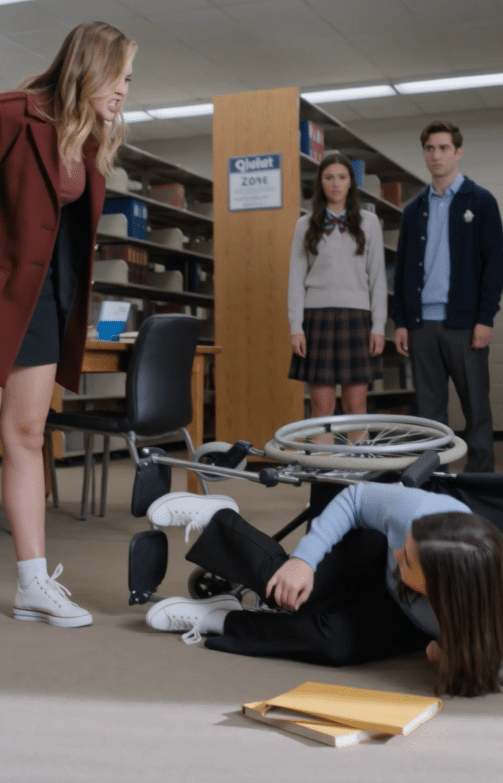
The wheelchair hit the library floor with a crack that silenced every table in the room.
Sixteen-year-old Lily Bennett landed hard beside her scattered books, one hand clutching the corner of an interview folder as if it were the only thing she had left. Her wheelchair skidded several feet away, its front wheels spinning uselessly beneath the fluorescent lights.
For one terrible second, nobody moved.
Then Lily gasped.
Pain tightened her face. A thin red mark appeared along her forearm where it had scraped the floor, and she tried to draw her knees closer as she struggled to breathe through the shock. Her pale blue sweater had twisted at the shoulder, and pages from her scholarship application lay scattered beneath the study tables.
Standing over her was seventeen-year-old Madison Pierce, wearing an expensive red jacket and the satisfied expression of someone who had finally gotten what she wanted.
Madison glanced at the wheelchair.
Then she looked at Lily.
“Trash. Scholarships won’t fix you.”
A girl near the reference shelves covered her mouth. Two boys at a computer station stared at each other, visibly unsure whether they should intervene. A student who had been reading beside the quiet-zone sign slowly lowered her book.
Nobody spoke.
Only seconds earlier, Lily had been trying to study.
Madison had entered the library talking loudly into her phone, laughing as she walked between the tables. Lily had looked up from her interview notes and waited until Madison passed her table.
“Please…” Lily had said quietly. “This is the quiet zone.”
Madison stopped.
She turned around so slowly that Lily immediately regretted speaking.
“What did you just say?”
Lily swallowed.
“I just have an interview soon. I need to concentrate.”
Madison stepped directly in front of the wheelchair, blocking Lily’s path. Her face had flushed with anger, not because Lily had insulted her, but because someone she considered beneath her had dared to correct her in public.
“You think you can tell me what to do?”
“No. I just—”
Madison kicked the front frame of the wheelchair.
The chair jolted violently, throwing Lily onto the floor. Her books and interview folder flew from her lap, and the wheels spun as the chair slid away.
Lily was still trying to understand what had happened when Madison stepped closer and kicked her again, then a second time, striking her back and side as she curled inward in pain.
A sharp gasp swept through the library.
Madison looked around at the stunned students, almost daring someone to challenge her.
Then she looked down at Lily.
“You don’t belong at that interview.”
Lily’s fingers trembled as she reached for the folder.
“Please don’t touch it.”
Madison laughed.
“Why? You think a few papers are going to make you special?”
Lily tried to pull the folder toward her chest. Her breathing was uneven, her eyes wet with pain, but she kept reaching for the pages that had slid beneath the nearest table.
Those papers represented nearly two years of work.
They contained her grades, recommendation letters, personal statement, and the final application materials for a scholarship that could change the course of her life. She had revised her essay so many times that she could recite parts of it from memory.
Madison knew exactly how much the interview mattered.
That was why she had come looking for Lily.
The library door suddenly swung open.
A middle-aged woman entered with the school principal and guidance counselor moving quickly behind her. The woman wore a navy suit beneath a dark coat, and her eyes immediately went to the student on the floor.
She crossed the room without hesitation.
“Give her some space,” she ordered.
The principal stepped between Madison and Lily while the counselor hurried to Lily’s side. The woman in the navy suit knelt, carefully gathered the interview folder, and checked that Lily was responsive before asking the counselor to get the school nurse and contact her family.
Only after Lily was being attended to did the woman rise.
She turned toward the principal.
“Move her interview to the boardroom.”
Madison’s expression changed.
The woman was Dr. Evelyn Hart, director of the prestigious Hartwell Future Foundation—the organization awarding the scholarship Madison had spent months trying to win.
Madison stared at her.
“Boardroom?”
For the first time since entering the library, she looked afraid.
But she still did not understand the most important thing.
Dr. Hart had not come to the school merely to interview Lily.
She had come because Lily’s application contained a story that had already caught the foundation’s attention—and because the documents scattered across the library floor were about to expose a problem much bigger than one student’s jealousy.
Act II
Lily Bennett had learned early that people often made assumptions before they learned her name.
Some spoke to her as though she were younger than she was. Others addressed whoever happened to be standing beside her instead of speaking directly to her. A few tried to turn ordinary conversations into inspirational speeches about how brave she must be simply for attending school.
Lily had become skilled at smiling politely and moving on.
She was born with a condition that affected her mobility and had used a wheelchair for years. Her parents had never treated it as a reason to lower their expectations, but they had also never pretended that every obstacle could be overcome by determination alone.
There were ramps that ended at locked doors, classrooms that were difficult to navigate, and school events where the organizers seemed to remember accessibility only after someone complained.
Lily hated being treated as a problem to solve.
She wanted to be known for her work.
Science was her strongest subject, especially environmental engineering. She loved the idea that small design changes could make daily life easier for thousands of people. Her science fair project had begun with a simple question: why did so many public buildings still force people to take longer, less convenient routes because their entrances were not designed for everyone?
That question became a research project, then a presentation, and eventually an essay for the Hartwell Future Foundation scholarship.
The foundation funded students who demonstrated academic ability, community commitment, and a clear plan for using their education to solve practical problems. The award covered tuition, books, and mentoring through a network of universities and engineering organizations.
For Lily, it was more than money.
It was a chance to attend a strong engineering program without forcing her parents to take on debt they could not afford. It was an opportunity to work with people who cared about accessibility as a serious design challenge rather than a charitable afterthought.
She had spent months preparing.
Her guidance counselor, Ms. Ramirez, had reviewed her application after school. Lily had practiced interview questions in front of her bedroom mirror, learning to explain her ideas without rushing when she became nervous.
She had also learned to handle disappointment.
The previous year, she had applied for a smaller academic award and been placed on a waiting list. She had been devastated for two days, then returned to her research project because she still believed the work mattered.
This time, she had advanced to the final interview.
Only a handful of students from the region had been selected.
Madison Pierce had expected to be one of them.
Madison came from a wealthy family whose name appeared on donor plaques across town. Her father, Richard Pierce, owned a successful commercial development company, and her mother chaired several local charity committees. Madison had grown up attending private events where adults praised her potential before she had done anything to prove it.
She was bright enough, polished enough, and accustomed to being taken seriously.
But she had also grown accustomed to getting what she wanted.
When the scholarship finalists were announced, Madison discovered that Lily had been selected while she had not made the final group.
The news felt impossible to her.
She had participated in school leadership activities, volunteered at fundraising events, and built a carefully curated application. She believed those accomplishments should have placed her ahead of someone whose circumstances, in Madison’s eyes, were a disadvantage.
Rather than question whether her application had been strong enough, she questioned whether the selection process was fair.
She told classmates that the foundation was looking for a feel-good story.
She suggested that Lily had been chosen because the judges wanted to appear compassionate.
And when those comments failed to change anything, Madison began watching Lily more closely.
She noticed when Lily stayed late in the library. She noticed the folder Lily carried everywhere. She even learned the date of the interview.
Madison told herself she only wanted to prove that the process was rigged.
But jealousy had already turned into something more personal. Lily’s achievement threatened Madison’s belief that success was something she deserved simply because she had always expected it.
The morning of the assault, Madison had seen Lily reviewing her notes in the quiet zone.
She could have walked away.
Instead, she decided to make Lily feel as small as Madison believed the scholarship committee had made her feel.
The attack lasted only seconds.
Its consequences would follow them both much longer.
When the school nurse arrived, Lily was helped into a safe position while the counselor called her parents and arranged for medical evaluation. Nobody attempted to lift her back into the wheelchair without first checking her condition.
Dr. Hart remained nearby.
She had been scheduled to meet Lily in a conference room later that morning, but she had arrived early to discuss the school’s scholarship partnership with the principal. She had expected a routine visit.
Instead, she had found a student on the floor and an entire library frozen in silence.
The principal looked deeply shaken.
“Dr. Hart, I’m so sorry. We’ll handle this immediately.”
“You will,” Dr. Hart replied. “But first, we take care of Lily.”
Madison tried to interrupt.
“She started it. She told me to be quiet like she owns the place.”
The principal turned toward her.
“Madison, stop talking.”
“But—”
“Now.”
For once, Madison was not being rescued from the consequences of her own behavior.
Dr. Hart handed Lily’s folder to Ms. Ramirez, who checked that the documents were still together. The director then asked the principal to preserve any available school camera footage and obtain written accounts from students and staff who had witnessed the incident.
She made no declaration about guilt or punishment. Those decisions would require a proper investigation.
But she was determined that no one would be allowed to dismiss the assault as ordinary school drama.
Then Lily looked up at her.
“Am I still allowed to have the interview?”
The question struck Dr. Hart harder than the violence had.
Lily had just been attacked in front of her classmates, and she was still worried that she might lose the opportunity she had worked so hard to earn.
Dr. Hart pulled a chair close.
“Lily, nobody gets to take away your right to be considered fairly.”
Then she looked toward the principal.
“Move the interview to the boardroom.”
And when Madison heard those words, she realized that the interview she had tried to destroy might become the one event she would never be able to forget.
Act III
By lunchtime, rumors had spread through the school.
Some students said Madison had deliberately knocked Lily out of her wheelchair. Others claimed that the scholarship director had witnessed the entire attack and was going to have Madison expelled on the spot.
Neither version captured what was actually happening.
The principal had placed Madison under the school’s immediate disciplinary procedures while staff gathered accounts and reviewed the available evidence. Her parents had been contacted, and she was instructed to remain away from Lily while the school assessed the incident.
Lily, meanwhile, was being evaluated for her injuries.
Her parents arrived at the school visibly frightened. Her mother, Susan Bennett, held Lily’s hand while her father, Daniel, spoke with the nurse and asked what additional care might be necessary.
Lily tried to reassure them.
“I’m okay.”
Her mother looked at the scattered papers on the counselor’s desk.
“You don’t have to say that for our sake.”
Lily’s composure broke.
“I thought I was going to lose the interview.”
Susan pulled her into a careful embrace.
“You matter more than an interview.”
“I know,” Lily whispered. “But I worked so hard.”
Daniel turned away for a moment, struggling to hide his anger. He had spent years watching his daughter prepare for a world that was not always designed with her in mind. He knew how much effort she put into reaching opportunities that other students sometimes took for granted.
He wanted the people responsible to understand what they had done.
But Lily did not want revenge.
She wanted to finish what she had started.
Later that afternoon, after the medical team had assessed her and her family had received guidance about follow-up care, Lily agreed to return to school for a meeting with Dr. Hart. The interview would not proceed until Lily felt ready, and the foundation made clear that her health came first.
The boardroom had been prepared for her arrival.
A staff member ensured that the route was accessible, the table allowed room for her wheelchair, and the interview materials were arranged where she could reach them. Ms. Ramirez sat nearby for support, while Dr. Hart and two foundation representatives took their places across the table.
Lily entered carrying her folder.
Her hands were still slightly unsteady.
“Thank you for waiting,” she said.
Dr. Hart shook her head.
“You have nothing to apologize for.”
The interview began with ordinary questions about Lily’s coursework, research, and plans for college. Gradually, her nervousness eased. She explained her environmental engineering project and described how she wanted to study the design of public spaces, transportation systems, and buildings.
One foundation representative asked what had inspired her interest in accessibility.
Lily considered the question.
“People often talk about accessibility as if it’s an extra feature,” she said. “Something you add if there’s money left over. But if someone can’t enter a building independently, then the building hasn’t really done its job.”
The room became quiet.
She continued, explaining that good design should allow people to participate without having to ask for special permission every time they encountered a barrier.
Dr. Hart listened closely.
She had read Lily’s essay before the visit. What impressed her now was not simply the quality of Lily’s ideas, but the way she connected technical questions to ordinary human experiences. She did not describe people with disabilities as a problem waiting for a solution. She described the built environment as something that could either respect people or exclude them.
When the interview ended, Dr. Hart thanked Lily and told her the foundation would complete its evaluation according to the established process.
There was no promise of an award in the room.
There was no attempt to turn the assault into a reason to favor one applicant over another.
Lily had earned the interview before anyone kicked her wheelchair.
She deserved to be evaluated on the merits of her work.
But the incident had exposed another issue that could not be ignored.
During the school’s review, Ms. Ramirez explained that Madison had repeatedly made demeaning remarks about Lily’s scholarship application. Several students had heard her suggest that Lily was receiving opportunities out of sympathy rather than ability.
No formal complaint had been filed about those remarks before the assault. Some students had dismissed them as jealousy. Others had been reluctant to challenge Madison because of her family’s influence and her reputation for retaliating against anyone who embarrassed her.
The school had no basis to treat every rumor as established fact.
But the consistency of the witness accounts gave the administration a reason to examine the broader pattern, rather than considering the attack in isolation.
The principal also learned that several students had witnessed the violence and frozen instead of helping. Their failure to intervene did not make them responsible for Madison’s actions, and the school would not punish students simply for being frightened.
However, staff planned to address how students could safely seek help, alert an adult, or call for assistance when someone was in danger.
A school was supposed to be a place where students could learn without fearing humiliation or physical harm.
That responsibility did not disappear when the person causing harm came from a powerful family.
Then, just as the school began preparing its formal response, Madison’s father arrived.
He was accustomed to having difficult conversations in polished offices, where a firm handshake and a few carefully chosen words could make problems disappear.
He asked to speak privately with the principal.
And the first thing he said was not that he was worried about Lily.
It was that his daughter had been treated unfairly.
Act IV
Richard Pierce entered the principal’s office carrying a leather briefcase and wearing the expression of a man who expected to be inconvenienced, not challenged.
Madison sat beside him, arms folded across her red jacket. She had stopped looking openly defiant, but she still seemed convinced that the situation would eventually be corrected in her favor.
Richard began by describing his daughter’s academic record, her volunteer work, and the pressure she had been under after losing the scholarship opportunity.
He spoke as if those details explained what had happened.
“My daughter made a mistake,” he said. “But I don’t think it helps anyone to turn this into a public spectacle.”
The principal remained composed.
“This is a serious allegation of physical assault against another student. We have a duty to investigate it.”
“Allegation?” Richard asked. “You have students repeating stories, and now the foundation director is involved. I want to know whether my daughter is being singled out.”
Dr. Hart had joined the meeting at the principal’s request. She sat across from Richard with her hands folded on the table.
“Madison is being held accountable under the same process that would apply to any student accused of this conduct,” she said. “The foundation will not determine the school’s disciplinary outcome.”
Richard looked at her.
“Then why move the interview to the boardroom? It makes it look as though Lily is being rewarded for what happened.”
Dr. Hart’s expression did not change.
“The interview was moved because Lily had been injured and needed an accessible, private setting where she could decide whether she was ready to continue. The location was not a prize.”
“Still, the timing is unfortunate.”
“For Lily,” Dr. Hart replied, “the timing was painful. She was attacked while preparing for an opportunity she had earned.”
Madison shifted in her chair.
“Dad, I told you she was acting like she was better than everyone.”
Dr. Hart turned toward her.
“Asking for quiet in a library does not justify violence.”
“She embarrassed me.”
“And you chose to hurt her.”
The words landed with a force no one in the room could ignore.
Richard opened his briefcase and removed a sheet of paper.
He suggested that the school resolve the matter privately, keep the incident out of the wider school community, and avoid damaging Madison’s future over one impulsive decision. He did not threaten anyone outright, but he repeatedly referenced his family’s standing and their support for local educational programs.
The principal listened, then placed the paper back on the desk without signing it.
“We will follow the school’s disciplinary policy. We will protect student privacy where required, but we will not conceal a serious incident to protect someone’s reputation.”
For the first time, Richard looked genuinely uncertain.
He had expected a negotiation.
Instead, he was hearing a boundary.
The school continued collecting statements and reviewing available footage. Madison was given an opportunity to respond to the evidence, and the administration consulted the appropriate staff before deciding on disciplinary measures.
The foundation conducted its own review of Lily’s scholarship application, separate from the school’s process. Dr. Hart made it clear that Lily’s candidacy would be evaluated on the same criteria as every other finalist. The assault would not earn Lily points, and Madison’s behavior would not be used as a substitute for evaluating Lily’s academic merit.
The distinction was important.
Lily had not applied to be anyone’s symbol of courage. She had applied because she wanted to study engineering.
And she had no desire to win by watching another student lose.
Several days later, the foundation completed its evaluation. Lily received an invitation to a final discussion about her proposed research, along with confirmation that she remained under consideration for the award.
When Ms. Ramirez told her, Lily read the email twice.
“Does this mean I got it?”
“Not yet,” her counselor replied. “It means they want to hear more about your work.”
Lily let out a breath.
“Okay. Then I’ll prepare.”
It was such an ordinary answer that Ms. Ramirez nearly cried.
Lily was still focused on the future, even after someone had tried to make her feel she had no right to one.
The school’s disciplinary review reached its conclusion soon afterward. Based on the evidence it was able to establish, the administration imposed consequences under its student conduct policy and arranged additional measures to protect Lily from further harassment. The school did not disclose private disciplinary details to the wider student body, and the foundation did not interfere with the decision.
Madison was no longer allowed to treat the matter as a misunderstanding that could be erased by an apology demanded by her father.
She had to confront the fact that the school had documented what happened, that witnesses had spoken, and that her own choices had consequences.
But the most difficult moment came when Richard asked her a question on the drive home.
“Why did you do it?”
Madison stared out the passenger window.
“She got something I deserved.”
“Then why attack her?”
“Because she acted like she belonged there.”
Richard gripped the steering wheel.
“And you thought hurting her would prove you belonged?”
Madison had no answer.
For the first time, the explanation she had repeated to herself sounded as ugly as the act itself.
She had not been trying to defend fairness.
She had been trying to punish Lily for succeeding where she had failed.
And no amount of family influence could make that truth disappear.
Act V
The scholarship decision arrived on a rainy Thursday morning.
Lily was at home, reviewing her notes at the kitchen table, when an email appeared from the Hartwell Future Foundation. Her mother was making tea nearby, and her father was trying to repair a loose hinge on one of the kitchen cabinets.
Lily opened the message.
Then she stopped breathing for a moment.
Her mother noticed the change in her face.
“What is it?”
Lily looked up, eyes wide.
“I got it.”
Susan set the mug down.
“What?”
“The scholarship. I got the scholarship.”
For a second, nobody moved.
Then Susan crossed the kitchen and wrapped her arms around her daughter. Daniel abandoned the cabinet hinge and joined them, laughing as Lily held the email against her chest.
The award would cover major college expenses and provide mentoring as Lily pursued environmental engineering. It would not remove every obstacle from her life, but it would give her family something they had rarely been able to afford.
Room to plan.
Room to hope.
Room for Lily to choose a future based on what she wanted to build rather than what her family could afford.
She read the letter again that evening, paying attention to the words describing her research, her academic work, and the promise of her proposed project.
The foundation had not chosen her because she had been attacked.
It had chosen her because she had earned the opportunity.
That mattered more to Lily than any public declaration could have.
At school, the news spread gradually. Students who had watched the assault in the library learned that Lily had received the award after completing the same evaluation process as the other finalists. Some congratulated her awkwardly. Others apologized for standing frozen when Madison attacked her.
Lily accepted their words without pretending the incident had not hurt.
“I was scared, too,” she told one student who apologized. “I don’t expect everyone to know what to do. But next time, please get someone who can help.”
The student nodded, eyes lowered.
It was not a grand speech. Lily had no interest in becoming a lecturer on courage.
She simply wanted the next person who was hurt to have a better chance of receiving help.
The school followed through on its review of student safety procedures. Staff clarified how students could report harassment, how serious incidents would be documented, and how witnesses could summon help without putting themselves in unnecessary danger.
The library remained a library.
Students still studied beneath the tall shelves, whispered over homework, and searched for books before exams. The quiet-zone sign stayed above the tables where Lily had once tried to prepare for her interview.
But the people who had been there that day remembered the silence after the wheelchair struck the floor.
They remembered how quickly an ordinary afternoon had become something none of them could forget.
Madison’s future did not end because of one incident, but it changed. She faced school consequences and the difficult work of rebuilding trust. Her family’s influence could offer advice and support, but it could not require other students to forget what they had witnessed.
For a time, Madison blamed everyone else.
She blamed Lily for speaking up. She blamed the principal for refusing to make the matter disappear. She blamed Dr. Hart for moving the interview and allowing the scholarship process to continue.
But those explanations became harder to maintain as the weeks passed.
Lily had not stolen her opportunity.
Lily had not humiliated her in front of the library.
Lily had not forced her to kick a wheelchair.
Those had been Madison’s choices.
Eventually, Madison wrote a letter to Lily. It was not a demand for forgiveness, and it did not ask Lily to help repair her reputation. With guidance from her family and school staff, she acknowledged that she had used jealousy as an excuse to hurt someone she believed she could overpower.
Lily read the letter once.
She did not answer immediately.
Forgiveness was not a deadline, and an apology did not entitle Madison to a clean slate. Lily had a right to decide what kind of contact, if any, she wanted.
She put the letter away and returned to her research.
Months later, Lily attended a foundation event where scholarship recipients presented the projects they hoped to pursue. She spoke about accessible public design, explaining how entrances, transit stops, and shared spaces could be planned so that fewer people would be forced to ask for exceptions.
Dr. Hart sat in the audience.
When Lily finished, the applause was warm and sustained. Her parents watched from the back of the room, holding hands. Ms. Ramirez smiled through tears.
Afterward, Dr. Hart approached Lily with a folder containing information about her mentoring placement.
“You have a strong idea here,” she said. “The next step is learning how to turn it into something people can use.”
Lily smiled.
“That’s what I want to do.”
Dr. Hart glanced toward the other students gathering around the presentation tables.
“You know, the day I found you in the library, I was worried the interview might be the last thing on your mind.”
“It was,” Lily admitted. “At first.”
“What changed?”
Lily thought about the question.
“I realized that if I stopped because someone wanted me to feel like I didn’t belong, then they would have decided my future for me.”
Dr. Hart nodded.
“That is a lesson worth remembering.”
Lily looked down at the folder in her hands.
She would remember the library, too. She would remember the pain, the scattered pages, and the moment when every witness seemed frozen in place. She would remember the fear that the opportunity she had worked toward might disappear because someone else could not tolerate seeing her succeed.
But she would also remember the people who eventually stepped forward, the counselor who stayed beside her, the principal who refused to bury the incident, and the director who protected her right to be evaluated fairly.
The boardroom had not made Lily important.
The scholarship had not made her worthy.
She had possessed dignity before she entered the library, before the assault, and before anyone knew whether she would win the award.
Madison had mistaken access for entitlement and cruelty for strength. She believed that if she could make Lily look powerless, she could prove that Lily never belonged among the finalists.
Instead, the incident revealed the weakness behind Madison’s confidence.
Lily did not need to defeat her.
She needed to keep going.
And that was exactly what she did.
The final image Lily carried from that day was not Madison’s red jacket or the wheelchair lying on its side. It was the sight of Dr. Hart kneeling beside her, gathering the interview folder from the floor before turning to face the people responsible for protecting the students in that room.
The first thing the director had saved was not a scholarship decision, a reputation, or a public statement.
It was Lily’s work.
Because the papers scattered across the library floor represented something Madison had failed to understand: an opportunity earned through effort could survive humiliation, and a person’s future could be bigger than the worst thing someone tried to do to them.
Madison had looked down at Lily and said, “You don’t belong at that interview.”
But Lily had gone to the interview anyway.
And in the end, she walked away with something far more lasting than an award.
She walked away knowing that no one else’s jealousy had the power to decide where she belonged.